


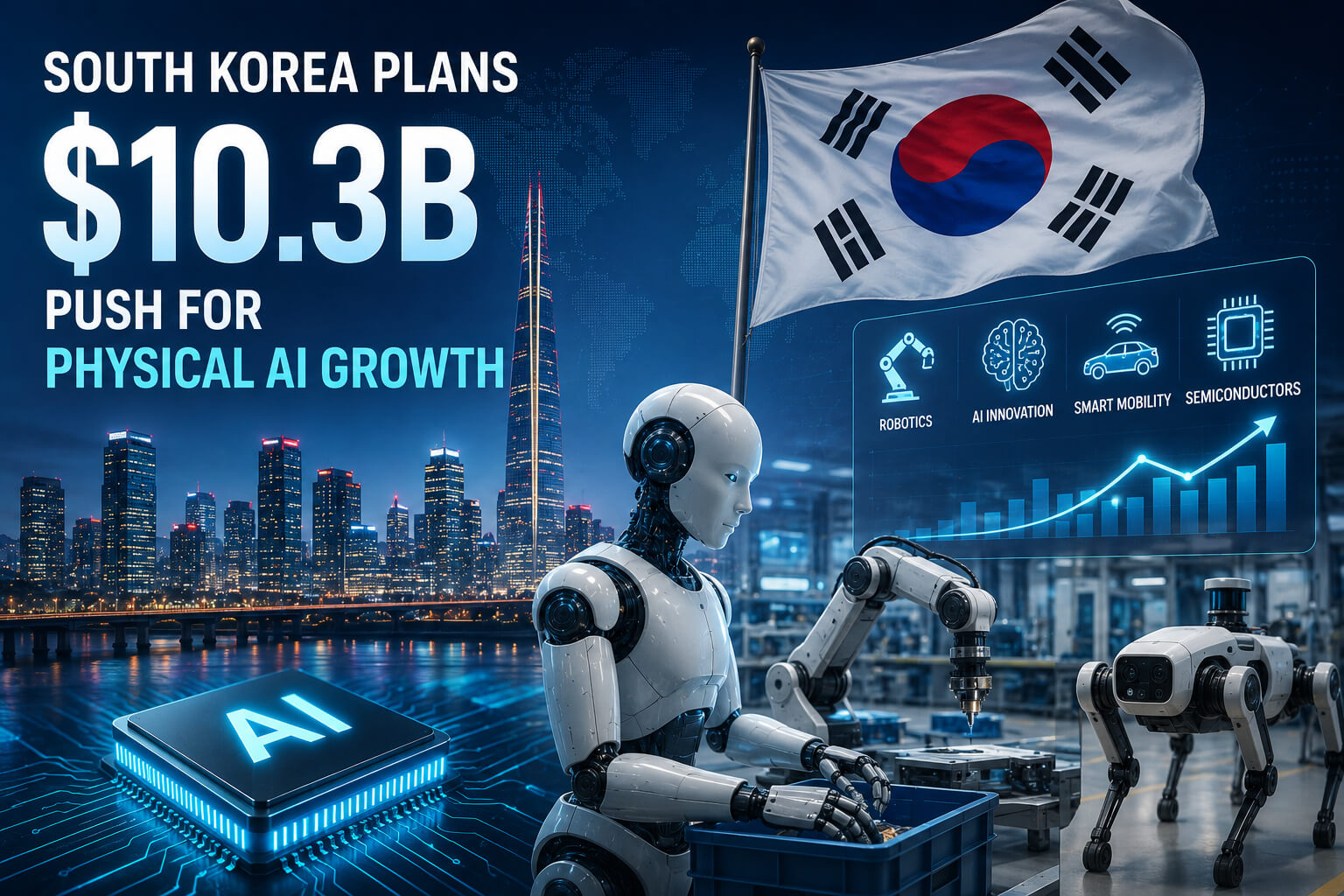
South Korea is putting serious money behind physical AI, and this is not the usual soft policy announcement that disappears after a press briefing. The country is planning around $10.3 billion in financing for physical AI sectors, with the expansion of LS Cable’s subsea cable project selected as the first project under the effort. The plan is tied to South Korea’s National Growth Fund, which is being used to back strategic industries seen as important for the country’s next phase of economic growth.
This matters because physical AI is not only about chatbots, apps, or software platforms. It is AI that touches the real world. Robots. Manufacturing systems. Industrial infrastructure. Energy networks. Logistics. Machines that do not just answer questions, but move, inspect, build, coordinate, and respond inside physical environments.
Why Physical AI Is Getting Government Attention
The timing is not random. Countries are starting to realize that the next AI race may not be won only by whoever builds the biggest language model. The harder question is who can bring AI into factories, ports, power systems, mobility networks, construction sites, and industrial supply chains.
That is where physical AI becomes important.
Generative AI changed how people create text, images, software, and digital content. Physical AI goes after a different problem. It asks whether machines can understand the real world well enough to act inside it. That shift is much harder. The environment is messy. Data is harder to collect. Safety matters more. Hardware costs money. Mistakes can break equipment, delay production, or create real operational risk.
For South Korea, this is not an abstract technology trend. The country already has deep strengths in semiconductors, manufacturing, shipbuilding, robotics, electronics, batteries, telecoms, and industrial engineering. Physical AI sits directly on top of those strengths.
LS Cable Becomes the First Project
The selection of LS Cable’s subsea cable expansion as the first project gives the program a very industrial starting point. It also says something about where South Korea sees AI-linked infrastructure going.
Subsea cables are not flashy in the same way as AI models or humanoid robots, but they are part of the physical backbone of the digital economy. Data movement, energy systems, offshore infrastructure, and cross-border connectivity all depend on hard infrastructure that has to be built, maintained, and scaled.
By placing this type of project at the front of the National Growth Fund’s physical AI push, South Korea appears to be connecting AI growth with infrastructure capacity. Not just software. Not just cloud. The pipes, cables, factories, networks, and systems underneath it all.
That is a more grounded version of AI strategy. Maybe less glamorous. Probably more useful.
Physical AI Could Become a New Growth Engine
South Korea’s $10.3 billion financing plan shows how AI policy is moving into a different phase. The first phase was about national AI ambition. The next phase is about whether governments can turn that ambition into industrial capability.
Physical AI could support automation in manufacturing, smarter inspection systems, AI-driven robotics, predictive maintenance, industrial safety, logistics optimization, and energy infrastructure management. These are not small use cases. They sit inside sectors that affect exports, productivity, and national competitiveness.
This is why the funding matters. Physical AI needs more than model development. It needs factories, sensors, data pipelines, robotics platforms, edge computing, cloud infrastructure, and companies willing to test AI in real operations. That usually requires patient capital and government-backed confidence.
The Bigger Message for AI Economies
South Korea’s move sends a clear signal to other AI-focused economies. The AI race is no longer only about who has the most advanced model. It is also about who can apply intelligence across the physical systems that keep economies running.
That is a harder race. It involves infrastructure, regulation, industrial partners, hardware supply chains, and long investment timelines. It also favors countries that already understand advanced manufacturing and engineering.
South Korea fits that profile well.
The country’s physical AI push may help position it as a stronger player in the next wave of industrial automation and intelligent infrastructure. And with the National Growth Fund now backing projects in this space, physical AI is starting to look less like a future concept and more like a national economic strategy.
AI Is Leaving the Screen
The most interesting part of this development is not only the size of the financing. It is the direction.
AI is slowly leaving the screen.
It is moving into cables, factories, energy systems, robots, ships, logistics networks, and industrial facilities. South Korea’s latest push shows that governments are beginning to treat physical AI as a strategic layer for national growth, not just another technology category.
That shift could define the next chapter of AI competition.
