


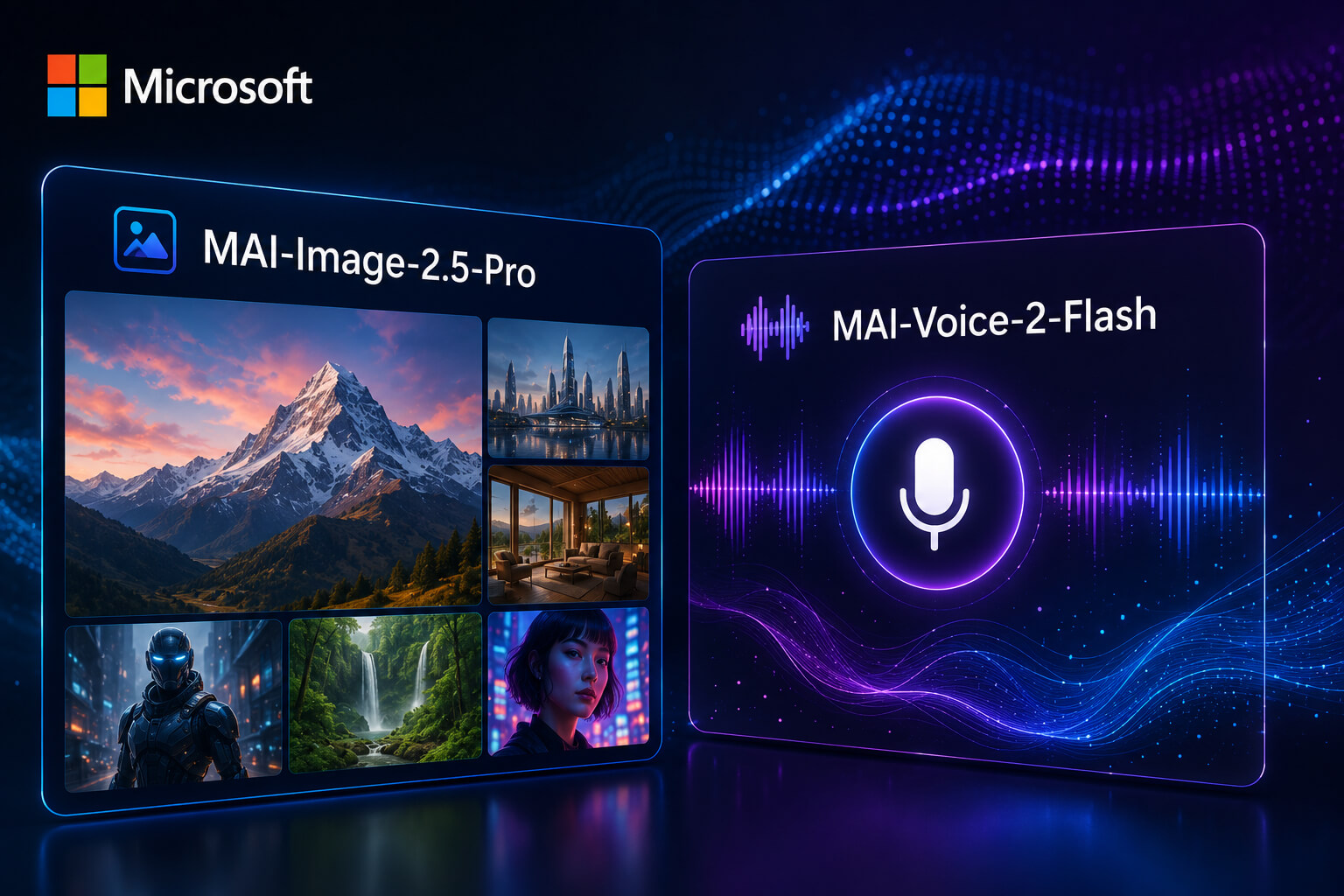
Microsoft is no longer treating its homegrown AI models like side projects. The company has launched MAI-Image-2.5-Pro and MAI-Voice-2-Flash, two specialized models aimed at very different workloads. One focuses on high-fidelity image creation and editing. The other is built to generate natural speech quickly enough for busy call centers and real-time voice agents.
Both models are now available in public preview through Microsoft Foundry. This is not simply another pair of models added to an already crowded catalog. Microsoft is steadily replacing outside technology with its own systems across Bing, PowerPoint, OneDrive, Dynamics 365 and Azure. That shift is becoming easier to see.
MAI-Image-2.5-Pro Targets High-Fidelity Creative Work
MAI-Image-2.5-Pro is Microsoft’s highest-fidelity image model so far. The model can generate images from text prompts, edit existing pictures and place readable text inside a design. Microsoft is pitching it toward jobs where visual accuracy matters more than raw generation speed, including hero images, advertisements, product concepts and detailed creative edits.
Text inside AI-generated images has always been awkward. Letters become distorted. Words disappear. A simple poster can turn into nonsense. Microsoft says the Pro model handles this much better. It can follow natural-language editing instructions while preserving important parts of the original image, which should make repeated creative changes less frustrating.
A designer could ask the model to replace a background, update the wording on a package or change the lighting without rebuilding the entire image from scratch. That sounds like a small improvement until the tenth revision arrives.
Microsoft Gives Developers Another Point on the Cost Curve
MAI-Image-2.5-Pro is priced at $5 per one million text input tokens, $8 per one million image input tokens and $106 per one million image output tokens.
Those numbers will matter mostly to developers and companies running the model at scale. The broader point is that Microsoft is building different MAI variants for different jobs rather than forcing one large model to handle everything.
Maximum image quality will cost more. Faster or lighter versions can handle workflows where speed and volume matter more. It is a fairly practical strategy. Creative studios, presentation tools and cloud storage services do not need the same model configuration, even when all three involve images.
Bing Image Creator Is Now Powered by Microsoft’s Own Model
Microsoft’s in-house image technology is already moving into products used by millions of people.
Bing Image Creator now uses MAI-Image-2.5 as its default end-to-end model. Microsoft describes the service as 100% in-house by default, meaning it no longer has to rely on an external image model for the main generation and editing experience. PowerPoint also uses MAI-Image-2.5 for image-to-image features. According to Microsoft, the move cut GPU costs by as much as 84% compared with GPT-Image-2.
OneDrive has adopted the model for several image-editing workflows as well. Microsoft reports that the rollout increased image save rates by 26%, reduced P95 latency by roughly 25% and delivered 2.5 times greater efficiency during medium-utilization production workloads. The save-rate figure is particularly interesting. People are not merely generating images. More of them appear to be keeping the results.
MAI-Voice-2-Flash Is Built for Conversations at Scale
The second release takes a different approach.
MAI-Voice-2-Flash is a lightweight speech-generation model designed for applications that cannot afford long pauses. Contact centers, automated assistants and speech-to-speech agents need responses to arrive quickly. A voice that sounds natural but takes several seconds to answer is not especially useful. Microsoft says the Flash model runs twice as fast as MAI-Voice-2 while keeping the same natural prosody and acoustic quality. It also costs 32% less, with pricing set at $15 per one million characters.
That combination makes the model less about dramatic voice demonstrations and more about actual deployment. A company processing millions of customer conversations will notice the difference between an impressive demo and a model that responds quickly without burning through infrastructure spending.
Dynamics 365 Contact Center Gets Microsoft’s Faster Voice Model
MAI-Voice-2-Flash now powers Dynamics 365 Contact Center, Microsoft’s enterprise platform for companies building AI-assisted call center services. Microsoft says the deployment can reduce GPU costs by as much as 89%. The model is intended to deliver expressive, natural speech during customer interactions while keeping latency low enough for live conversations.
It has also been integrated into Azure Voice Live. Developers can use the service to build voice agents capable of speech-to-speech interaction without assembling separate systems for listening, processing and speaking. This could support customer service bots, booking assistants, workplace tools and other applications where users expect immediate spoken replies.
Nobody wants to talk to an AI agent that leaves an uncomfortable pause after every sentence. Speed changes the entire experience.
Microsoft Wants Its Products Powered by Microsoft Models
The launch says as much about Microsoft’s broader AI strategy as it does about image and voice generation. A year ago, the company began talking openly about building more purpose-designed models in-house. Those models would use clean, traceable and enterprise-grade training data while serving specific Microsoft products.
Now they are moving into production. Bing uses Microsoft’s image model. PowerPoint and OneDrive use it for editing. Dynamics 365 and Azure use Microsoft’s voice technology. Other MAI systems cover coding, transcription and reasoning.
Microsoft still works closely with OpenAI and offers models from several developers through Azure. The company, however, clearly wants more control over the technology sitting inside its own products. Control means more than ownership. It can mean lower computing costs, faster product changes and models tuned around one specific workload instead of a broad collection of unrelated tasks.
Specialized AI Models Are Becoming More Important
The industry spent years chasing models that could do almost everything. That race is not over. Still, production environments create different pressures. Businesses care about latency, predictable pricing and whether a model can perform one job reliably thousands or millions of times. MAI-Image-2.5-Pro and MAI-Voice-2-Flash reflect that reality.
The image model pushes toward quality, editing precision and readable design elements. The voice model strips away unnecessary weight to prioritize speed, scale and lower operating costs. Neither model needs to be the answer to every AI problem. They only need to work well where Microsoft puts them.
What the New MAI Models Mean for Microsoft
Microsoft is gradually assembling an AI stack that looks less dependent on any single external partner. The company now has dedicated models for images, voice, transcription, coding and reasoning. Each release gives Microsoft another piece it can optimize around Azure infrastructure and its own software ecosystem.
For users, the changes may first appear as faster image edits in OneDrive, better graphics in PowerPoint or smoother conversations with an automated support agent. Behind those small product improvements sits a larger strategy. Microsoft wants the models, the cloud infrastructure and the software experience to belong to the same system. MAI-Image-2.5-Pro and MAI-Voice-2-Flash move it another step in that direction.
