


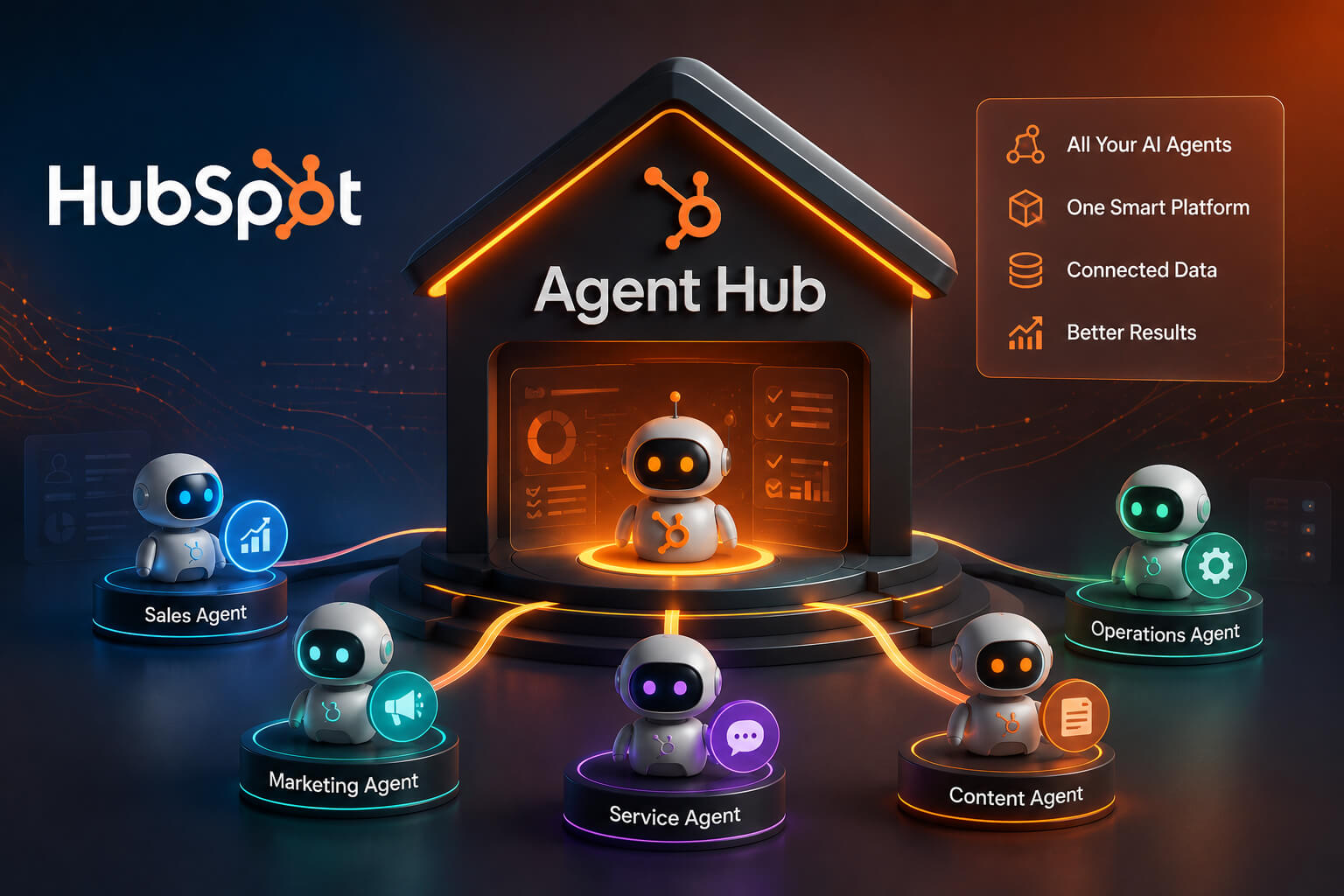
HubSpot is trying to clean up a problem that many businesses are only beginning to notice: once a company starts using several AI agents, those agents can quickly become just as fragmented as the software tools they were supposed to replace.
The company has launched Agent Hub and Agent Builder in public beta for Professional and Enterprise customers. Together, the new tools give marketing, sales and customer service teams one central place to build, monitor and coordinate AI agents across HubSpot’s platform.
It sounds like another AI dashboard at first. The more interesting part is the shared context underneath it.
HubSpot Wants Its AI Agents to Stop Working in Silos
An AI prospecting agent might contact a customer while a service agent is already handling a complaint from the same account. Technically, both agents could be working correctly. From the customer’s perspective, the company looks completely disconnected.
That is the scenario HubSpot says Agent Hub is designed to prevent. Instead of treating every agent as a separate automation, the platform lets them work from the same customer information, including contact records, deal histories, buying signals and previous interactions.
This matters more as businesses move beyond a single chatbot.
One agent may search for leads. Another could answer support questions. Others might update CRM records, prepare sales information or trigger follow-up tasks. Without shared context, adding more agents does not necessarily make a business smarter. It can simply create a faster version of the same old operational mess.
Agent Hub Creates One Control Center for AI Work
Agent Hub acts as the central management layer. Teams can use it to view the live status and performance of active AI agents, find agents that have not yet been activated and organize their work around specific business goals. Those goals could include generating demand, closing deals, improving customer support or supporting broader growth efforts.
HubSpot is also putting Agent Builder and its Agent Marketplace inside the same environment. Users should not need to jump between several products just to understand which agents are running or what they are actually doing. That visibility could become important surprisingly fast.
Companies have spent years struggling to track traditional automation workflows. AI agents add another layer because they can interpret information, choose actions and move through tasks with less direct supervision. A business needs more than a list of activated tools. It needs a way to see what those tools are doing and whether their actions still make sense.
Agent Builder Lets Teams Create Agents With Plain Language
Agent Builder is the creation side of the release. HubSpot says teams can describe a task in natural language through Breeze Assistant. Agent Builder then works out which workflows, triggers and actions should run.
Users can combine custom agents, existing workflows and triggers on a single visual canvas. An agent can start working at a scheduled time, after a contact record changes, through a webhook or following an event in a third-party integration.
The natural language feature lowers the technical barrier, although it does not remove the need for careful planning.
Someone still needs to define what the agent should accomplish, which data it can access and when a human should step in. Building the automation may become easier. Deciding what the automation should be trusted to do remains the harder question.
HubSpot Is Using CRM Data as the Main Advantage
HubSpot’s larger bet is not simply that companies want more AI agents. Plenty of vendors can offer those.
Its stronger argument is that custom agents built inside HubSpot already have access to the customer data stored across its CRM and go-to-market tools. That can include call transcripts, contact details, deal activity and purchasing signals without requiring teams to complete separate field mapping or data setup for every agent. The value of that connection is fairly practical.
An agent preparing a sales follow-up should know whether the customer has an unresolved support issue. A service agent should be able to see recent account activity. A marketing agent should not continue sending promotional messages that clash with what is happening elsewhere in the relationship. Shared data will not guarantee a good customer experience, but disconnected data can ruin one very quickly.
Ignite Reading Shows What a Custom Agent Can Handle
HubSpot highlighted Ignite Reading as an early example. The virtual literacy tutoring organization operates across more than 25 US states. It built a custom agent that finds and processes academic calendars for individual school districts using information already stored in its deal records.
According to HubSpot, employees previously spent around 15 to 20 minutes processing each district calendar. The custom agent reduced that work to seconds and is expected to save more than 350 hours per year.
It is not a flashy use case. That is partly why it works. Academic calendar processing is repetitive, structured enough to automate and directly tied to information the organization already maintains. Many of the most useful business agents may look like this: narrow systems removing small but persistent pieces of manual work.
Agent Management Is Becoming the Next AI Software Problem
The first phase of workplace AI focused heavily on access. Companies wanted chatbots, copilots and tools that could generate text or answer questions. The next phase looks less glamorous.
Businesses now need to manage these systems, give them reliable data and stop multiple agents from taking conflicting actions. Governance, performance tracking and coordination start to matter once experimentation turns into normal daily operations.
CMSWire noted that disconnected agent systems can reinforce the same organizational silos businesses already face across marketing, sales and service. Adding AI does not automatically solve those divisions. Poorly coordinated agents could make them harder to detect because more activity happens automatically. Agent Hub is HubSpot’s attempt to place itself at the center of that management layer.
HubSpot Is Pushing Deeper Into Agentic CRM
The release also fits HubSpot’s broader effort to position its customer platform around agentic AI rather than isolated AI features. Instead of selling one chatbot or one assistant, the company wants agents to operate across the entire customer lifecycle. Marketing, sales and support are not being treated as separate AI markets here. They are being pulled into one system built around the same CRM data.
Whether customers embrace that approach will depend on how much control Agent Hub actually provides once businesses begin running larger numbers of custom agents. A clean dashboard is useful. Reliable coordination is harder. HubSpot Agent Hub and Agent Builder are currently available in public beta to Professional and Enterprise customers.
