


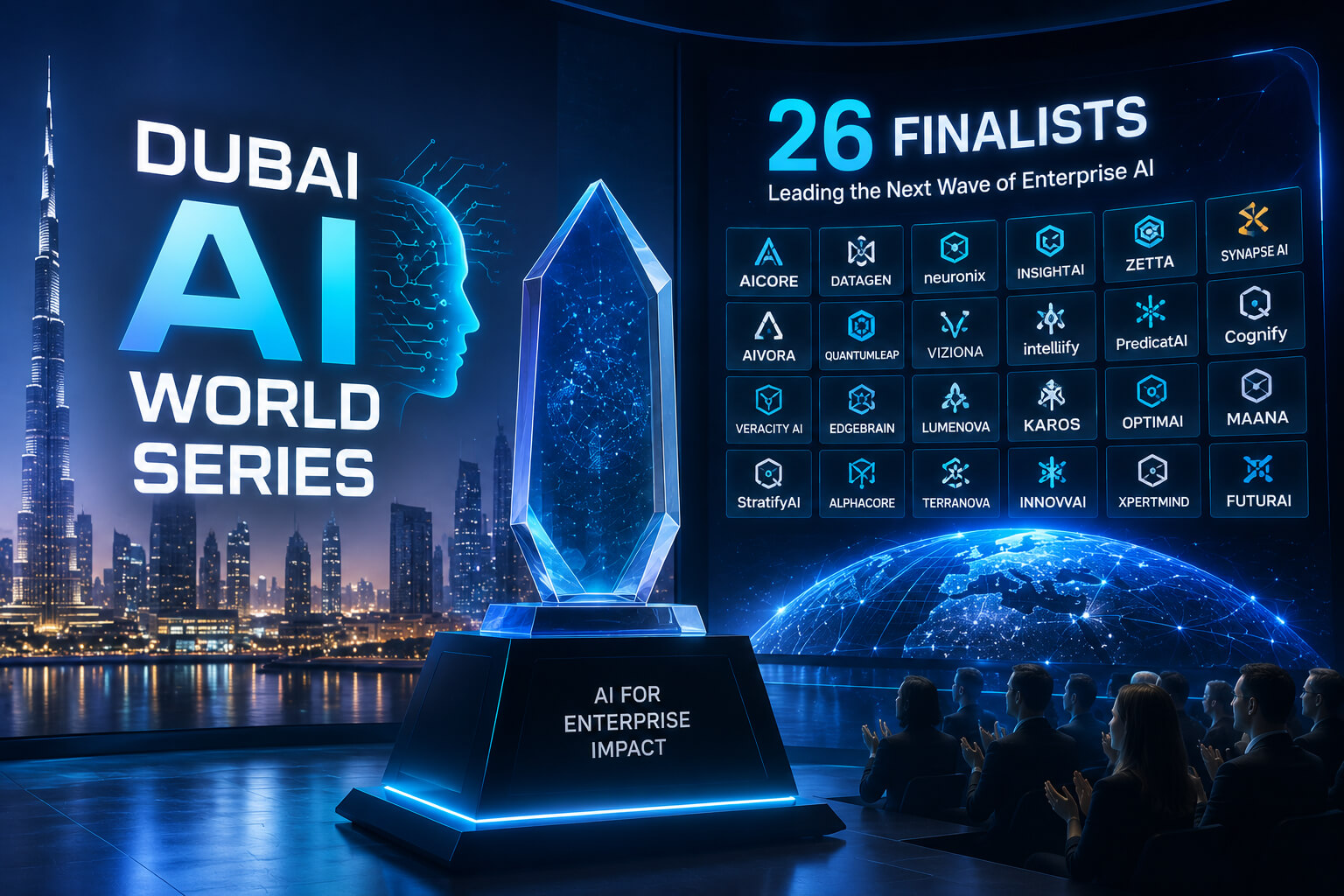
Dubai’s AI awards scene just got a little more serious. The announcement of the Dubai AI World Series finalists has captured the attention of the tech industry.
The AI World Series Awards has announced 26 finalists for its 2026 edition, with more than 60 entries shortlisted across 14 categories. The third annual awards ceremony will take place in Dubai on October 8, 2026, hosted by Dubai Silicon Oasis. That is not just another awards-night detail.
The finalist list points to something bigger happening in AI right now. Companies are no longer only talking about experiments, demos, or “future potential.” A lot of the shortlisted work appears to sit much closer to the real business layer: operations, customer service, data, risk, marketing, education, real estate, and automation. In other words, the AI conversation is getting less theoretical. Finally.
AI World Series Finalists Show Where Business AI Is Actually Being Used
The Dubai-based Artificial Intelligence for Business Institute announced the shortlist, naming 26 finalists across more than 60 awards entries. The categories range from AI Solution of the Year to Best Use of Data & AI in Real Estate.
Some of the names on the list are hard to ignore. Finalists include ADNOC Distribution, Dubai’s Roads and Transport Authority, Dubai Economy and Tourism, Saudi food and agriculture group Savola, Czech bank Česká Spořitelna, and German life sciences company QIAGEN.
That mix matters. It shows AI adoption spreading across sectors that do not always move at the same speed. Government transport. Energy retail. Tourism. Banking. Food production. Pharmaceuticals. Real estate. These are not tiny side projects in one corner of the software industry. They are signs that AI is being pushed into older, heavier, more operational parts of the economy through increasingly practical industry applications.
Dubai Is Turning AI Recognition Into a Serious Business Signal
Awards can sometimes feel decorative. A logo on a website. A LinkedIn post. A dinner photo. This one carries more weight because the timing is awkward in the best way. Global AI spending is rising fast, yet businesses are still trying to figure out which projects actually work. Which AI tools save money. Which improve service. Which create measurable value. Which are just expensive experiments wearing a nice dashboard.
That is why third-party recognition now matters more than it used to. The AI World Series uses independent expert judges and a certified scoring methodology. For companies spending heavily on automation, agentic workflows, analytics, and AI-enabled products, that kind of external benchmark becomes useful. Not perfect. Useful. Dubai, meanwhile, gets another reason to position itself as a serious AI hub, not just a place hosting AI conferences.
The 2026 Categories Cover More Than Chatbots
The 2026 awards span 14 categories, and the range says a lot about where enterprise AI is heading.
The list includes AI Solution of the Year, Best Use of AI for Business Transformation, Best Use of AI for Operational Excellence, Best AI Enabled Product or Platform, Data, Analytics & AI Insights, Best Use of AI in Marketing, Best Use of AI in Education, and Best AI Ethics, Governance & Responsible AI.
There are also categories for risk, fraud, security, customer experience, conversational AI, proptech, startups, and data-driven real estate. That spread is important because AI is no longer being judged only by whether it can answer questions or generate content. The stronger test is whether it can help a company run better.
Can it reduce friction? Can it find risk earlier? Can it improve customer experience without making people hate the system? Can it turn messy data into something leaders can actually use? Those are harder questions. Better questions, too.
ADNOC Distribution and Česká Spořitelna Stand Out on the Shortlist
ADNOC Distribution appears as a finalist in four categories, including AI Solution of the Year, Best Use of AI for Business Transformation, Best Use of AI for Operational Excellence, and Best Conversational AI Implementation. Česká Spořitelna appears even more often, with finalist recognition across five awards categories.
That kind of repeated presence usually says one of two things. Either the organization has built several separate AI initiatives, or it has managed to turn one strong AI strategy into multiple practical use cases. Maybe both. Either way, it reflects a shift away from isolated AI pilots. The stronger enterprise AI stories now look broader, messier, and more embedded inside the business.
Not one chatbot. Not one dashboard. A portfolio.
AI Governance Still Has a Seat at the Table
One of the more important categories is Best AI Ethics, Governance & Responsible AI. It may not sound as exciting as a new AI product or a customer-facing automation tool. Still, it matters more than many companies want to admit.
As AI moves into risk, security, finance, public services, and customer engagement, governance becomes less optional. Businesses need to know how systems are tested, who is accountable, where data goes, and how decisions are reviewed. The awards list does not treat responsible AI as a side note. Good. Because enterprise AI without proper infrastructure and security controls is not innovation. It is a future incident report.
AI for Business Institute Adds a New Honours Programme
The Artificial Intelligence for Business Institute has also introduced the AI for Business Institute Honours, a separate non-competitive recognition programme. Unlike the main awards, this programme is designed to recognise organisations for specific AI achievements rather than ranking them against each other. That is a smart move, especially in a market where not every meaningful AI project fits neatly into a competitive category.
Some organisations may not be building the flashiest platform. They may be improving internal systems, workforce processes, decision-making, or responsible AI practices. Those efforts still matter. Actually, they may matter more than the shiny stuff.
Why This Matters for the Middle East AI Market
Dubai hosting the 2026 AI World Series Awards fits into a wider regional story. The Middle East is no longer just importing AI tools from elsewhere. Governments, banks, energy firms, transport authorities, real estate companies, and startups are trying to build AI into local operations. Some of it will work. Some of it will be overhyped. That is normal.
The finalist list gives a useful snapshot of where serious AI adoption is starting to show up. It also reflects the broader regional push to expand AI infrastructure and deployment across the Middle East.
It also reminds us that the next phase of AI competition may not be about who launches the loudest model. It may be about who applies AI well inside boring, complicated, high-value business problems. That is where the money is. That is where the pressure is. And increasingly, that is where Dubai wants to be seen.
Winners Will Be Announced in Dubai This October
The finalists are now moving through scoring by independent expert judges ahead of the awards ceremony on October 8, 2026, at Dubai Silicon Oasis. Until then, the shortlist itself already tells a story.
AI is moving deeper into business operations. The Middle East is becoming a more visible part of that shift. And companies are starting to compete not only on whether they use AI, but on whether their AI actually does something useful. That last part still matters most.
