


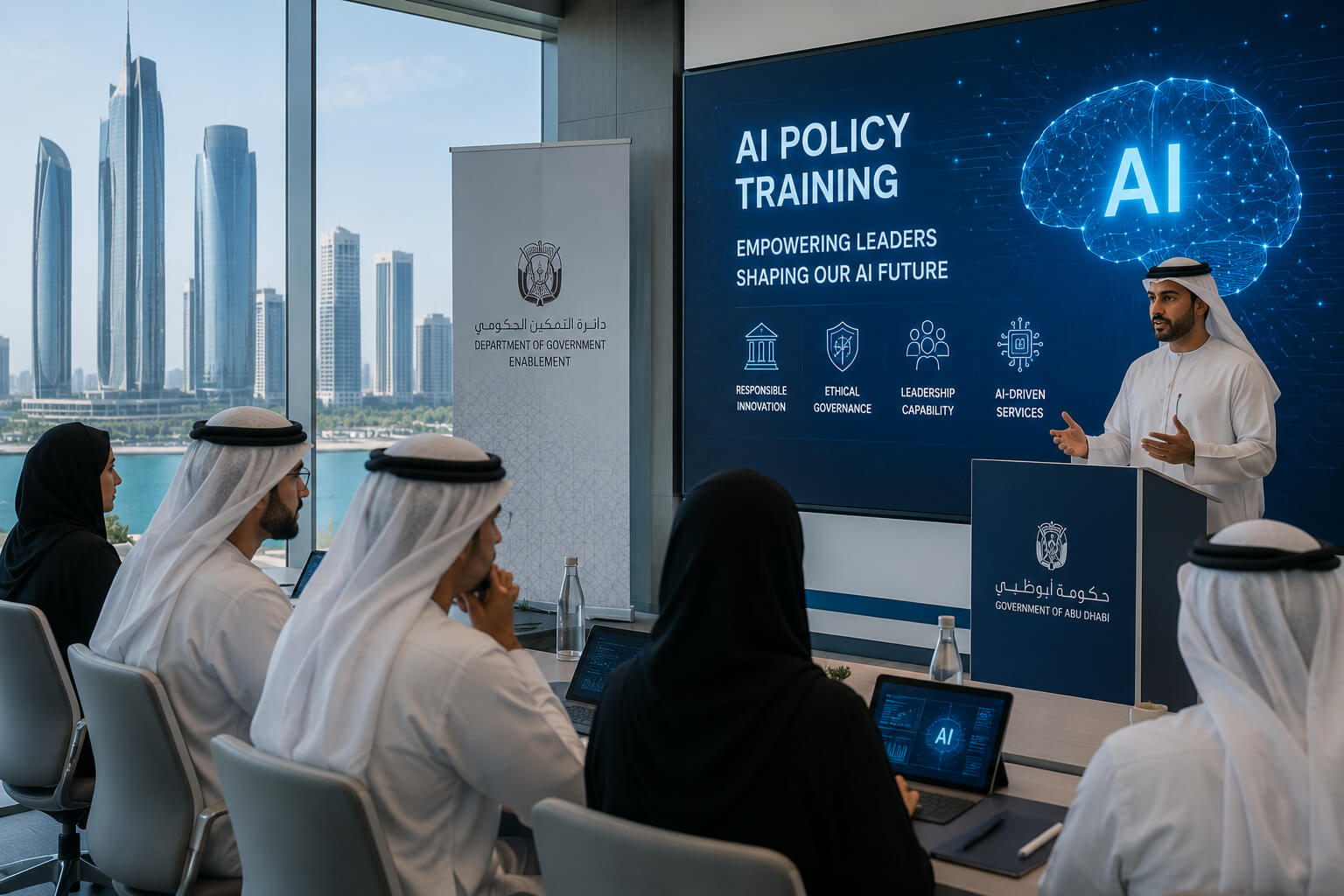
Abu Dhabi is bringing artificial intelligence into an area that rarely receives as much attention as chatbots, data centres or new language models: government policymaking.
The Department of Government Enablement – Abu Dhabi has launched an AI-powered Policy Development Programme for executive directors and other senior government leaders involved in designing, implementing and overseeing public policy.
This is not a general introduction to AI. The programme targets officials who make decisions, choose policy tools and deal with the problems that appear when government strategies move from presentation slides into the real world.
AI Training Moves Closer to Government Decision-Making
Much of the public-sector discussion around AI has focused on automating services. That usually means faster applications, automated approvals, digital assistants or systems that help residents find the correct government service. Abu Dhabi’s latest programme looks further upstream. It focuses on the people who decide which policies should exist in the first place.
Participants will learn how to identify policy challenges, choose suitable interventions, engage stakeholders and overcome implementation bottlenecks. The programme also covers policy evaluation, communication and the use of evidence when making decisions.
That distinction matters. A government can install advanced technology and still struggle if its policies are unclear, poorly coordinated or difficult to implement. AI may help analyse information and explore possible outcomes, but officials still need to understand the communities, institutions and trade-offs behind every policy decision.
Abu Dhabi Partners With Singapore Policy School
The Department of Government Enablement is delivering the programme with the Lee Kuan Yew School of Public Policy in Singapore. A central part of the initiative will be an intensive module held in Singapore. It will include workshops, lectures, group projects, learning visits and discussions with guest speakers.
The module will cover behavioural insights, impact assessment, monitoring and evaluation, policy communication, transformational governance and Singapore’s Smart Nation experience. Participants will also study how governments can apply AI during broader institutional transformation.
Singapore is a logical place for that part of the programme. Its government has spent years connecting digital infrastructure, public services and data-led administration. Abu Dhabi is not simply importing that model, though. The stated goal is to help officials apply international policy frameworks in ways that fit the emirate’s own priorities and government structure.
The Programme Is About Execution, Not AI Hype
Government AI announcements often sound ambitious. Turning them into measurable public outcomes is harder. A policy may look impressive when announced but stall because departments do not coordinate, stakeholders were consulted too late or officials selected tools that did not match the original problem. The new training programme appears designed around those less glamorous issues.
Participants will work on translating strategy into action, assessing policy impact and building systems that can respond earlier to emerging challenges. DGE describes this as part of an “anticipatory governance” approach, where institutions try to identify future needs rather than waiting for problems to become urgent.
AI fits into that process as a tool, not the entire answer. It can help officials examine large datasets, detect patterns and test different scenarios. It cannot automatically decide which outcome is fair, politically acceptable or practical. That still belongs to people.
Abu Dhabi’s Wider AI Government Plan Is Much Bigger
The policy programme sits inside Abu Dhabi’s broader attempt to become the world’s first fully AI-native government by 2027. Under its Government Digital Strategy 2025–2027, the emirate plans to invest AED13 billion in digital infrastructure, AI adoption and government transformation.
The strategy includes plans to automate and digitise government processes, move operations onto sovereign cloud infrastructure and introduce more than 200 AI solutions across public services. Abu Dhabi also expects the programme to contribute more than AED24 billion to its economy and support the creation of over 5,000 jobs by 2027.
Those are large targets. They also explain why leadership training is becoming more important. Buying AI systems is one part of the work. Government departments must also know when to use them, how to measure their impact and where human oversight should remain.
Government Employees Are Already Receiving AI Training
Abu Dhabi has already trained a large share of its public-sector workforce in artificial intelligence. According to the Department of Government Enablement, more than 95% of over 30,000 government employees had completed comprehensive AI training as of September 2025.
The training covered more than technical tool use. It also included responsible deployment, ethics, accountability and the need to preserve human oversight in public services. Abu Dhabi government entities have also created Chief Data and AI Officer positions to oversee AI adoption and governance.
The new Policy Development Programme moves that training higher up the decision-making structure. Civil servants may use AI tools during their daily work. Senior leaders decide how those tools influence policies, budgets, public services and government priorities. They need a different kind of preparation.
AI Policy Skills Could Become a Government Requirement
Abu Dhabi’s programme points to a wider shift taking place inside governments. AI literacy is no longer limited to developers, data scientists or technology departments. Policy teams, legal officials, regulators and senior executives increasingly need to understand what AI can do, where it can fail and how its recommendations should be challenged.
The risk is not only that governments adopt AI too slowly. They could also adopt it quickly without asking enough questions. Who supplied the data? How reliable is the output? Can affected residents appeal an automated decision? What happens when a system produces a confident but incorrect recommendation? Training leaders to think through those questions may prove more valuable than teaching them how to use the latest AI interface.
Abu Dhabi Is Building the Human Side of an AI-Native Government
Abu Dhabi has made no secret of its AI ambitions. The emirate is investing in cloud systems, automated services, AI platforms and digital infrastructure. The Policy Development Programme addresses the human layer behind that technology.
It aims to give senior officials the skills to design better policies, coordinate implementation and use AI without treating it as a substitute for judgment. That part of the AI transformation will not attract the same attention as a new model or massive data centre. It may decide whether the transformation actually works.
Sources
- Middle East AI News – Abu Dhabi launches AI policy training for leaders
- Emirates News Agency – DGE launches AI-powered Policy Development Programme
- Department of Government Enablement – Abu Dhabi Government Digital Strategy 2025–2027
- Department of Government Enablement – AI-native government strategy update
