


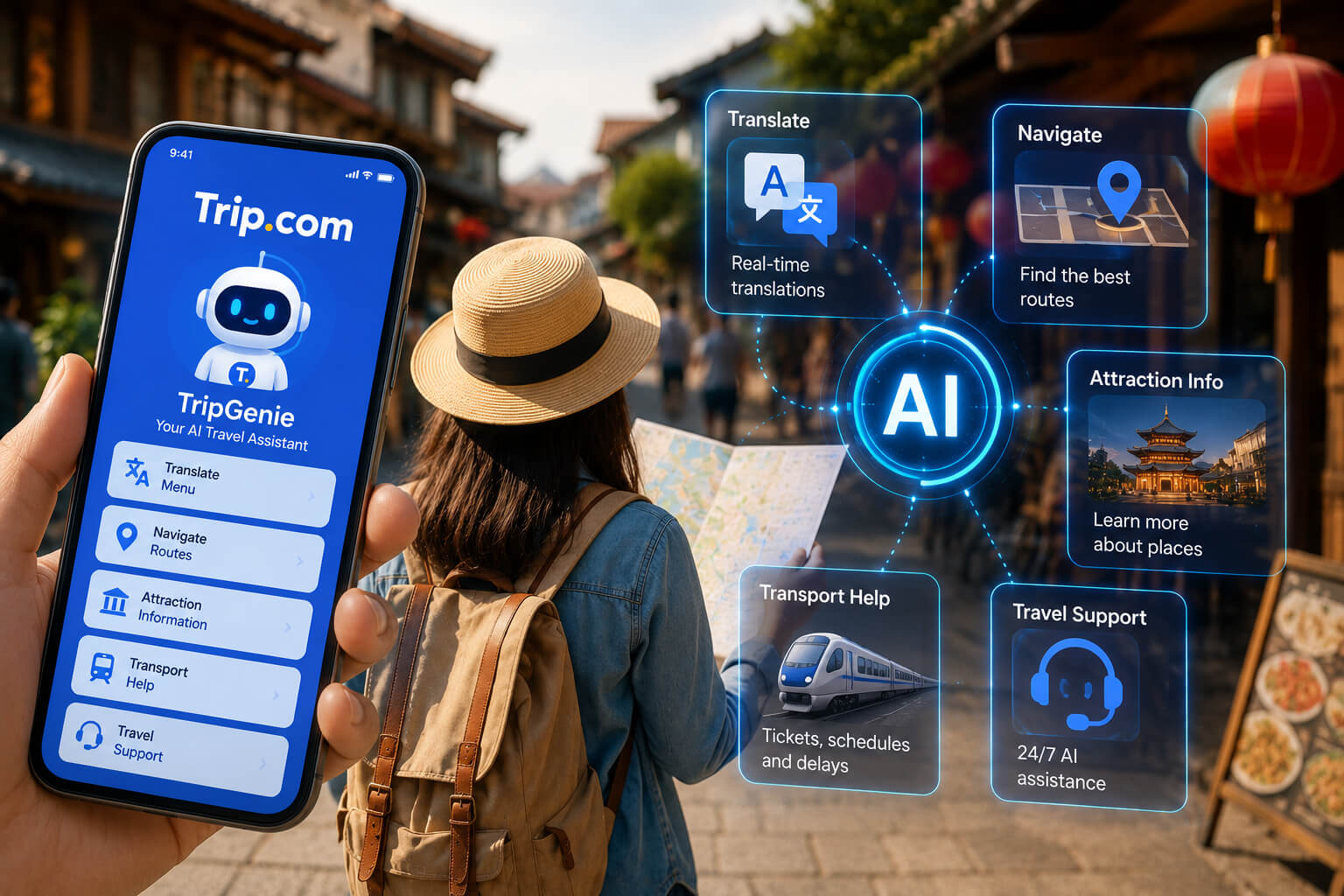
Booking a flight is not usually the hardest part of a trip anymore. The harder part comes later. The unreadable menu. The train ticket machine that feels designed to punish tourists. The attraction with five ticket options and no clear explanation. The landmark you are staring at but do not fully understand. The delayed flight at midnight when nobody around speaks your language.
Trip.com is trying to solve that awkward middle part of travel with a wider set of digital tools, many of them powered by TripGenie, its in-app AI travel assistant. This is not just about booking hotels faster. That space is already crowded. Instead, Trip.com is trying to become useful after the booking, when the traveler is already moving through a city and needs help right now.
Trip.com Puts AI Closer to the Actual Travel Moment
Trip.com says travelers are no longer only looking for flights and hotels. They want help with the moments between bookings, including planning, navigation, translation, attractions, transport, and unexpected problems. That makes sense. Travel apps used to focus heavily on inventory. Find a room. Find a flight. Compare the price. Done.
Now the bigger opportunity is the trip itself. TripGenie is being positioned as the assistant inside that experience. It helps users plan, understand places, communicate, and make decisions while they are already on the move. Not in a perfect travel brochure way. More like: “I’m tired, I’m lost, and I need this to work.”
Trip.Planner Handles the Endless Itinerary Problem
Trip planning sounds fun until there are 47 browser tabs open. Trip.com’s Trip.Planner is built for that problem. It helps travelers create personalized itineraries based on destination, trip length, travel style, and preferences. The idea is to reduce the time spent comparing options and turn scattered ideas into a more usable travel plan.
This matters because itinerary planning is where many people get stuck. They do not always need more choices. Usually, they need fewer choices that actually fit the trip. A family trip, a food-focused weekend, a first-time city visit, a slow cultural holiday, these are not the same kind of itinerary. Trip.Planner tries to shape the plan around that difference.
Live Translation Makes the Destination Less Intimidating
Language barriers can shrink a trip fast. A traveler may want to ask a local vendor about ingredients, speak with a driver, understand directions, or explain a problem at a hotel desk. Without the language, the interaction often becomes clumsy. Sometimes travelers just avoid it altogether.
TripGenie’s Live Translation feature is designed to help users communicate in real time. Trip.com frames this as a way to make conversations feel more natural and help travelers connect more confidently with the people around them. That is the less flashy side of AI travel. Not a robot planning an entire vacation. Just a traveler trying to ask a simple question without panic.
Image Recognition Turns Landmarks Into Explanations
Travelers often take photos of places they do not fully understand. A statue. A temple detail. A museum display. A historic street marker. Something looks important, but the sign is unclear or written in another language.
TripGenie’s Image Recognition feature lets travelers use their camera to identify attractions and receive more information about what they are seeing. It turns the phone camera into a quick explainer. That could change how people experience destinations. Instead of taking a photo and moving on, they can pause for a little context. Not a full lecture. Just enough to make the place feel less random.
Trip.com Also Wants to Cut Down the Queue Problem
Queues can quietly wreck a travel day. Trip.com allows travelers to pre-book attractions and choose suitable packages before arriving. That helps users avoid unnecessary waiting and pick the option that fits their schedule, budget, or travel style.
This is not the most futuristic feature in the world. It is also one of the most practical. Nobody wants to spend half a holiday standing in line because the ticket choices were confusing or the entrance rules were unclear. AI may get the attention, but better ticket planning still matters.
Train Travel Gets a Cleaner Booking Layer
Rail travel can be one of the best ways to explore a country. It can also feel extremely confusing for visitors. Trip.com points to high-speed rail in China and Japan, regional train systems across Europe, and rail passes across markets including the UK, France, Germany, Spain, Italy, Japan, China, and South Korea.
The company says its platform helps travelers book train tickets, regional rail passes, airport express services, and flexible ticketing options across Europe and Asia.
That is important because train travel often has its own hidden friction. Ticket rules can differ by route. Pass types are not always easy to compare. Station systems may feel unfamiliar. Local apps can also be difficult for tourists to use. Trip.com is trying to put that into one travel flow instead of forcing users to figure it out from scratch every time.
Support Still Matters When the AI Cannot Fix Everything
Even the best travel tech cannot prevent every problem. Flights get delayed. Connections are missed. Luggage disappears. Someone gets sick. A booking detail suddenly matters more than it did yesterday.
Trip.com highlights its 24/7 customer support and SOS features as part of the same travel support system. That part matters because AI tools are helpful, but travelers still want reassurance when something goes wrong.
A chatbot can explain a route. It may not be enough when a traveler is stranded, stressed, or dealing with a real emergency. So the stronger travel product is not only AI. It is AI plus booking support, human help, emergency features, and clear access when the user needs it.
AI Travel Is Moving Beyond Search and Booking
The bigger shift is easy to miss. For years, online travel platforms competed around booking. Which app had the cheaper flight? Where was the better hotel deal? And who offered the strongest loyalty perk? Now travel companies are competing for the full journey.
Trip.com’s approach points to a more active kind of travel app, one that helps before, during, and after the booking. Planning the itinerary. Translating conversations. explaining landmarks. Booking tickets. Sorting train routes. Finding support when something goes wrong. That is where AI travel tools start to feel less like a gimmick. Not because they replace the trip. They do not. They remove some of the small frictions that make travel feel heavier than it should.
Trip.com Is Betting on Practical AI, Not Just Travel Hype
Trip.com’s AI travel push is not really about making travel feel futuristic. It is more practical than that. Make the plan easier. Turn the foreign language into something less scary. Help travelers understand the landmark faster. Speed up the ticket process. Make train booking less painful. Keep support easier to reach.
That is the pitch. The travel industry has plenty of shiny AI promises already. Trip.com’s advantage may come from using AI in boring but useful places. The parts of travel where people are tired, confused, rushed, or unsure. That is when a tool earns its place on the phone.
