


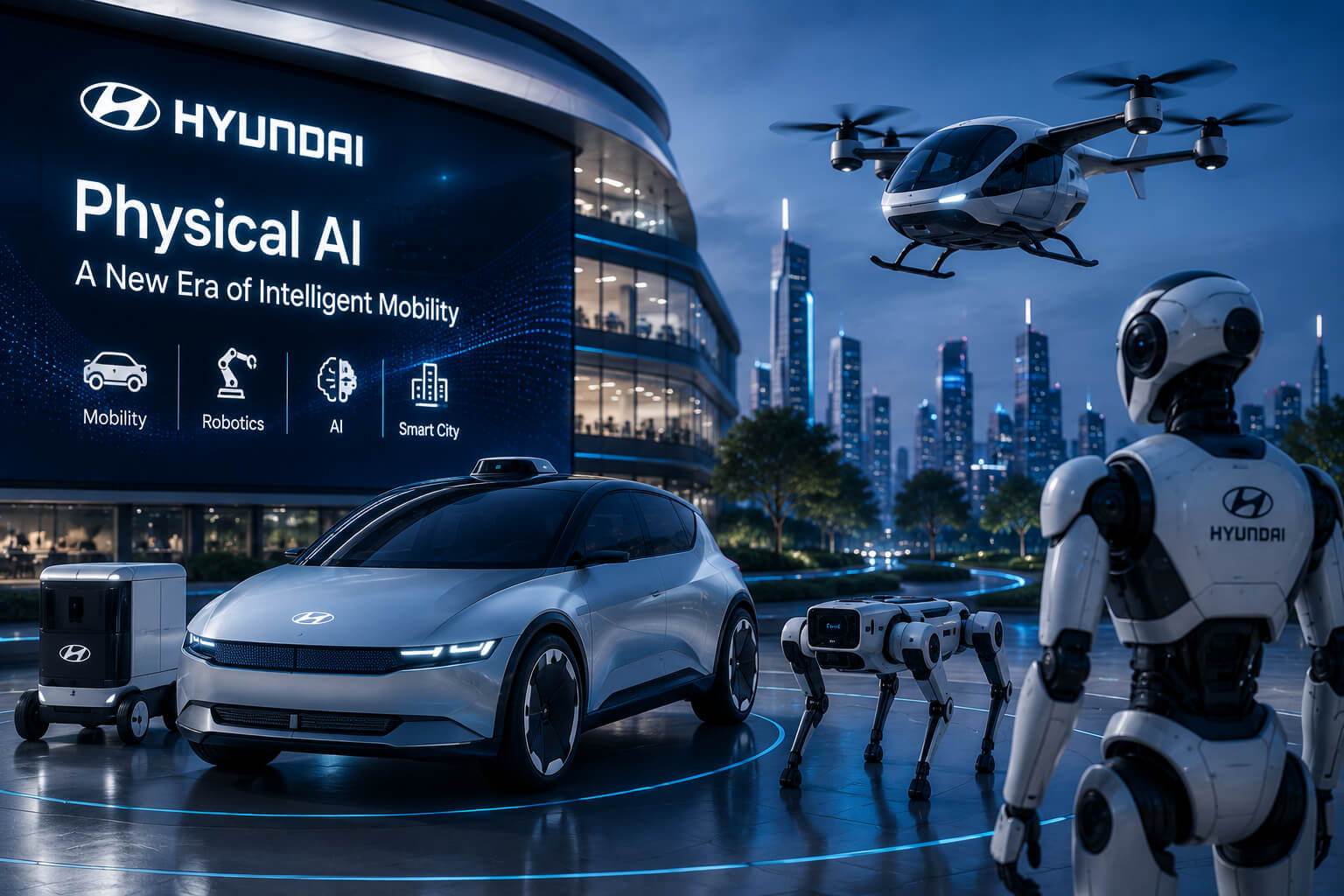
Hyundai Motor Group has drawn a much bigger circle around its future. Cars are still part of the picture, but they are no longer the whole story.
Speaking at the San Francisco AI Summit, Executive Chair Euisun Chung described Hyundai’s long-term ambition as becoming a Physical AI solution company. That phrase signals a shift beyond building vehicles. The company wants artificial intelligence to move into robots, factories, logistics systems and, eventually, entire cities.
Physical AI has become one of the fastest-growing ideas in the industry. Instead of limiting AI to software or chatbots, companies are teaching machines to interact with the physical world. Hyundai believes its decades of manufacturing experience give it a head start.
Hyundai’s Vision Starts With Robots and Ends With Smart Cities
Hyundai describes its roadmap as a progression rather than a single product launch.
The company plans to connect intelligent vehicles, autonomous robots, AI-powered manufacturing plants and smart infrastructure into one ecosystem. Rather than operating independently, these systems would continuously exchange information and improve each other over time.
According to Chung, the long-term destination is city-scale intelligence where transportation, robotics and infrastructure work together through AI instead of functioning as isolated technologies.
That is an ambitious target. It also explains why Hyundai has invested heavily in robotics over the past several years.
A Data Flywheel Could Become Hyundai’s Biggest Competitive Advantage
One of the most interesting parts of Hyundai’s strategy is not actually the robots.
It is the data.
The company plans to collect information from vehicles, logistics operations, manufacturing plants and robot deployments. That information feeds AI models, improves them, and then sends updated intelligence back into real-world operations.
Hyundai calls this process a data flywheel. The more machines operate, the more useful data they generate. Better data produces smarter AI models. Smarter AI improves future operations, creating a continuous learning loop.
This approach mirrors what many leading AI companies already pursue, except Hyundai’s data comes from physical machines rather than online interactions.
Boston Dynamics Will Sit at the Center of the Plan
Hyundai’s robotics business extends far beyond warehouse automation.
Boston Dynamics remains central to its Physical AI strategy. The company highlighted Spot, Stretch and the Atlas humanoid robot as key platforms for future development.
Atlas, in particular, is expected to work alongside people inside factories, logistics centers and mobility environments. Hyundai also plans to deploy development versions of the next-generation Atlas robot within its manufacturing facilities before expanding broader commercial use after testing.
Earlier this month, Hyundai also announced plans to acquire SoftBank’s remaining stake in Boston Dynamics, giving it complete ownership of the robotics company and greater control over its Physical AI roadmap.
NVIDIA and Waymo Expand Hyundai’s AI Ecosystem
Hyundai is not trying to build everything alone.
Its partnership with NVIDIA continues to grow through AI infrastructure, autonomous driving technologies, manufacturing digital twins and a new Robot Reference Platform designed for universities, startups and research institutions in South Korea.
The company is also maintaining its collaboration with Waymo.
Hyundai will supply specially modified IONIQ 5 electric vehicles equipped with redundant safety systems for Waymo’s autonomous driving fleet. Those vehicles will be produced at Hyundai Motor Group Metaplant America in Georgia.
Together, those partnerships help Hyundai cover multiple layers of the Physical AI stack—from chips and software to autonomous vehicles and humanoid robots.
Billions of Dollars Will Support AI Infrastructure
Vision alone is not enough.
Hyundai plans to invest approximately 42 trillion won over the next decade in South Korea’s Yeongnam region. The funding will support AI manufacturing hubs, robotics production, aerospace industries and sustainable energy infrastructure.
The investment is also intended to strengthen the country’s robotics ecosystem, expand testing capacity and improve industrial competitiveness while creating new jobs.
Why Hyundai’s Strategy Matters
Many automakers now describe themselves as mobility companies. Hyundai is pushing that idea another step forward.
Its future business increasingly revolves around intelligent machines that can move, perceive, learn and cooperate in real environments. Cars remain important, but they become only one device inside a much larger AI ecosystem.
If Hyundai executes this roadmap successfully, it may end up competing as much with robotics and AI infrastructure companies as with traditional automotive manufacturers.
