


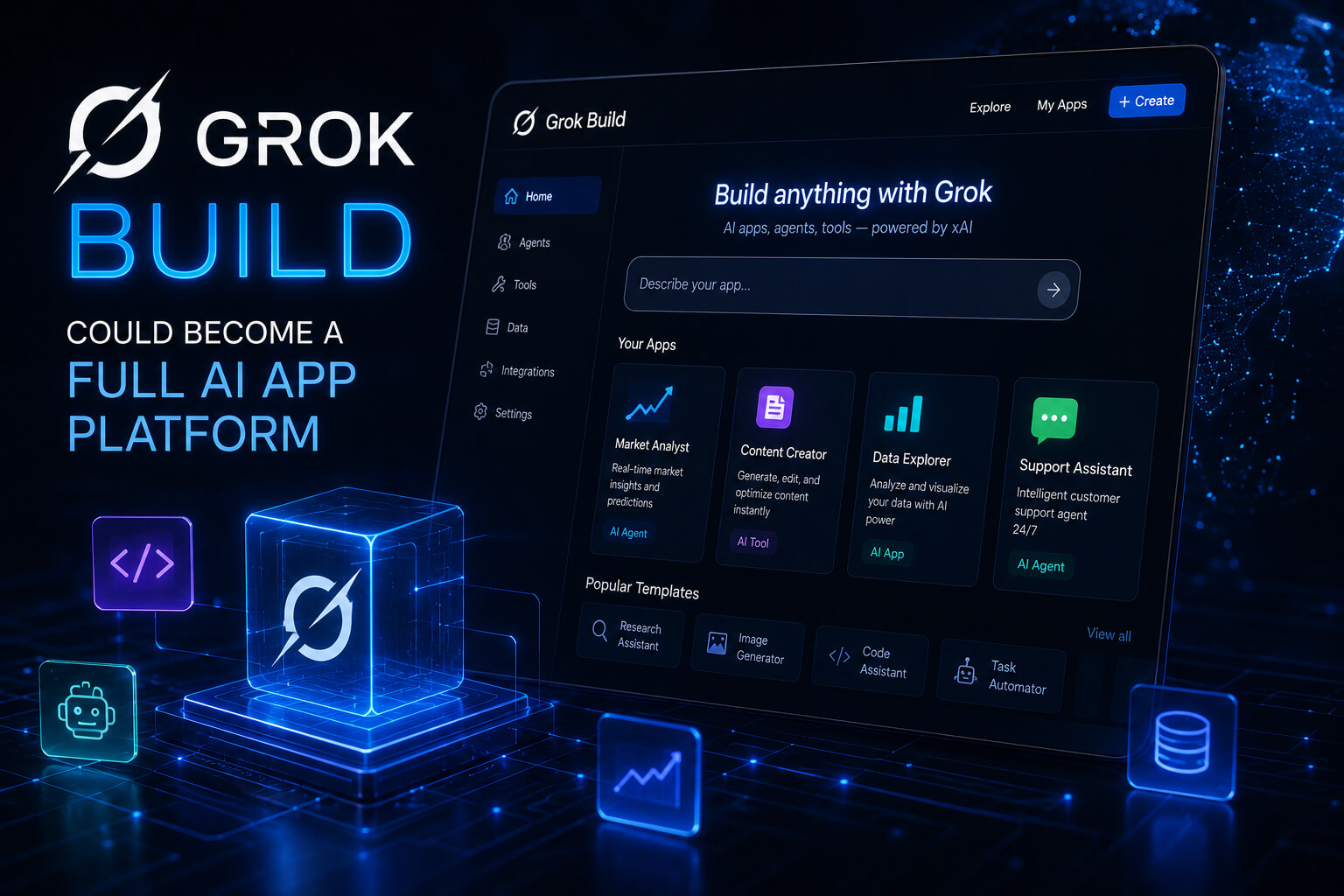
SpaceXAI may be preparing to take Grok Build far beyond its current role as an AI coding assistant. The new vision for Grok Build AI app platform could mean a broader set of features on the horizon.
According to a new report, the company is developing features that could allow people to create applications with Grok Build, publish them directly, and share the finished product through a simple link. No separate hosting service. No awkward deployment process. Potentially, no need to leave the Grok ecosystem at all.
Nothing has been formally announced yet, so the details remain tentative. Still, the direction is hard to miss. Grok Build could be turning into an AI app platform rather than another tool that simply helps developers write code.
Grok Build May Handle More Than Coding
Grok Build currently works as a terminal-based coding agent. It can understand a codebase, modify files, execute commands, search the web, and manage longer development tasks.
SpaceXAI’s official page describes it as a coding agent powered by Grok 4.5. The tool includes features such as Plan Mode, a native subagent view, mouse support, and a full-screen terminal interface. Early access is available to SuperGrok and X Premium+ subscribers.
That already puts Grok Build in competition with AI development tools such as Claude Code, Cursor, GitHub Copilot, and OpenAI Codex.
The reported publishing feature would change the comparison. Instead of stopping once the code has been generated, Grok Build could take responsibility for the next part too: making the application live.
A user might describe an idea, ask Grok to build it, review the result, and publish the application without setting up an external deployment pipeline.
That is a much bigger product.
Publishing Through a Link Could Remove a Major Barrier
Building an application with AI has become surprisingly easy. Deploying one can still be messy.
Users often need to create an account with a hosting provider, connect a repository, configure environment variables, manage a domain, and troubleshoot deployment errors. Experienced developers know the routine. New users frequently get stuck right there.
Grok Build may try to remove that gap.
The reported system could allow a completed application to receive its own shareable link. That would make the experience feel less like traditional software development and more like publishing a document or sharing a cloud-based design.
For quick prototypes, internal tools, interactive demonstrations, or personal projects, that convenience matters. Many users do not need a complicated cloud setup. They just need the application to work somewhere outside their own computer.
SpaceXAI Could Keep the Entire Development Process Inside Grok
There is also a straightforward business reason for SpaceXAI to build this feature.
When Grok only generates code, users can take that output and deploy it somewhere else. The coding assistant performs the difficult work, but another company receives the hosting activity, developer data, and long-term customer relationship.
An integrated Grok Build AI app platform could keep more of that workflow inside SpaceXAI.
Users might rely on Grok for planning, coding, testing, publishing, and later updates. Over time, the company could add paid hosting, custom domains, collaboration tools, application analytics, databases, authentication, or additional computing resources.
Those features have not been confirmed. They are logical possibilities rather than announced products. The important part is the platform structure. Once users can publish applications directly, SpaceXAI has room to build an entire commercial layer around that process.
This Is Part of a Wider Shift in AI Coding
AI companies no longer want their coding products to function as smarter autocomplete tools.
They want to control more of the software creation process.
The newer generation of coding agents can inspect projects, make changes across multiple files, run commands, identify errors, and continue working through longer tasks. The next obvious step is deployment.
We are already seeing AI products move toward environments where users can generate interactive tools, websites, dashboards, and small applications without manually assembling every technical component.
Grok Build appears to be moving in the same direction, although it is approaching the problem through a terminal-based development agent rather than a purely visual no-code interface.
That distinction could help it attract both groups: developers who want control and less technical users who mainly want a working result.
Grok 4.5 Gives the Platform a Stronger Technical Base
SpaceXAI recently upgraded Grok Build to Grok 4.5, which the company positions as a model designed for coding, reasoning, and agentic work.
The current Grok Build interface includes planning tools and support for subagents, suggesting that SpaceXAI wants the product to handle larger tasks rather than isolated code snippets.
Direct publishing would fit neatly into that strategy.
A coding agent that can plan an application but cannot make it available to users still leaves the job unfinished. Add publishing and hosting, and the product begins to look like an end-to-end development environment.
The difference sounds small on a feature list. In practice, it could completely change who uses Grok Build.
The Feature Could Attract Non-Developers
Professional developers may appreciate faster deployment, but the more interesting audience could be people who do not consider themselves programmers.
A marketer could create a campaign calculator. A teacher might build an interactive quiz. A small business owner could make a booking form or internal dashboard. Someone testing a startup idea could publish a basic prototype before hiring a full development team.
These users usually do not want to think about infrastructure. They want to describe an application, make a few changes, and share it.
Of course, generating a functional prototype is not the same as creating secure, production-ready software. Applications handling customer information, payments, medical data, or sensitive business records still need proper testing and oversight.
AI can shorten the path. It does not make engineering risks disappear.
Important Questions Remain Unanswered
SpaceXAI has not officially confirmed the reported publishing system, which leaves several important details unclear.
It is not known whether published applications would include free hosting, whether users could connect custom domains, or whether the feature would remain limited to paid Grok subscriptions. Storage, databases, authentication, traffic limits, privacy controls, and commercial usage rules also remain open questions.
Security will matter just as much as convenience.
A platform that lets users create and publish software quickly will need systems for detecting malicious code, protecting account credentials, reviewing external integrations, and preventing applications from exposing sensitive information.
The simpler publishing becomes, the more responsibility shifts toward the platform providing it.
Grok Build Is Starting to Look Like a Platform
For now, Grok Build remains an AI coding agent built around the terminal. That is what SpaceXAI officially offers today.
The reported app publishing feature points toward something broader.
Should the company let users generate, host, and share applications directly, Grok Build would no longer compete only with coding assistants. It would also enter the crowded market for AI app builders, deployment platforms, and browser-based development environments.
That could be the real goal.
Writing code is useful. Owning the place where that code becomes a product is far more valuable.
