


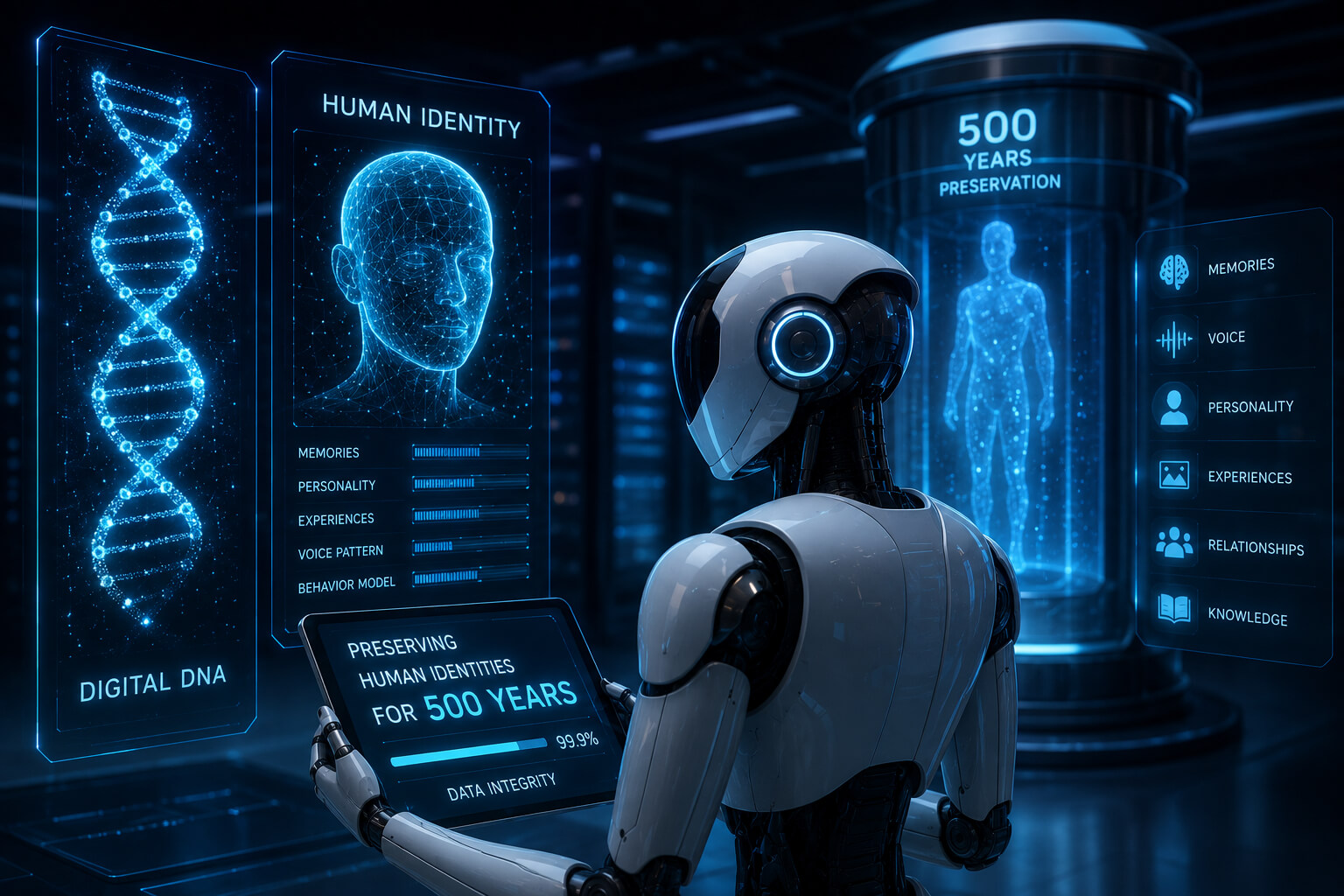
Forget the urn. Forget the static memorial page that nobody opens after the first few months. A newly announced AI robotics project has pitched a far stranger alternative: preserving elements of a person’s identity inside a humanoid robot for as long as 500 years.
The proposal comes from Veterans First for America and the team behind the QAIAx AI City Hall project. According to a press release published on July 26, the researchers have submitted a patent application covering what they call “Digital DNA,” a system designed to capture human behaviors, abilities and personal characteristics before transferring that information into an AI-powered robot or holographic representation. It sounds like science fiction. At this stage, it largely remains a proposal rather than a demonstrated path to human immortality.
Digital DNA Would Copy Behavior, Not Human Consciousness
The phrase “Digital DNA” makes the technology sound biological. It is not.
The proposed system would reportedly use a 40-sensor haptic suit to collect information such as movement patterns, physical responses, professional skills and behavioral traits. That data would form a digital profile that could later operate through an Omni-AI humanoid robot or a light-based holographic projection. In theory, a family could preserve how a parent spoke, moved or responded to familiar situations. A company might retain the working style of a specialist. Future descendants could interact with a machine designed to resemble somebody who died centuries earlier.
That would still be a simulation built from recorded data. The announcement does not provide evidence that memories, awareness or human consciousness can be copied into a machine. Calling the result immortality stretches the word considerably. What survives would be a digital model of the person, not necessarily the person.
The 500-Year Promise Comes With a Seven-Figure Price
The project’s proposed licensing structure treats digital identity as a long-term subscription.
Its announcement outlines three possible tiers: A 100-year licence would cost $300,000. A 250-year option would rise to $600,000, while the full 500-year package would cost $1 million. The longest plan would target family trusts, foundations and other organisations seeking what the project describes as multi-generational continuity.
Reduced fees or waivers may reportedly be offered to disabled veterans, retired emergency responders, educators and survivors of war. These figures remain proposed prices. The announcement does not show that commercially available robots, functioning identity-transfer systems or customers using the service already exist.
The Robots Are Connected to a Much Larger Smart City Plan
Digital replicas are only one piece of the QAIAx concept.
The team says it wants to develop a network of 300 decentralised “Microcities” inside selected US federal and military enclaves, along with possible international locations. These communities would combine humanoid robots, automated agriculture, water recycling, utility management and AI-assisted public administration. The proposed operating model gives machines most of the work.
Under what the organisers call a 90/10 hybrid workforce, automated AI systems would manage roughly 90% of municipal services. Licensed human professionals would oversee the remaining portion, review unusual cases and approve sensitive administrative or clinical decisions. Again, this describes the project’s intended framework. It should not be mistaken for a fully constructed city or an operational population of autonomous humanoids.
A Clinical Trial Registration Exists, but That Does Not Validate Every Claim
The QAIAx project is connected to a study registered on ClinicalTrials.gov under the identifier NCT07661823.
The official listing describes research into whether an AI-led public health and administrative system could provide affordable behavioural and mental health services inside self-contained communities referred to as Microcities. The study also mentions AI humanoids, mental health tools and experimental approaches to public administration. That registration gives the project a real entry in a US government-maintained research database. It does not prove that its technologies work.
ClinicalTrials.gov itself does not evaluate the scientific validity, safety or feasibility of every claim submitted by a study sponsor. Registration mainly makes the planned research publicly visible. The distinction matters here. A registered study involving robots and AI infrastructure is not evidence that a person’s identity can already survive inside a humanoid body for five centuries.
Digital Immortality Creates an Ownership Problem
Even a convincing digital replica would produce immediate legal trouble.
Who would own the robot after the original person dies? Could heirs change its personality? Would a company be allowed to keep using a deceased employee’s digital likeness? What happens when a family trust wants to delete the model, but another relative considers it a living part of the family? Consent becomes messy as well.
A person may agree to create a digital copy today, yet nobody can predict how that copy could be used 100 years from now. The organisation controlling the software might change. Security systems could fail. Laws governing identity, biometric information and AI-generated personalities could look entirely different.
A 500-year contract would outlive almost every modern company, storage platform and legal framework. The robot body may not be the hardest part. Maintaining legitimate control over someone’s identity for half a millennium might be the real engineering challenge.
Security Risks Would Follow the Person Beyond Death
A detailed AI replica could become an unusually valuable target. Attackers might steal the profile, reproduce the person’s voice or manipulate the model into saying things the original individual never believed. Criminals could use a trusted digital ancestor to influence family members, approve fraudulent transactions or reveal information accumulated through decades of conversation.
The longer the identity remains active, the larger its data trail becomes. A robot designed to remember a family for generations would eventually know an enormous amount about relationships, finances, health concerns and private disputes. Protecting that information for 500 years would require security practices that nobody can realistically guarantee today.
The Idea Is Speculative, but the Questions Are Already Real
The QAIAx announcement does not show that digital immortality has arrived. It presents a patent-linked concept, proposed commercial pricing and an ambitious research programme built around AI-managed communities. Still, the underlying direction is not absurd.
Technology companies already build digital avatars, voice clones, memory systems and conversational AI agents that imitate human personalities. Robotics firms continue to improve humanoid movement and physical interaction. Combine those developments and machines that resemble specific individuals become increasingly plausible. The uncomfortable part comes next.
A robot may eventually speak like someone, remember their stories and respond with familiar expressions. Families could find comfort in it. Others may find the experience unsettling or even exploitative. The machine might feel present. That does not make it alive.
For now, the promise of a 500-year digital existence deserves curiosity mixed with heavy scepticism. The announcement offers a provocative vision, not proof that death has become a software problem.
