


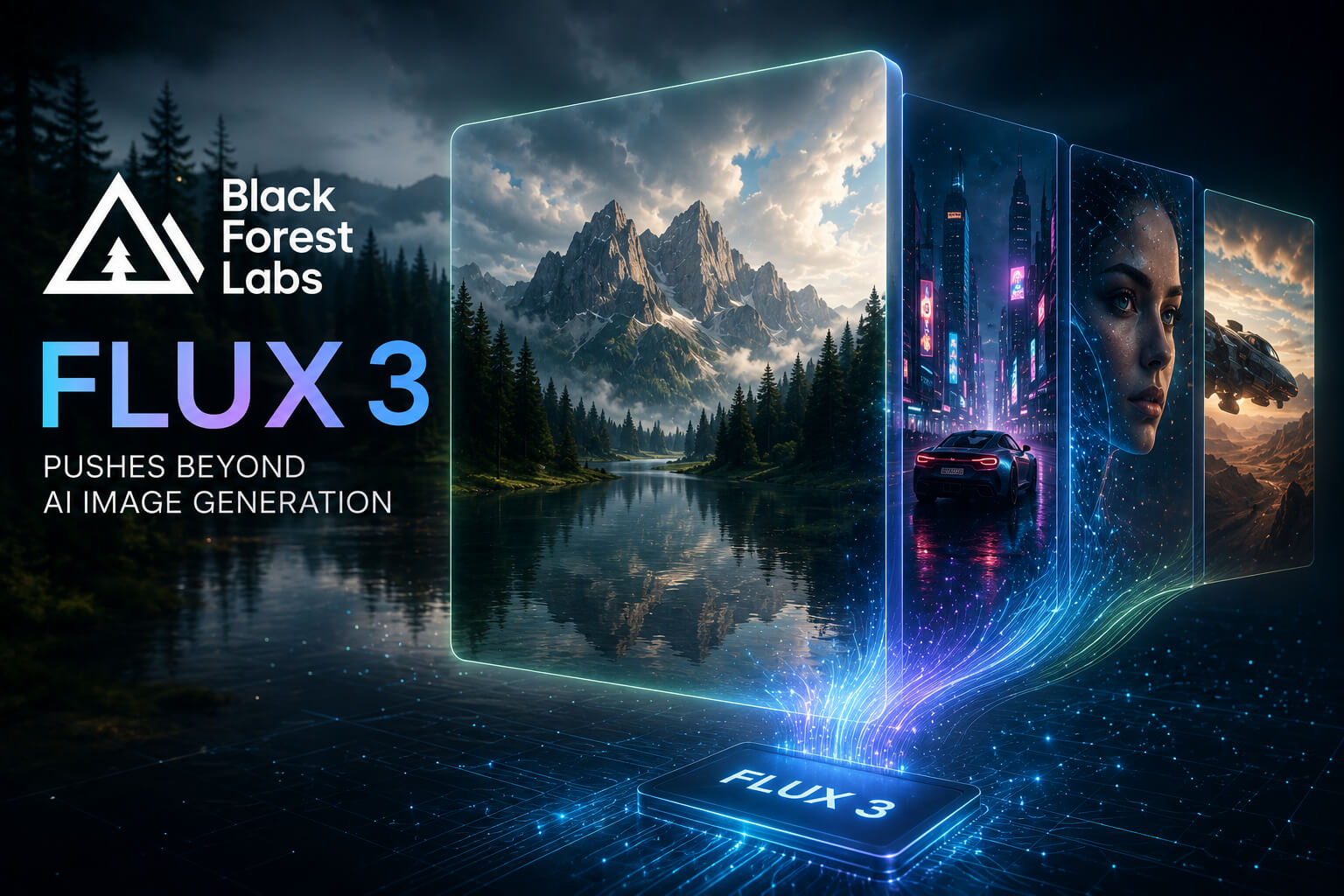
Black Forest Labs built its name around AI-generated images. With FLUX 3, the German AI company is attempting something much larger. Their newest project, the FLUX 3 multimodal AI model, aims to push the boundaries of artificial intelligence even further.
The newly announced FLUX 3 multimodal AI model brings image generation, video, audio and action prediction into one architecture. Rather than stitching together separate systems for each type of media, Black Forest Labs says the model learns from them jointly. That difference matters.
A video model that understands sound as part of the same scene could produce more natural timing between movement, speech and background noise. A robotics model trained on visual sequences could also learn how actions unfold, not simply identify what appears in front of a camera. For now, though, FLUX 3 remains an early-access product rather than a broadly available creative tool.
FLUX 3 Learns Images, Video and Audio Together
Most generative AI products still treat images, video and audio as separate jobs. One model creates the picture. Another animates it. A third generates the soundtrack. FLUX 3 takes a different route.
Black Forest Labs says it jointly trained the system across images, video and audio, allowing the model to develop a shared representation of objects, movement, sound and physical events. The company describes this approach as a step toward “visual intelligence,” where AI does more than produce attractive media. It begins to model how scenes behave.
That could make outputs feel more connected. A dropped glass should fall, strike the floor and make a sound at the right moment. A person speaking should move in a way that matches the generated voice. Weather, lighting and movement should remain consistent instead of changing unexpectedly between frames. Those are the ambitions, at least. Independent testing will be needed once wider access becomes available.
The Model Can Generate Video With Native Audio
One of the biggest additions is video generation. FLUX 3 can reportedly create clips lasting up to 20 seconds while generating synchronized audio inside the same workflow. That audio may include dialogue, environmental sound or effects connected to events occurring in the video.
Twenty seconds is still short for traditional filmmaking. For advertising concepts, social clips, product previews and storyboard experiments, however, it is enough to change how creative teams work.
Instead of producing a silent clip and sending it through several other tools, a creator could start with a prompt and receive a more complete scene. Not necessarily a finished commercial. More like a usable first draft with motion, atmosphere and sound already in place. This is where FLUX 3 starts looking less like an upgraded image generator and more like a media-production system.
Image Generation Remains Part of the Core Product
Black Forest Labs is not abandoning still images. FLUX 3 continues the company’s work in text-to-image generation while placing it inside the wider multimodal architecture. The company claims the model can produce realistic creations across different visual styles while maintaining a stronger understanding of the world represented in each scene.
The practical benefit could be better consistency. Generated subjects may remain recognizable across multiple images and video frames. Objects may behave more naturally. Prompts involving movement, interaction or cause and effect could also become easier for the model to interpret.
Still, company demonstrations are not the same as production use. Creators will want to see how well FLUX 3 handles typography, hands, complex motion, character continuity and detailed editing once the model reaches more users.
FLUX 3 Also Moves Into Robotics
The more unusual part of the announcement has little to do with marketing graphics or AI videos. FLUX 3 includes action-prediction capabilities designed for physical AI and robotics. Black Forest Labs is working with mimic robotics on FLUX-mimic, a video-action model intended to help robots learn industrial tasks from demonstrations. Early work is being tested in manufacturing environments connected to Audi.
A robot does not only need to recognize an object. It must understand what usually happens next. Where should it grip a component? How much force should it apply? What movement completes the task without damaging anything?
Video-action models attempt to learn those relationships from visual examples. If the approach works, companies could teach robots more complicated tasks without collecting enormous amounts of manually labelled training data. It is an ambitious extension for a company still widely associated with AI art.
Early Access Means Most Users Cannot Try Everything Yet
FLUX 3 has been announced, but that does not mean every feature is ready for public use. Black Forest Labs currently describes the model as available through early access. Broader API availability, private model deployments and an open-weight developer edition are expected later, although access may vary across the image, video and robotics components.
That staged rollout deserves attention.
AI announcements often mix features that users can access immediately with capabilities that remain limited to selected partners. FLUX 3 may become an important creative platform, but its real value will depend on pricing, generation speed, output reliability, licensing terms and how much control developers receive. The company has not yet answered every one of those questions publicly.
Black Forest Labs Is Building a Broader Visual AI Business
FLUX 3 also fits into a wider shift happening inside Black Forest Labs. The company’s earlier FLUX models focused heavily on high-quality image generation and editing. It has since introduced specialized tools for virtual try-on, outpainting and object removal while building integrations for creative and enterprise platforms.
The strategy now looks clearer.
Black Forest Labs does not want to remain one of many companies selling AI image generation. It wants its models to sit underneath creative software, advertising workflows, video tools and eventually machines operating in the physical world. FLUX 3 is the most direct expression of that plan so far.
FLUX 3 Enters a Crowded Multimodal AI Race
The opportunity is large, but so is the competition. AI companies are racing to build models that generate more than one type of content. Image tools are moving into video. Video systems are adding native sound. General-purpose models are becoming better at understanding documents, screens, photographs and live environments.
FLUX 3 gives Black Forest Labs a credible place in that race, especially given the popularity of its earlier visual models. Yet impressive demos will only carry the product so far. Creators need consistent characters. Developers need stable APIs. Businesses need clear licensing and predictable costs. Robotics customers need systems that work outside controlled demonstrations.
FLUX 3 may eventually deliver all of that. Right now, it represents something slightly different: a serious attempt to turn FLUX from an image-model family into a shared foundation for generated media and physical action. That is a much bigger bet than producing better pictures.
