


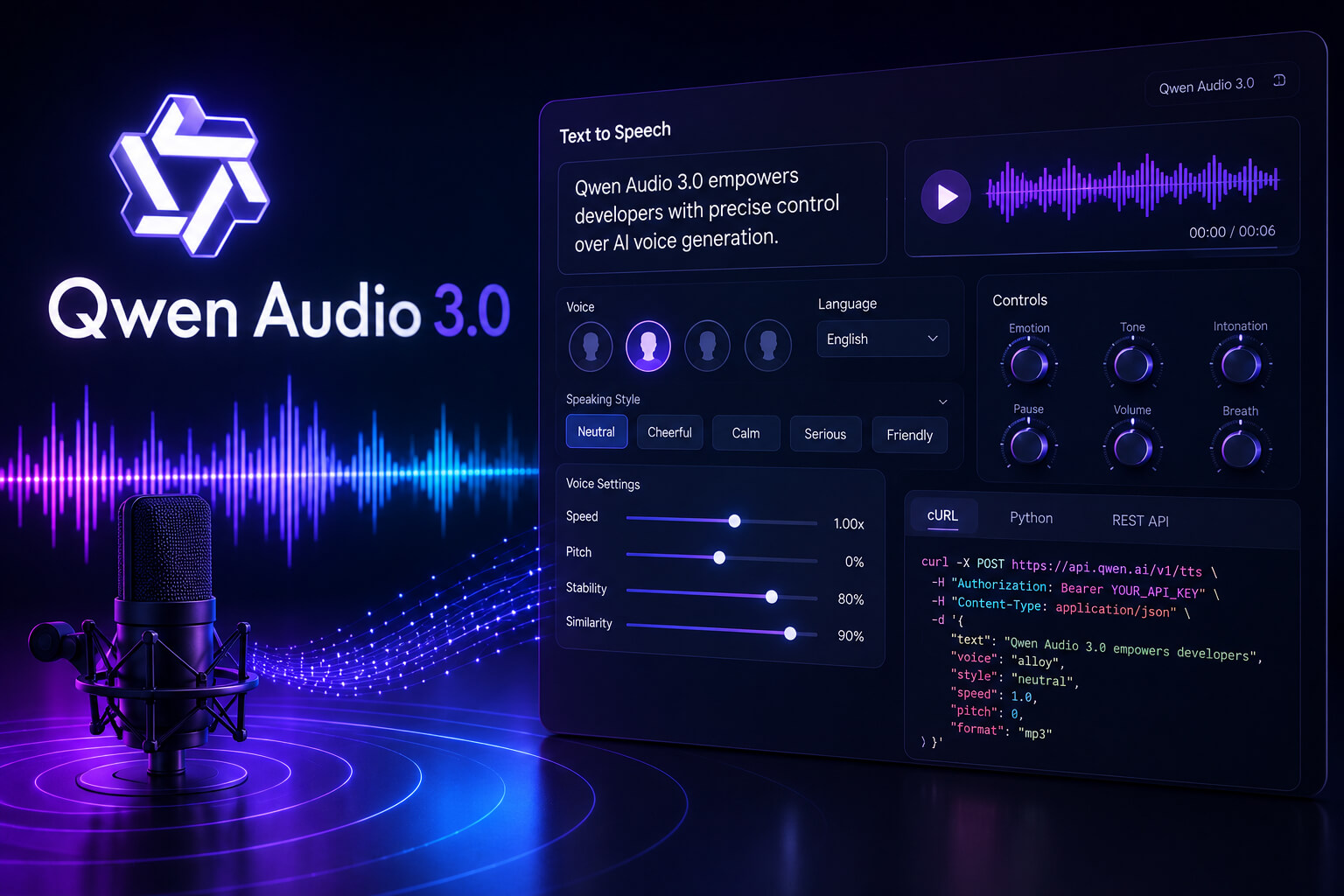
Alibaba’s Qwen team is pushing deeper into synthetic speech with Qwen Audio 3.0 TTS, a new text-to-speech system built for everything from live AI assistants to polished audio production. It arrives in two versions. Flash prioritizes speed and real-time interaction, while Plus leans toward higher-quality speech for professional use.
That split matters. A customer service bot cannot afford an awkward pause before every response. An audiobook studio, meanwhile, may care far more about natural pacing, emotion and clarity than shaving a few milliseconds from generation time. Qwen Audio 3.0 TTS tries to serve both.
Qwen Audio 3.0 TTS Goes Beyond Reading Text Aloud
Basic text-to-speech systems usually do one thing: convert words into a reasonably understandable voice. Alibaba is aiming higher here. Qwen Audio 3.0 TTS allows developers to direct a voice using ordinary language. They can describe the intended delivery instead of wrestling with a long list of technical speech parameters.
A prompt might ask the model to sound calm, excited, serious or conversational. It can also adjust characteristics such as pacing, volume, tone and speaking style. The model supports fine-grained inline tags for effects including whispers, laughter, breathing and emotional delivery. According to launch details reported by Times of AI, the system includes 86 control tags that developers can place directly inside a script.
This sounds like a minor convenience until someone has to produce hundreds of audio clips. Natural-language control removes part of the editing burden and makes voice generation easier for teams without specialist audio engineers.
Flash and Plus Target Different Voice Applications
Alibaba has released the hosted model in two service tiers: Qwen Audio 3.0 TTS Flash and Qwen Audio 3.0 TTS Plus. Flash focuses on low-latency output. That makes it the more obvious choice for conversational agents, virtual assistants, interactive characters and customer support systems where the voice needs to respond quickly.
Plus is aimed at situations where audio quality carries more weight. Alibaba positions the Plus model for content production, audiobooks, film and video dubbing, brand voice development and premium speech services. The company says it improves clarity, resolution, expressiveness and robustness in noisy or reverberant audio conditions.
It is not really a case of one model replacing the other. The choice depends on what the application cannot compromise: response speed or finished audio quality.
Voice Cloning and Voice Design Expand the Model’s Uses
Qwen Audio 3.0 TTS also supports voice cloning, allowing the system to generate speech resembling a reference voice. That capability opens the door to personalized assistants, localized characters and consistent narration across large content libraries. It also raises familiar questions around permission, impersonation and the responsible use of cloned voices.
The platform includes voice design tools as well. Instead of always copying an existing speaker, developers can describe the type of voice they need and shape its delivery through instructions.
For a game developer, that could mean designing a distinct voice for a fictional character. A company might build a consistent brand voice for tutorials and product videos. Education platforms could generate different speaking styles depending on the age group or lesson. The technology is flexible. The rules surrounding its use will need to be equally clear.
Multilingual Speech Is a Major Part of the Launch
Qwen Audio 3.0 TTS supports 16 languages, according to the launch report. Alibaba also says the latest release expands its handling of low-resource languages and Chinese dialects while improving dialect authenticity. Multilingual support is becoming less of a bonus feature and more of a requirement for commercial voice platforms.
Businesses do not want to maintain a completely different speech system for every market. They want one API capable of generating localized instructions, support responses, narration and marketing material without making every language sound like an afterthought.
Dialect quality may prove particularly important. A model can technically support a language while still sounding stiff, overly formal or disconnected from how people actually speak. Alibaba is clearly trying to close that gap.
Developers Can Access It Through Alibaba Cloud
Qwen Audio 3.0 TTS is available as a hosted service through Alibaba Cloud’s model platform. Developers can connect to it through an API rather than deploying and maintaining the underlying speech model themselves. Both streaming and non-streaming generation are supported, giving teams room to build real-time experiences or create finished audio files in advance.
Alibaba Cloud’s model release log lists both the Plus and Flash editions, describing Plus as the quality-focused option and Flash as the low-latency version for real-time interaction. The international QwenCloud page currently lists Qwen Audio 3.0 TTS Plus at $0.20 per 10,000 characters. Actual availability, billing and regional pricing may vary depending on the Alibaba Cloud service and account being used.
Qwen Is Building a Wider Speech AI Stack
Qwen Audio 3.0 TTS is not Alibaba’s first move into generated speech. The company already offers the open-source Qwen3-TTS family, which supports streaming generation, voice design, voice cloning and natural-language voice control. Its downloadable models cover ten major languages and include configurations designed for custom voices and rapid voice cloning.
The new hosted release looks more directly aimed at production teams that want managed infrastructure and straightforward API access.
That distinction is useful. Researchers and developers who need local deployment can explore the open-source Qwen3-TTS models. Businesses that prefer a managed service can use the cloud-based Audio 3.0 tiers. Alibaba is covering both sides rather than forcing every user into the same setup.
AI Voice Competition Is Shifting Toward Control
Natural-sounding speech is no longer enough to make a voice model stand out. The harder problem now involves control. Can the voice follow direction? Emotion also needs to shift without becoming theatrical. Different languages must sound natural. Most importantly, the system has to respond fast enough to sustain an actual conversation.
Qwen Audio 3.0 TTS is Alibaba’s answer to those questions. Its strongest selling point may not be one dramatic technical breakthrough. It is the combination of multilingual output, controllable expression, voice cloning, streaming support and separate models for speed and quality. That makes the release practical, which is often more important than flashy.
