


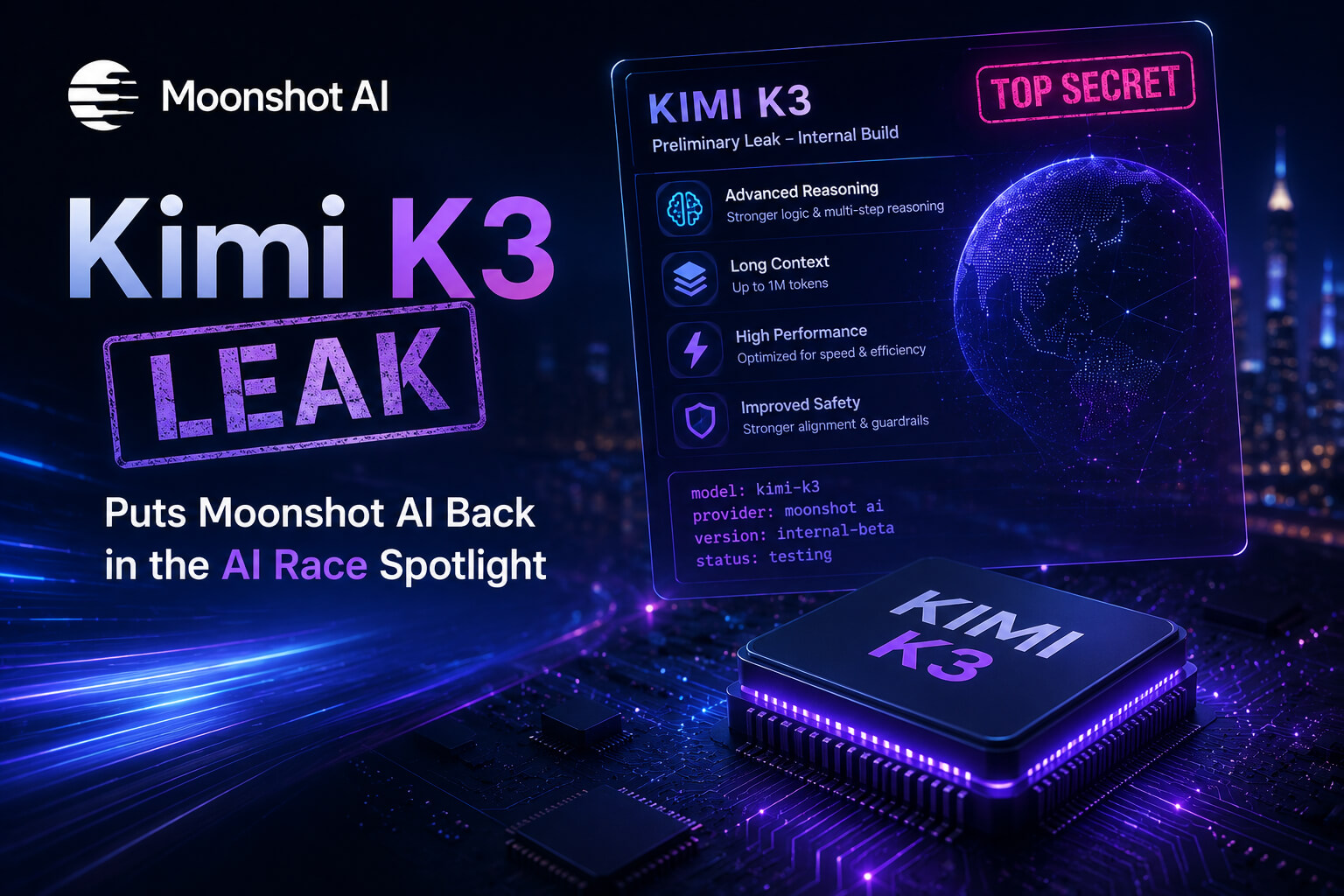
Moonshot AI has not officially launched Kimi K3 yet, but the internet is already acting like it has. A leaked page and a wave of community reports have pushed Kimi K3 into the center of AI chatter, with claims that the next-generation model could bring a massive jump in scale, context length, coding ability, and agent-style workflows.
The careful part first: most of this is still unconfirmed. Moonshot AI has not released a full model card, technical report, pricing page, benchmark sheet, or official launch statement for Kimi K3. So the details floating around right now should be treated as early signals, not final product facts. Still, the leak is interesting. Very interesting.
What Is Kimi K3?
Kimi K3 is expected to be the next major AI model from Moonshot AI, the Chinese AI company behind the Kimi assistant and earlier Kimi large language models. The Kimi line has already built a reputation around long-context processing, document handling, research support, and coding tasks. Kimi K3 appears to be aimed at pushing that identity further, especially if the leaked specs turn out to be close to reality.
Reports suggest the model may use a Mixture of Experts architecture. That matters because MoE models do not need to activate every part of the model for every task. Instead, they route work through selected expert components, which can make very large models more efficient to run. That is the theory, anyway. For users, the practical pitch is simpler: a model that can handle bigger files, longer conversations, more complex coding work, and multi-step AI tasks without losing track of what happened earlier.
The Leaked Kimi K3 Specs Are Big
The number getting the most attention is 2.5 trillion parameters. If accurate, that would put Kimi K3 among the largest models being discussed in the current AI market. Parameter count does not automatically mean better performance, of course. We have seen that lesson enough times already. But at this scale, people pay attention.
Another major rumored feature is a 1 million-token context window. That is the part that may matter more to everyday users and developers. A context window that large could allow Kimi K3 to process huge research papers, legal documents, long technical manuals, full codebases, books, or extended chat histories in one session.
No chopping everything into tiny pieces. No constantly reminding the model what happened five prompts ago. At least, that is the promise.
Why the 1 Million-Token Context Window Matters
Long context has become one of the real battlegrounds in AI. A model that can remember and process more information in one conversation can be useful for research, software development, business analysis, education, and enterprise workflows. It is not only about “reading more text.” It is about keeping structure, references, dependencies, and decisions intact across a large task.
For coding, that could mean understanding an entire project instead of one file. Researchers could use it to compare several long reports without losing the thread. Business users could drop in contracts, strategy documents, meeting notes, spreadsheets, and internal guidelines, then ask the model to work across all of them.
Kimi has already been associated with long-context strength, so Kimi K3 leaning hard into that direction would not be surprising.
Kimi K3 May Focus Heavily on Coding and AI Agents
The leaks also point to stronger coding performance and better reasoning. That is now almost required for any serious frontier-style model release. The market has moved past simple chatbot upgrades. Developers want models that can write code, debug errors, understand repositories, generate tests, explain architecture, and work through multi-step software tasks.
The AI agent angle is also important. AI companies are no longer just trying to build models that answer questions. They are trying to build systems that can plan, use tools, follow instructions across multiple steps, and keep context while completing more complicated workflows. Kimi K3, based on the reported details, seems to be moving in that direction. Not shocking. But still worth watching.
The Launch Timing Is Still Unclear
One leaked report suggested a July 15, 2026 launch window after a page reportedly appeared on Kimi’s API platform referencing a “Kimi K3 launch limited-time recharge campaign.” That sounds like a launch clue. It also sounds like the kind of thing that can be misread, pulled early, delayed, or changed before anything official happens.
For now, Moonshot AI has not confirmed the release date. That leaves Kimi K3 in a strange place. It is not officially here, yet it is already being compared with other major AI models. That is how fast the AI rumor cycle moves now. A hidden page appears, someone spots it, and suddenly the model has a whole public narrative before the company even speaks.
Why Moonshot AI Matters Right Now
Moonshot AI is one of the Chinese AI companies gaining attention as China’s model ecosystem becomes more competitive. The company’s Kimi models have been discussed alongside other Chinese AI systems that are pushing aggressively on cost, context length, open model strategy, and developer adoption. This matters because the AI race is no longer only about OpenAI, Google, Anthropic, and Meta.
Chinese AI labs are moving fast. DeepSeek already changed how many people think about low-cost model training and open-weight competition. Alibaba’s Qwen models have become more visible globally. Moonshot AI is another name that keeps coming up, especially among users who care about long context and practical productivity. Kimi K3 could strengthen that position if the final release delivers.
The Big Catch: Benchmarks Are Missing
The problem with leaks is that they usually give the exciting parts first. Huge parameter count. Big context window. Better coding. Better agents. Possible launch date. What they usually do not give is the boring but necessary stuff: verified benchmarks, pricing, latency, safety behavior, API limits, licensing details, deployment options, and real-world comparisons.
That is where Kimi K3 still has a lot to prove. A 2.5 trillion-parameter model sounds impressive, but users will want to know how it performs against GPT, Claude, Gemini, DeepSeek, Qwen, and other leading models. Developers will also care about cost and reliability. Enterprise buyers will want security, compliance, and stable access. Specs start the conversation. Performance decides whether people stay.
Kimi K3 Could Be a Serious Long-Context AI Model
For now, Kimi K3 is best understood as an anticipated Moonshot AI model with leaked but unconfirmed specifications. If the reports are accurate, it could arrive with a Mixture of Experts design, 2.5 trillion total parameters, a 1 million-token context window, improved coding support, stronger reasoning, and more capable AI agent workflows.
That is a big package. But until Moonshot AI confirms the model officially, the smart approach is to stay excited without treating every leaked number as final. Still, the signal is clear enough. Moonshot AI wants to be part of the next major AI model conversation, and Kimi K3 may be its loudest move yet.
