


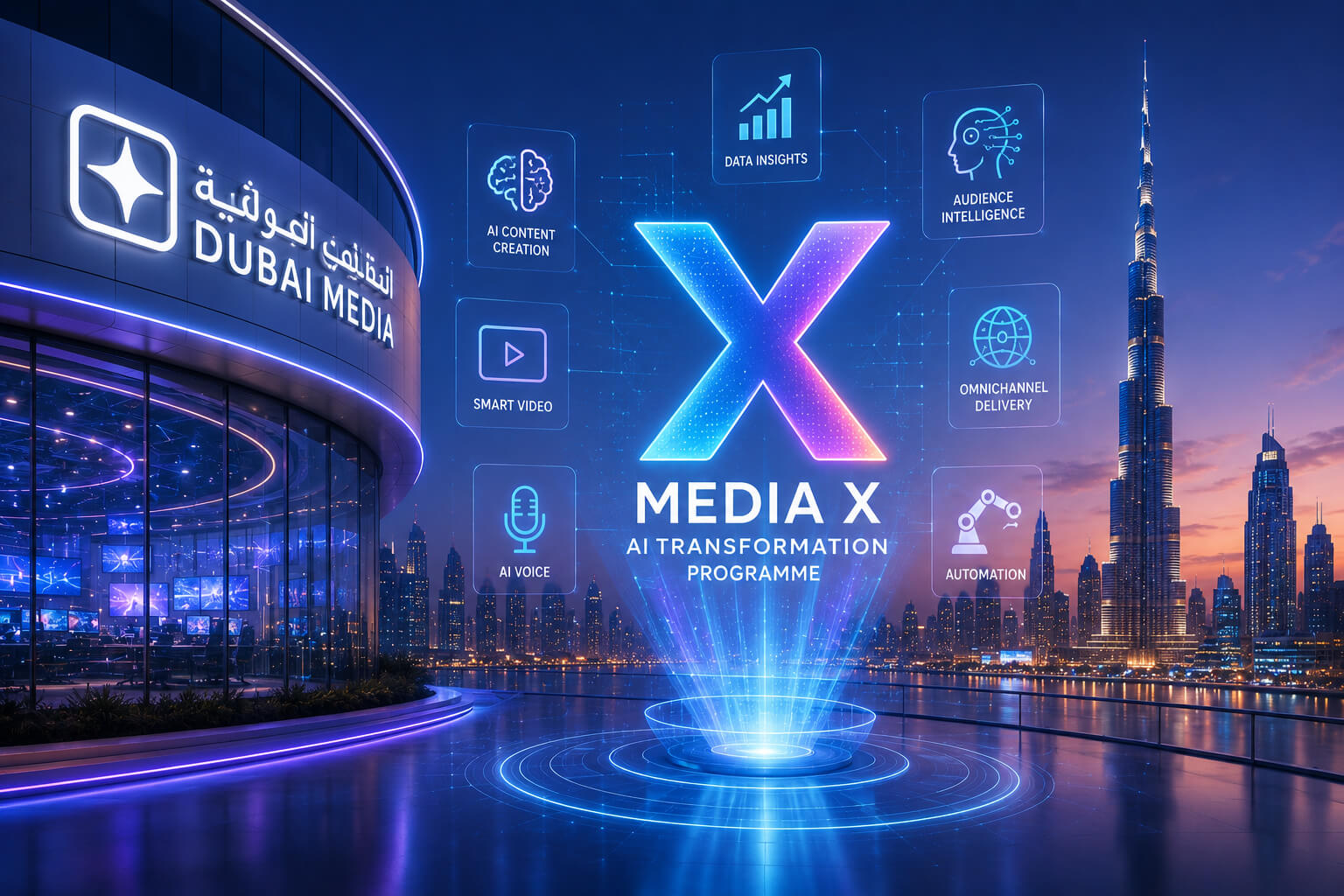
The organisation has launched the Media X AI Transformation Programme, a new initiative designed to embed AI across content creation, production, operations, and internal media workflows. The goal is not just to experiment with new tools. Dubai Media wants to build a next-generation media ecosystem that is faster, smarter, and more prepared for where journalism, entertainment, and digital content are heading.
And honestly, this is where media is going anyway.
Newsrooms are no longer only competing on who publishes first. They are competing on video speed, audience data, platform formats, translation, personalization, automation, and the ability to turn one story into ten different content versions without losing quality. AI is becoming part of that pressure.
Dubai Media Pushes AI Deeper Into Content and Operations
The Media X programme is focused on using AI across several parts of Dubai Media’s work, including content creation, production, and operational processes. That matters because many media companies still treat AI like a side tool. Something for headlines. Maybe captions. Maybe translation.
Dubai Media appears to be aiming for something wider.
This is about putting AI inside the media machine itself. The planning. The production. The workflows. The way teams create and distribute content. The way talent is trained to work with new systems instead of watching those systems arrive from the outside.
That shift is important.
AI in media is not just about replacing manual work. Used carefully, it can help teams move faster, understand audiences better, localize content, support multilingual output, and reduce repetitive production tasks. Used badly, it can flood platforms with shallow content and make trust even harder to protect.
That is the balance Dubai Media now has to manage.
Building an AI-Powered Media Ecosystem in Dubai
Dubai has already been pushing artificial intelligence across government, business, and digital services. The Media X programme now places media more clearly inside that wider AI direction.
Earlier this year, Dubai also launched an initiative aimed at moving the private sector toward agentic AI within two years, showing how seriously the emirate is treating AI adoption across industries.
Media cannot really sit outside that shift.
Audiences are moving across platforms. Video is becoming more fragmented. AI search is changing how people discover information. Social media feeds are being reshaped by recommendation systems. Even the role of a journalist, producer, editor, and content strategist is changing.
Dubai Media’s move suggests it wants to prepare for that future instead of reacting late.
Talent Development May Be the Bigger Story
The technology side gets attention first. AI tools always do.
But the more important part may be people.
A media organisation can buy tools quickly. Training teams to use them well takes longer. Writers, editors, producers, designers, camera teams, social teams, and newsroom leaders all need to understand what AI can do, where it fails, and when human judgment matters more.
Dubai Media Academy has also been running AI-focused training programmes, including sessions on prompt engineering and the future of media after AI.
That makes Media X feel less like a one-off announcement and more like part of a larger media transformation plan.
Because in the end, AI does not automatically create better media. People using AI with taste, ethics, and editorial discipline might.
AI Could Change How Regional Media Competes
The Middle East media market is becoming more digital, more video-led, and more global. Dubai Media already operates in a city that wants to position itself as a hub for technology, business, culture, and media.
AI can help with that ambition.
It can speed up production. Arabic and English content workflows can also become easier to manage. Teams can repurpose long-form shows into social clips more efficiently. In addition, AI can assist with archives, subtitles, audience insights, recommendations, and digital platform management.
But there is also a risk here.
If every media organisation uses the same AI tools in the same way, content starts to feel flat. Headlines begin to look similar. Structures repeat. The tone becomes familiar. Safe language takes over. The winners may be the organisations that use AI for scale while still keeping a strong editorial voice.
Dubai Media’s challenge is not simply to become more automated.
It is to become more distinctive while using automation.
Why Media X Matters Now
The timing is not random.
Generative AI has already changed how content is written, edited, translated, designed, summarized, and distributed. Media companies around the world are now trying to work out what should be automated, what should remain human, and how to protect credibility in the middle of all that.
Dubai Media’s Media X programme puts that question directly inside a major regional media organisation.
It signals that AI is no longer sitting at the edge of media strategy. It is moving into the center.
For Dubai, this is also about future readiness. The city has been building its reputation around digital transformation, smart services, and AI-led growth. A media ecosystem that can use AI responsibly and creatively fits into that wider picture.
The real test comes after the launch.
How will AI be used in daily newsrooms? How much will it improve production speed? Will it support better storytelling or just more content volume? Can Dubai Media keep trust and quality at the center while making its workflows more intelligent?
Those are the questions that matter now.
The Media X programme is a start. The harder part is what comes next.
Sources
- Emirates 24|7: Dubai Media launches “Media X” AI Transformation Programme to build a next-generation media ecosystem.
- Emirates 24|7: Dubai Media Academy rolls out AI-focused training series to support the future of content creation.
- Dubai Media Office: Dubai launches private-sector agentic AI initiative.
