


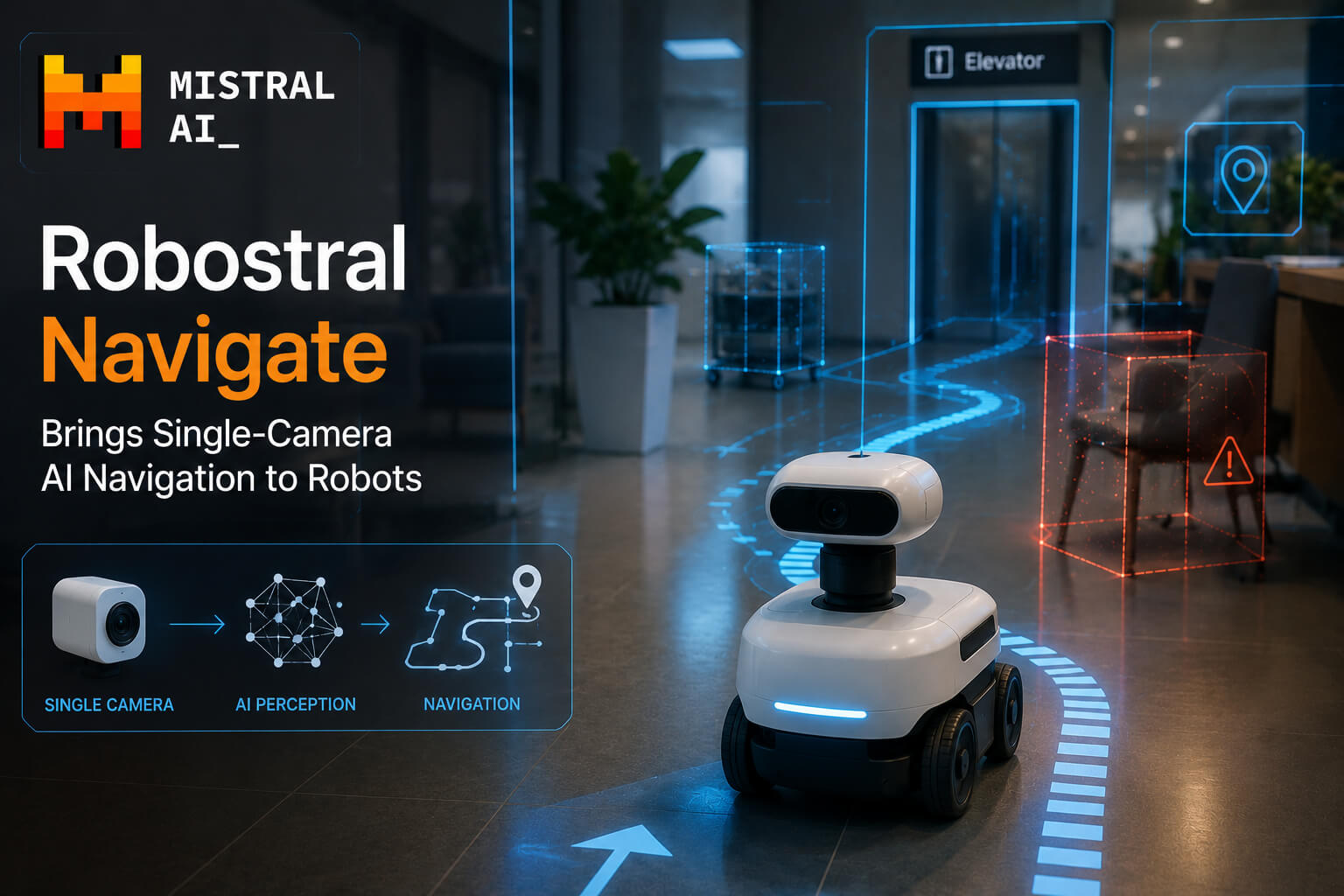
Mistral AI is moving deeper into robotics, and its latest release is not just another model sitting in a benchmark table.
The company has introduced Robostral Navigate, an 8B AI model built for embodied navigation. In simple terms, it helps robots move through real spaces by looking through a single ordinary RGB camera and following plain-language instructions. No LiDAR. No depth sensor. No complicated multi-camera setup.
That is the part that makes this interesting.
A robot can be given a task such as leaving a lobby, moving through a corridor, entering a room, and stopping near a specific shelf. Robostral Navigate is designed to understand that instruction, process what it sees, and decide where to move next.
Mistral Pushes AI From Screens Into Physical Spaces
Most AI model launches still live inside the same world: chat, coding, documents, search, images, agents. Useful, yes. But still mostly screen-based.
Robostral Navigate is different because it touches the physical world. It is built for robots that need to move inside offices, homes, commercial buildings, outdoor areas, logistics spaces, and other changing environments.
That is a harder problem than it sounds. Real spaces are messy. People move around. Objects shift. Lighting changes. A robot may face an obstacle it has never seen before. The path may not look exactly like anything in training.
Mistral says Robostral Navigate can operate across wheeled, legged, and flying robots, while also generalizing across different robot sizes. That gives the model a wider robotics angle, instead of locking it to one narrow hardware setup.
One Camera, No LiDAR, Still Strong Results
The headline claim is performance.
Robostral Navigate reached a 76.6% success rate on the R2R-CE validation unseen benchmark, which tests instruction-following navigation in environments held out from training. Mistral says this beats the best single-camera approach by 9.7 points and even outperforms the best depth or multi-camera system by 4.5 points.
That matters because robotics hardware can get expensive fast. If a navigation system can work well with one normal camera, it could reduce complexity for companies building robots for delivery, hospitality, manufacturing, and logistics.
Not every robot needs a huge sensor stack. At least, that is the direction Mistral seems to be pushing.
How Robostral Navigate Thinks About Movement
Robostral Navigate uses what Mistral describes as pointing-based navigation.
Instead of always telling the robot to move through fixed metric commands, the model predicts where the robot should move next inside the camera view. It points toward the target location in the image and also estimates the orientation the robot should have when it arrives.
That sounds small, but it is important. A pointing-based approach can make the robot less fragile when camera settings or world scale change.
There is still a fallback system. When the target is outside the current view, Robostral Navigate can use local movement instructions, such as moving forward, shifting left, or turning by a certain angle.
So it is not trying to force one method into every situation. It switches when needed.
Built In-House and Trained in Simulation
Mistral says Robostral Navigate was built entirely in-house and does not rely on existing open-source vision-language models.
The model started from Mistral’s own vision-language work focused on grounding tasks such as pointing, counting, and object localization. From there, navigation becomes a natural next step. If an AI system can understand where objects are, the next question is obvious: can it move toward them?
For training, Mistral used simulated data. The company says it built a data generation pipeline that produced about 400,000 trajectories across 6,000 scenes.
That is one reason robotics AI is moving faster now. Training directly in the real world is slow, expensive, and sometimes risky. Simulation gives researchers a way to generate many more scenarios before sending models into physical spaces.
Efficient Training Makes the Model More Practical
One of the more technical but important parts of the release is Mistral’s use of prefix-caching for training.
According to the company, this approach reduced training tokens by 22 times compared with training one sample per time step. That means a training process that might have taken months could instead be completed in days.
That kind of efficiency matters because robotics models are not just judged by whether they work once in a demo. They need to improve, adapt, and become affordable enough for real deployment.
Mistral also used online reinforcement learning after supervised training. The model learns from trial and error, improves recovery from failures, and develops better exploratory behavior. Mistral says this added a 3.2% improvement in success rate.
Small percentage? Maybe on paper. In robotics, where one bad move can stop the whole task, that improvement is not nothing.
Why This Release Matters for Robotics
Robostral Navigate points to a bigger shift in AI.
The industry is trying to move from models that answer questions to models that act. First in software. Then through agents. Now, increasingly, inside machines that move through the world.
Navigation is one of the basic skills robots need before they become broadly useful. A delivery robot needs it. A warehouse robot needs it. A hospitality robot needs it. A home assistant robot definitely needs it.
Mistral is positioning Robostral Navigate as a first step toward a more unified embodied AI agent. That phrase can sound big and vague, but the direction is clear enough. AI systems are being trained not only to see and understand, but also to move, adjust, and complete tasks in physical environments.
Mistral’s Robotics Ambition Is Getting Clearer
Mistral has already built its reputation around language and multimodal AI, but Robostral Navigate shows that the company wants a place in embodied AI too.
The timing also fits the broader market. Robotics is heating up again, partly because large AI models are making perception, reasoning, and instruction-following more flexible. The old robotics problem was not only motors and hardware. It was understanding the world well enough to act in it.
Robostral Navigate does not solve all of robotics. Not close. But it does show where the field is going: smaller models, better grounding, less sensor dependency, and more practical movement through real spaces.
A robot that can follow one instruction and move through an unfamiliar environment using one camera is a meaningful step.
Not flashy in the consumer gadget sense. But for robotics, it is the kind of progress that could quietly matter a lot.
