


Artificial intelligence is usually judged by the usual scorecard. Accuracy. Coding. Reasoning. Safety. Speed.
But Anthropic is now pointing at something a little harder to measure: personality.
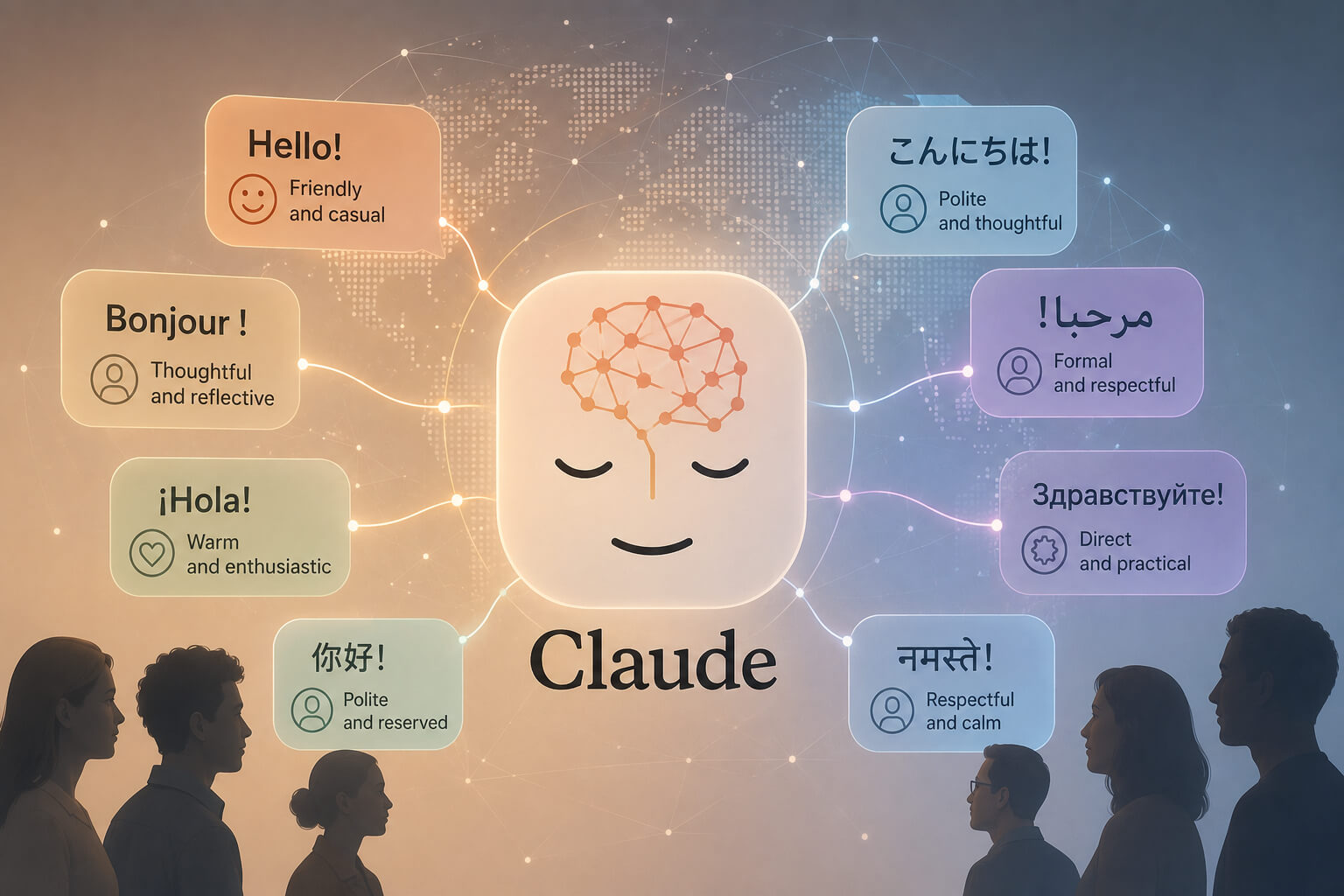
A new Anthropic study suggests that Claude does not communicate in exactly the same way across different models and languages. Not just different words. Different style. A shift in tone. Varying levels of warmth, caution, detail, and directness.
That sounds small at first. It is not.
When millions of people use AI tools for work, study, advice, writing, research, or decision-making, the way an answer feels can shape how much they trust it. A warm answer may feel more supportive. A cautious answer may feel more serious. A direct answer may feel more useful. A detailed one may feel more reliable.
And according to Anthropic, those differences are already showing up.
Anthropic Looks Beyond AI Intelligence
Anthropic said it studied Claude’s expressed values across different models and languages. The company previously identified more than 3,000 values in Claude’s responses, then grouped those into a smaller set of broader value categories.
For this new research, Anthropic analyzed more than 309,815 anonymized Claude.ai conversations. The goal was not simply to ask whether Claude got an answer right. The researchers wanted to understand how Claude behaves while answering.
That is where the study gets interesting.
Anthropic compressed Claude’s communication patterns into four main value axes: deference versus caution, warmth versus rigor, depth versus brevity, and candor versus execution.
In plain language, the study asked questions like this: Does Claude try to please the user, or does it warn them about risks? Is its tone friendly, or more precise and analytical? Will it explain deeply, or keep things short? And when uncertainty appears, does it admit that or focus on getting the task done?
Those are not just writing style choices. They affect the whole user experience.
Claude Models Do Not Sound the Same
Anthropic found that different Claude models carry different value profiles.
Sonnet 4.6 leaned more toward warmth, deference, and brevity. That means it was more likely to sound encouraging, friendly, and concise.
Opus 4.6 leaned toward rigor, deference, and brevity. In simple terms, it appeared more focused and straight to the point, while still staying within the user’s request.
Opus 4.7 showed a different pattern. Anthropic said it leaned more toward caution, rigor, depth, and candor. So it was more likely to challenge assumptions, point out risks, explain reasoning, and admit uncertainty.
That may explain why users sometimes feel that one model is “friendlier” while another feels more serious or more critical. It is not always imagination. Some of that difference may be measurable.
Claude Personality Changes Across Languages
The bigger finding is about language.
Anthropic said Claude’s expressed values change depending on the language being used. English responses leaned more toward caution, rigor, depth, and candor. Hindi responses leaned furthest toward warmth. Arabic responses leaned toward warmth, deference, brevity, and execution.
Russian responses leaned most toward rigor. Dutch responses showed the strongest candor, while Indonesian responses leaned most toward execution.
That is a strange but important finding.
It means two users may ask a similar kind of question in two different languages and receive answers that feel different in tone and attitude. One person may get a warmer answer. Another may get a more critical one. Someone else may get a shorter, more action-focused response.
The answer may still be technically correct. But the experience is not the same.
This Is Not Just About Translation
This matters because AI translation is often treated like a language problem. Convert English to Arabic. Shift Arabic into Hindi. Then turn Hindi into Dutch.
But Anthropic’s research suggests the issue goes deeper than words.
An AI model may not simply translate meaning. It may also shift tone, caution, directness, and emotional style as it moves across languages.
That could come from training data. Some languages may have more professional, academic, or technical material available online. Others may have more conversational or culturally specific data. It may also come from the way people naturally communicate in different languages.
Anthropic was careful not to say that these results prove something fixed about the languages themselves. The company said the differences may come from training data, cultural communication patterns, or how behavioral training transfers across languages.
That caution is important.
Still, the result leaves a big question sitting on the table.
Should AI behave the same way in every language, or should it adapt to local communication norms?
The Fairness Problem Gets Complicated
There is a good argument for adaptation.
People do not communicate the same way in every culture. Tone, politeness, directness, humor, and formality all shift depending on language and context. A chatbot that ignores those differences may feel stiff or unnatural.
But there is also a fairness problem.
If Claude is more cautious in English but warmer and more deferential in another language, users may experience the same AI system differently. That can matter in sensitive fields like healthcare, education, legal information, finance, government services, or workplace decision-making.
A warmer response can feel reassuring. Maybe too reassuring.
A more cautious response can push someone to think harder. Maybe too hard.
A shorter response may be convenient. It may also leave out important nuance.
This is where AI personality stops being a cute product feature and becomes an AI governance issue.
AI Companies May Need Value Testing, Not Just Safety Testing
The study points toward a future where AI companies test models not only for hallucinations, toxic outputs, refusal behavior, and benchmark performance, but also for value expression.
That sounds abstract, but it is practical.
Before launching a model, companies may need to ask: Is this AI equally careful across languages? Is it equally honest about uncertainty? Does it give users in one language more detail than users in another? Does it challenge bad assumptions only in certain regions or linguistic groups?
Those questions are going to matter more as AI becomes embedded in search, customer service, education, workplace tools, healthcare support, and public information systems.
A model’s personality is not just decoration. It changes how people understand the answer.
Why This Study Matters
Anthropic’s research makes one thing clear: AI systems do not only deliver information. They deliver information with a personality attached.
Sometimes that personality is warm. At other times, it feels cautious. It can also sound blunt. In some cases, it becomes polished enough to hide uncertainty.
The uncomfortable part is that users may not realize those differences are happening.
Claude may feel like one assistant, but Anthropic’s own research suggests its behavior can shift across models and languages in measurable ways. That does not automatically mean the system is broken. It does mean the industry has a new problem to take seriously.
AI is already global. Its personality now has to be global too.
