


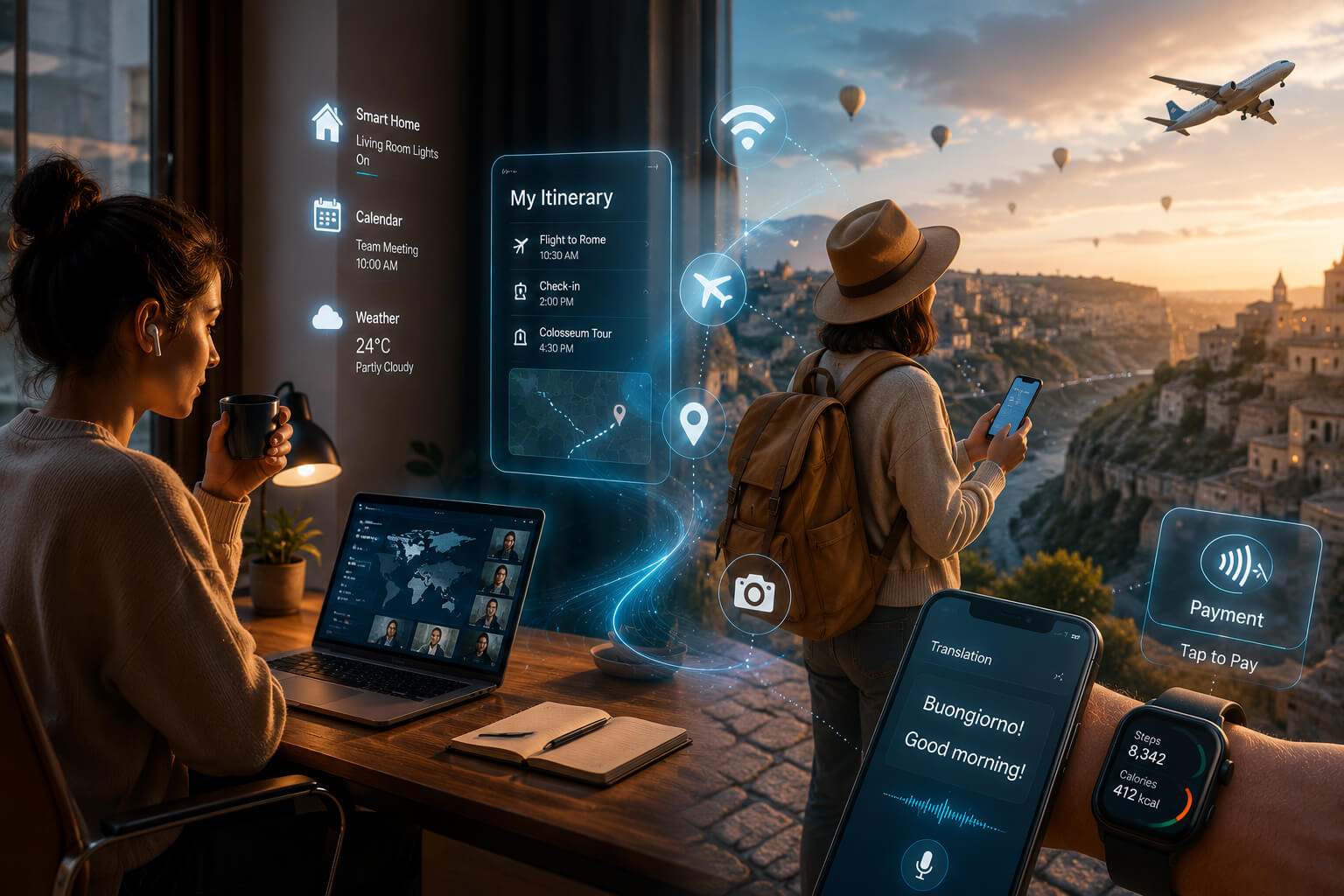
Travel used to mean leaving things behind. Today, technology in modern travel has completely changed how we experience the world.
You packed a bag. You switched off work. Maybe you printed a boarding pass, told a few friends you would be away, and disappeared from your normal routine for a while.
That version of travel feels older now. Not gone completely, but definitely weaker.
Today, travel sits inside the same digital world as everything else. Work chats follow people across airports. Friends stay close through messaging apps. Entertainment travels with them. Payments, maps, bookings, translation, customer support, and even trip ideas now live inside one screen.
A recent LEAP Insights article looked at this shift, arguing that technology has changed travel from a separate life event into something much more connected to everyday living. Younger travelers are pushing that change fastest, especially as they expect booking, planning, payment, and support to work as smoothly as the apps they already use every day.
Travel No Longer Feels Like a Break From Real Life
There was a time when travel had a clear start and end. You planned the trip, went away, came back, and returned to normal life.
That structure is much messier now.
Remote workers can answer emails from cafés in another country. Students mix study programs with long trips. Creators film, post, earn, and build audiences while moving from place to place. Some travelers extend their stays simply because their work can move with them.
So travel is no longer just a holiday or a temporary escape. For many people, it overlaps with work, identity, self-development, education, and lifestyle.
The tools made that possible. Cloud platforms keep work accessible. eSIMs make connectivity easier. Digital wallets reduce friction. Translation apps make unfamiliar places less intimidating. AI assistants are starting to help people plan and adjust trips in real time.
The suitcase is still physical. The rest of the experience is increasingly digital.
Social Media Has Become the New Travel Agent
Travel inspiration does not always start on a booking site anymore.
It starts in a feed.
A short video of a quiet street in Kyoto. A creator showing a food market in Bangkok. A hidden beach in the Philippines. A hotel room tour. A train ride across Europe. A “places you must visit” clip that appears while someone is not even planning a trip.
That is how travel decisions happen now. Not always through research. Sometimes through mood.
According to the LEAP Insights article, Skyscanner’s 2026 Gen Z travel research found that TikTok is the most popular travel inspiration source for UK Gen Z travelers, with Instagram following behind. It also reported that most Gen Z travelers globally follow at least one travel influencer on TikTok.
That changes the whole travel funnel.
People do not simply search for destinations. They react to stories, visuals, personalities, and social proof. A place becomes attractive because someone made it feel real. Not polished brochure real. Phone-camera real.
For travel brands, that is both an opportunity and a problem. The old model of selling rooms, flights, and packages is not enough. Travelers want context. They want feeling. They want to know what a place is actually like before they commit.
AI Is Becoming Part of the Journey
AI is also moving deeper into travel planning.
Not in a dramatic science fiction way. More like this: fewer tabs, fewer searches, less manual comparison.
A traveler might want a five-day trip with good food, walkable neighborhoods, a mid-range hotel, late-night activities, and a quiet place to work in the morning. That is not just a booking request. It is a personal preference stack.
AI travel tools are being built for that kind of messy human request.
The LEAP Insights piece cited Skyscanner data showing that confidence in using AI for trip planning and booking is rising among UK Gen Z travelers. It also referenced Amadeus research showing that AI helps some travelers save time and discover new destinations.
That matters because travel planning has always been full of small decisions. Flights. Hotels. Neighborhoods. Visas. Transport. Restaurants. Weather. Safety. Local customs. Budget. Timing.
AI does not remove all of that. Not yet. But it can compress the planning process and make travel feel more conversational.
Instead of “search, compare, open another tab, repeat,” the future may look more like asking, adjusting, refining, and booking inside one connected system.
Convenience Is Not the Whole Story
It would be easy to say travelers only want speed.
That would be wrong.
Younger travelers may expect smooth digital systems, but they are also asking harder questions. Where does their money go? Who benefits from tourism? Is the experience local or manufactured? Does the platform care about the destination, or only the transaction?
The LEAP Insights article highlighted this tension, noting that younger travelers want convenience, but also transparency and purpose. It also cited American Express’ 2026 Global Travel Trends report, which found strong interest among Millennials and Gen Z in unique, authentic experiences rather than traditional tourist attractions.
That is a useful signal for travel technology companies.
Automation alone will not win loyalty. A fast booking system is good. A cheap deal helps. But travelers are also looking for trust, local connection, and experiences that feel less generic.
The best platforms may not be the ones that simply move people from search to checkout faster. They may be the ones that make people feel more informed before they go and more connected when they arrive.
The Meaning of “Away” Is Changing
This might be the biggest shift.
Technology has made it harder to fully leave.
Work follows through laptops. Friends follow through apps. Entertainment follows through streaming platforms. Banking, identity, maps, photos, and memories all live on the same device. AI assistants may soon become normal companions for planning, translating, navigating, and troubleshooting while abroad.
That makes travel easier. It also makes it harder to disconnect.
The old idea of being “away” depended on distance. Now distance matters less because digital life is portable. A person can be in another country and still remain inside the same routines, chats, feeds, tasks, and obligations.
So modern travel is not just about movement anymore. It is about connection. Constant connection, sometimes too much of it.
Travel Technology Is Becoming Invisible
The most important travel technology may soon be the kind people barely notice.
A payment works. A translation appears. A booking updates. A delay is handled. A recommendation fits the traveler’s mood. A support request is answered before frustration builds.
No drama. A smoother system. No switching between ten disconnected apps.
That is where the industry seems to be heading. Travel technology is becoming more joined-up. AI assistance is growing. Personalization matters more. As a result, travel brands face more pressure to feel useful before, during, and after the trip.
Travel has not stopped being physical. People still want the airport rush, the hotel check-in, the street food, the new city, the feeling of being somewhere else.
But technology has changed the frame around it.
The journey now begins before the airport and continues long after the return flight. It lives in feeds, calendars, maps, chats, wallets, and AI tools. Travel is still travel, but it no longer sits outside everyday life.
It has become part of it.
Source: LEAP
