


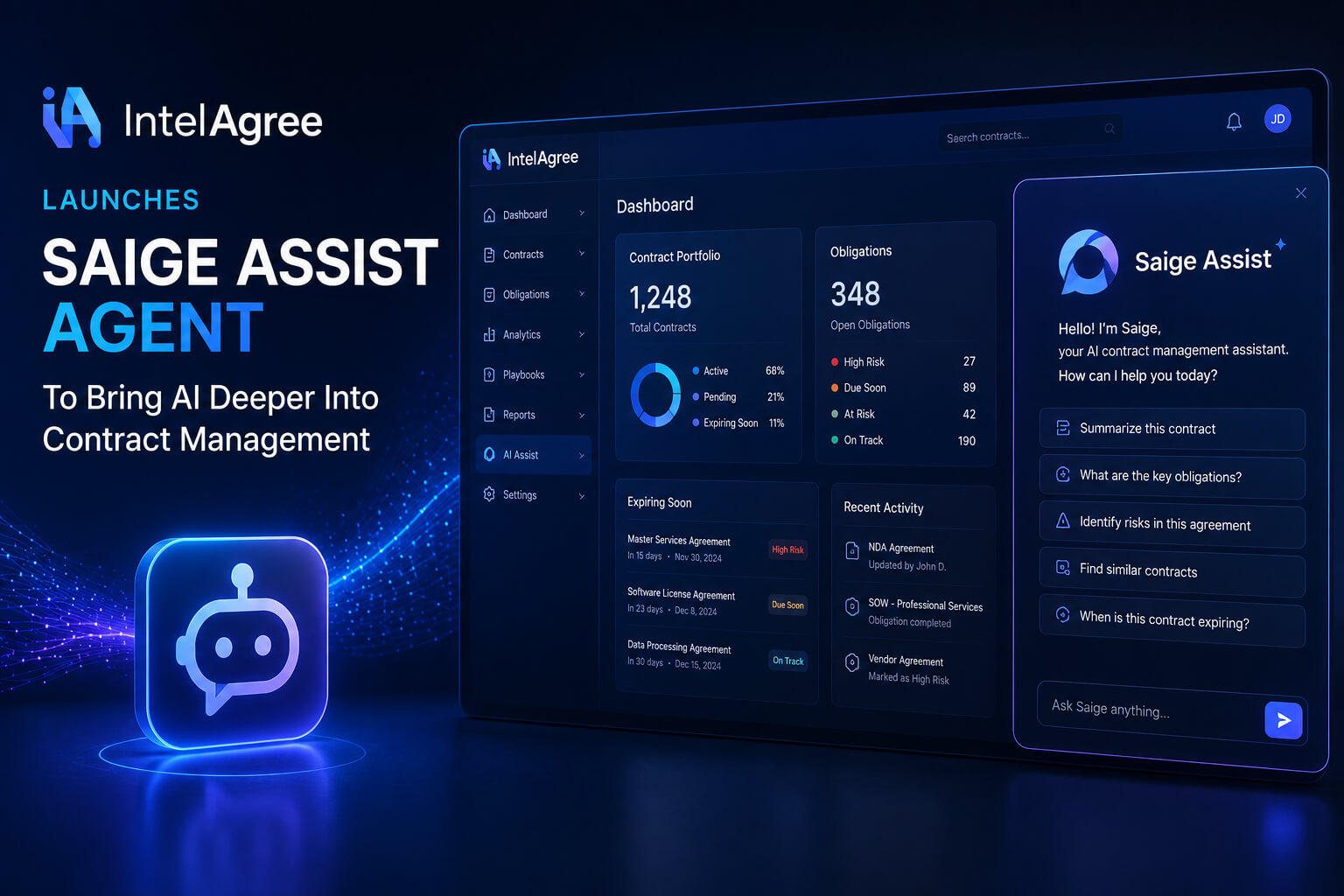
IntelAgree is pushing its contract intelligence platform further into agentic AI with the launch of Saige Assist: Agent, a new general-purpose AI agent built for contract portfolios.
This is not being positioned as a small chatbot feature attached to a contract platform. IntelAgree says the agent can work across a customer’s clause library, playbooks, negotiation history, and contract data to answer questions, compare versions, redline agreements, build dashboards, run analysis, and even make approval-gated updates inside the CLM platform.
That last part matters. A lot of AI tools in legal tech still stop at “here is an answer.” Useful, sometimes. But contract teams usually need the next step too. A redline. A risk summary. A comparison against past language. A dashboard. A change that actually lives inside the system, not just inside a chat box.
Saige Assist: Agent is IntelAgree’s attempt to move closer to that.
One AI Agent for the Whole Contract Portfolio
The company says Saige Assist: Agent is now in the final stage of private beta with select customers. Instead of giving users multiple narrow agents for separate jobs, IntelAgree is going with one broader agent that can reason across the full contract portfolio. That sounds simple, but in contract management it is a pretty big shift.
Contracts are messy. The same clause can mean different things depending on the customer, the counterparty, the deal size, the previous negotiation, and the company’s internal playbook. A generic AI model may write polished legal-sounding language, but that does not automatically mean it understands how a specific company negotiates.
IntelAgree’s pitch is that Saige Assist: Agent works from the customer’s own agreements and standards, not just a broad language model response. Kyle Myers, IntelAgree’s Chief Product Officer, said the agent was built to reflect the customer’s own agreements, playbooks, and negotiation patterns rather than a general LLM consensus. That is the core idea here: contract AI with memory of how the business actually works.
Redlining Is Only One Part of the Job
Saige Assist: Agent can redline and rewrite contracts against a customer’s playbook, clause library, and earlier versions negotiated with the same counterparty. Users can choose how much control they want the agent to take, from a broad first review of a routine renewal to a more careful clause-by-clause edit for a high-stakes deal.
The workflow also extends into Microsoft Word through the IntelAgree Word add-in, which is important because legal and contract teams still live there more than most software companies would like to admit. But IntelAgree is clearly trying to make the agent bigger than redlining.
The agent can answer natural-language questions across contract portfolios, compare contracts with past versions and prior agreements, summarize risk and compliance, build custom HTML dashboards, run scripts on contract data, and create interactive reports. That moves it from “AI legal assistant” into something closer to an operational contract analyst.
Approval-Gated AI Keeps Humans in Control
The company is also leaning heavily into approval controls.
Saige Assist: Agent can add comments, create and edit contract type playbooks and rules, and draft personas from a live negotiation, but IntelAgree says changes are confirmed before anything is saved. That is probably the only way this type of tool works in serious enterprise settings.
Legal teams may want speed. They do not want a system quietly changing contract standards, rules, or negotiation language without review. AI can help, but the final decision still needs to sit with a person, especially when the output affects risk, obligations, approvals, or compliance.
Michael Schacter, IntelAgree’s Director of Product Management, said the agent’s work does not stop at an answer and that changes inside the platform will be presented for approval first. That is the balancing act: make the AI useful enough to do real work, but not so autonomous that contract teams lose trust in it.
Personas and Prompt Libraries Make the Agent More Team-Specific
IntelAgree is also adding role-based customization through shareable personas and a reusable prompt library. These personas can be used inside the Microsoft Word add-in, while repeatable work can be handled through reusable Skills for the team. This part may sound like a small feature, but it could be useful in practice.
A legal counsel, procurement manager, sales operations user, and contract administrator do not always need the same style of answer. One may care about liability language. Another may care about renewal dates. Another may need quick risk scoring before a deal moves forward. If the agent can adapt to those workflows without forcing every user to write the same long prompt again and again, it becomes less of a novelty and more of a daily tool.
Why This Matters for Contract Lifecycle Management
Contract lifecycle management has always had a data problem hiding under a document problem. Companies sign thousands of agreements, then struggle to understand what is inside them. Obligations, renewal dates, risky clauses, negotiated exceptions, approval rules, and compliance requirements often sit buried in dense legal text.
IntelAgree has already offered AI contract redlining, negotiation, extraction, and risk analysis, along with integrations for Salesforce, Workday, Bullhorn, Docusign, and other tools. The new Saige Assist: Agent builds on that existing platform rather than launching as a standalone AI assistant.
That matters because enterprise AI is only useful when it connects to the actual business workflow. A nice summary is helpful. A redline based on company standards is better. A dashboard built from portfolio data is better again. An approval-gated update inside the CLM platform is where the tool starts to feel less like a chatbot and more like infrastructure.
Private Beta Comes Before Wider Access
Saige Assist: Agent is currently in the final stage of private beta, and IntelAgree says customers can request access through their customer success manager. For now, the launch is less about mass availability and more about where enterprise AI is heading.
The early wave of generative AI in legal and contracts focused heavily on drafting, summarizing, and clause suggestions. The next wave looks more operational. These agents can understand internal standards. They can also compare against history. In addition, they can build reports, update workflows, and still wait for human approval before making changes. That is the more interesting part of IntelAgree’s announcement. Not just AI that writes contract language. AI that knows why your team would accept, reject, or rewrite it.
