


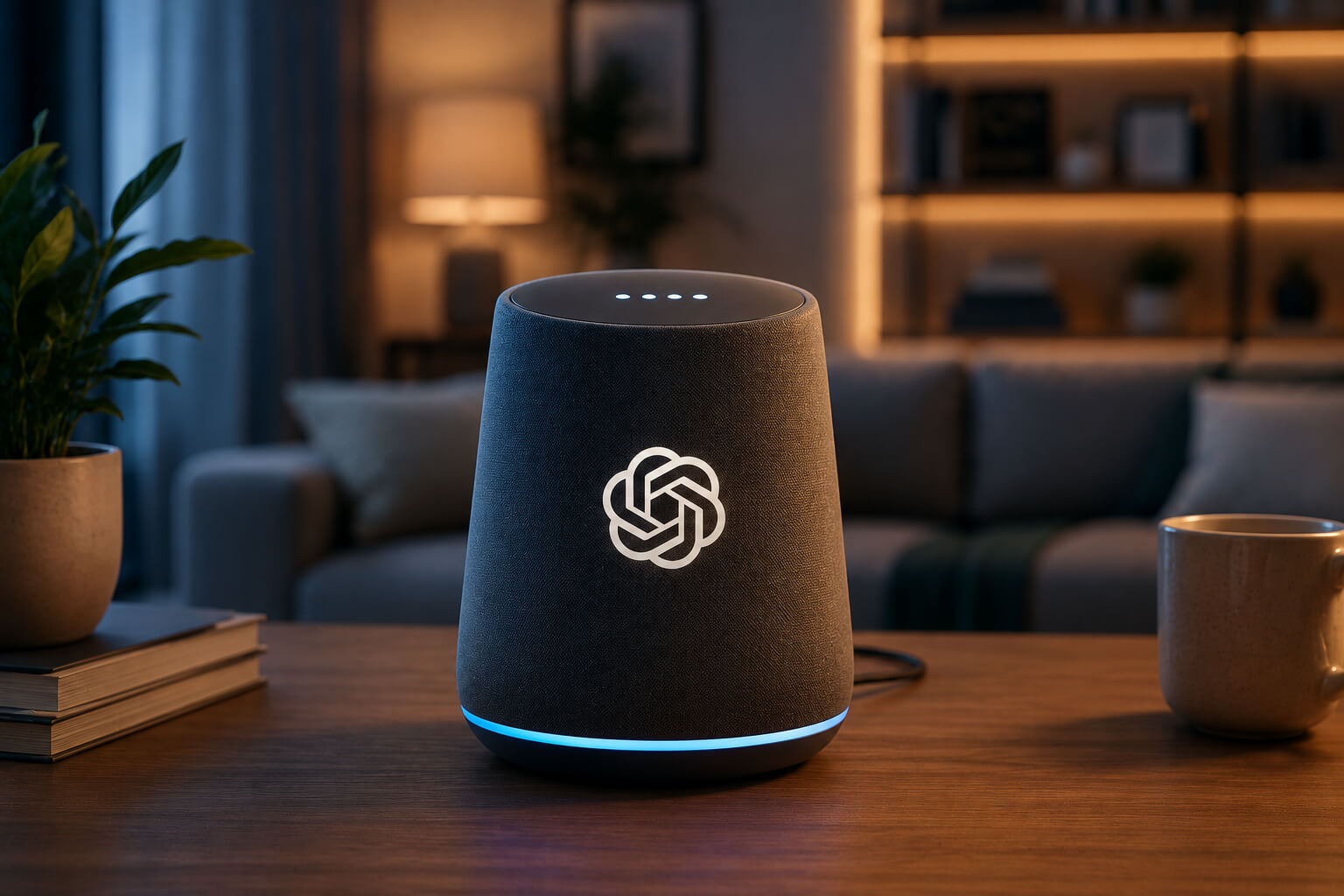
OpenAI may be getting ready to take ChatGPT off the screen and place it somewhere much more personal: inside the home.
The company is reportedly working on an OpenAI smart speaker powered by ChatGPT, a device that could put OpenAI directly against Amazon Alexa, Google Assistant, and Apple’s HomePod. This is not just another rumor about AI hardware. It feels more like OpenAI testing whether people actually want an AI assistant that lives with them, listens better, understands context, and does more than answer basic commands.
For years, smart speakers have mostly been useful in a limited way. Play music. Set timers. Turn lights on. Ask for the weather. Maybe control a few smart home devices. Useful, yes. Transformative? Not really. That is probably the opening OpenAI sees.
A ChatGPT Speaker Sounds Simple, But It Could Be a Big Shift
A ChatGPT-powered speaker would not need to behave like the smart speakers people already know. OpenAI’s advantage is conversation. Not just voice recognition, but more natural back-and-forth replies, memory-style interaction, and the ability to help with tasks that require more than one sentence.
That changes the product. Instead of saying, “Set a reminder,” a user might ask the device to plan their day, summarize messages, help draft a reply, explain something aloud, or manage a chain of small tasks across apps. That is where OpenAI could try to separate itself from older voice assistants. Alexa and Google Assistant were built for commands. ChatGPT was built for conversation. That difference matters.
OpenAI Hardware Plans Are Getting More Serious
Reports suggest OpenAI has been working on a wider family of AI-powered devices, with a smart speaker expected to be among the first. Earlier reports also mentioned possible smart glasses and even a smart lamp, showing that OpenAI may be thinking beyond one gadget.
The speaker is reportedly expected to be priced somewhere around $200 to $300, although final pricing and release timing are still uncertain. Some reports have also suggested that the device may include a camera, allowing it to understand more about the user’s surroundings. That part will get attention.
A camera-equipped AI speaker could make the device far more useful. It could see objects, read a room, understand context, or help users with visual tasks. But it also raises the obvious privacy question. People may like powerful AI. They may not like the idea of an always-present device watching from a table. OpenAI will have to explain that part carefully.
Why This Is Not Just Another Alexa Rival
The smart speaker market is already crowded, but it has also become strangely stale. Amazon pushed Alexa hard, then struggled to turn it into a major profit engine. Google Assistant remains widely available, but it no longer feels like the center of Google’s AI strategy. Apple’s HomePod is polished, but still more of an audio product than a serious AI assistant.
OpenAI could enter with a different pitch. Not “ask your speaker a question.” More like: “Talk to your AI.” That sounds small, but it changes the emotional feel of the device. A speaker powered by ChatGPT could become less of a household appliance and more of a daily companion for work, planning, learning, and home tasks. Of course, that is the clean version of the story. The harder version is whether people actually want that much AI in their private space.
Jony Ive’s Role Makes the Device More Interesting
OpenAI’s hardware push has drawn attention partly because of its connection to former Apple design chief Jony Ive. OpenAI acquired io Products, a startup co-founded by Ive, in a deal reportedly valued at $6.5 billion. That move made it clear that OpenAI was not treating hardware as a side experiment. Design will matter here.
AI devices have failed before because they looked exciting in demos but felt awkward in real life. Humane’s AI Pin is the easy example. Rabbit’s R1 also showed how difficult it is to build a dedicated AI gadget that people keep using after the novelty fades.
A smart speaker is a safer starting point. People already understand the category. They already put speakers in kitchens, bedrooms, offices, and living rooms. OpenAI does not need to convince users that the form factor should exist. It only needs to prove that its version is smarter enough to matter.
The Real Battle Is Trust
The biggest challenge for an OpenAI smart speaker may not be Amazon or Google. It may be trust. A home AI device needs permission to hear more, know more, and possibly see more. That is a lot to ask. OpenAI can talk about productivity, personalization, and smarter assistance, but users will still want clear answers.
- What is stored?
- What is processed locally?
- What goes to the cloud?
- Can the camera be turned off?
- Can the device forget things?
- Who gets access to the data?
Those questions will decide whether the product feels helpful or creepy.
OpenAI Wants AI to Move Beyond the Chat Window
The bigger message is clear. OpenAI does not want ChatGPT to stay trapped inside a browser tab or phone app forever. A smart speaker would move ChatGPT into daily routines. Morning questions. Work reminders. Cooking help. Family schedules. Quick summaries. Voice-first search. Maybe even companionship, depending on how far OpenAI wants to push the idea.
That is where the AI race is heading now. Not just better models. Not just faster answers. More physical presence. If OpenAI gets this right, the smart speaker could become its first serious step into consumer AI hardware. If it gets it wrong, it may become another reminder that AI software and AI gadgets are very different businesses. Either way, the home is becoming the next battlefield.
