


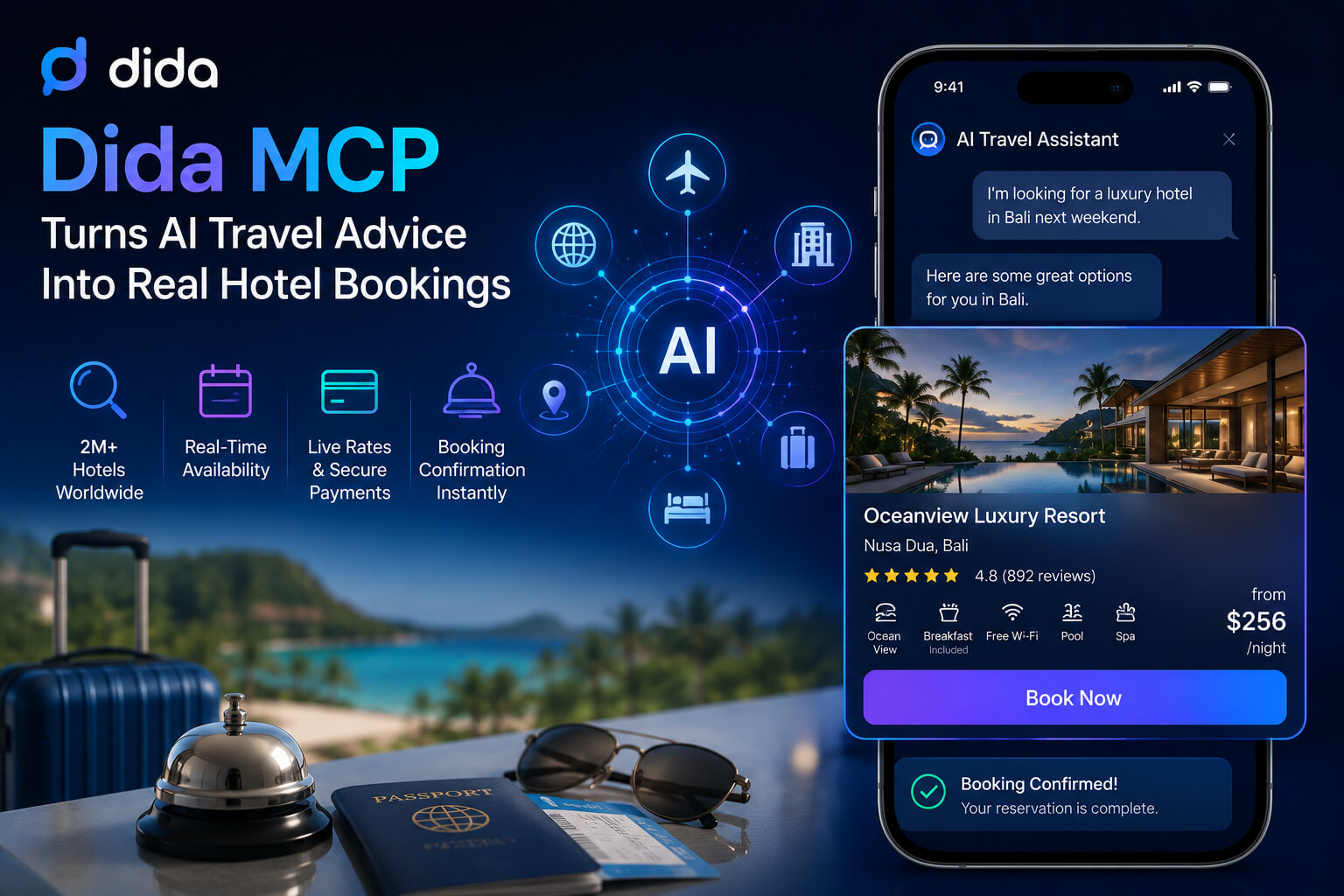
AI can suggest a hotel. That part is easy now.
The harder part is getting from “you should stay here” to an actual confirmed booking, with live availability, rates, payment, confirmation, servicing, and all the messy travel infrastructure behind it.
That is the gap Dida Holdings is trying to close with its new Dida MCP, an AI-native booking gateway built for approved B2B partners. The company says the system lets partners bring hotel search and booking from Dida’s global portfolio of more than 2 million hotel properties directly into their own AI apps, agents, platforms, and customer experiences.
Dida Wants AI Travel Tools to Do More Than Talk
There are already plenty of AI travel assistants that can recommend destinations, compare hotel styles, or build a loose itinerary in seconds.
Useful, yes. But not complete.
A traveller still needs to book something. They need a room that is actually available. They need the price to be live. They need the confirmation to go through. And if something goes wrong, there has to be a real system behind the booking.
Dida MCP is being positioned around that exact problem. Instead of sending users out of an AI assistant or partner app and into a separate hotel booking flow, approved partners can let users search, compare, and book hotels inside their own environment. No awkward handoff. No lost customer relationship at the final step.
That matters because the most valuable moment in travel is not always the recommendation. It is the booking.
The Partner Keeps the Customer Relationship
Dida is not presenting this as a consumer travel app. That is important.
The company says Dida MCP extends its existing B2B travel model into what it calls the AI agent economy. In plain terms, Dida sits behind the partner. The partner keeps the brand, the customer, and the data relationship, while Dida handles the hotel infrastructure behind the scenes.
That could appeal to travel agencies, OTAs, tour operators, wholesalers, TMCs, banks, loyalty platforms, telcos, superapps, e-commerce platforms, and other businesses that already have large audiences but do not want to build hotel supply and booking infrastructure from scratch.
The pitch is simple: bring the customer, keep the experience, let Dida do the heavy lifting.
Why This Fits the AI Agent Shift
AI travel planning is moving fast, but travel fulfillment is still not something a chatbot can fake.
A model can describe a hotel. It can rank options. It can build a polished recommendation. But it cannot invent live inventory or guarantee that a room is still available at the price shown.
That is where infrastructure companies become more important.
Dida says its platform supports hotel content, rates, availability, booking, confirmation, payments, settlement, and servicing. The company was founded in 2012 and now covers more than 2 million hotel properties in over 100 countries.
So this is not really about making AI sound better at travel. It is about letting AI-powered products complete the transaction.
Dida MCP Could Help Non-Travel Brands Enter Travel Faster
One interesting part of this launch is that it is not only aimed at traditional travel companies.
Banks, card programs, loyalty platforms, telcos, consumer device makers, and superapps are all possible users. These companies already sit close to consumers. Some have payments. Some have rewards. Some already know when users might be planning a trip.
But building travel supply is painful.
Hotel distribution is full of rates, rules, availability checks, payment flows, confirmation systems, customer support requirements, and partner agreements. Dida MCP gives these companies a faster way to add hotel booking without trying to become a full travel infrastructure company overnight.
That could make AI travel booking appear in places where people do not usually expect it: banking apps, loyalty portals, messaging-style agents, connected devices, and other digital ecosystems.
Secure Access Is Part of the Setup
Dida MCP uses OAuth-based authorization, giving approved partners and their AI agents controlled access to Dida’s hotel tools. That permissioned model matters because travel booking involves customer data, payment information, booking records, and service workflows.
The customer journey remains inside the partner’s product, while Dida supports the transaction underneath. So the experience feels native to the partner, not like a redirect to another travel site.
Hotels May Get a New AI-Led Demand Channel
For hotels and suppliers, this also opens another route to demand.
As more discovery moves into AI assistants and agent-driven platforms, hotels will need to appear in places beyond traditional search engines and travel websites. Dida MCP could help hotel inventory reach partner ecosystems while still keeping the controlled B2B distribution process in place.
That may become more important as travellers start asking AI agents to plan, compare, and book in one flow.
Not someday. Pretty soon.
Dida Starts With Hotels, But Plans More
Dida MCP is launching first with global hotel supply. That makes sense because hotels are one of the biggest and most complicated parts of travel to fulfill properly.
The company expects the same approach to expand later into other travel content, including flights, ground transportation, and experiences. For now, Dida is inviting selected partners from travel, hospitality, financial services, loyalty, technology, and consumer platform sectors into early access.
The bigger signal is clear enough.
AI travel tools are entering a new phase. The winners may not be the ones with the friendliest chatbot voice. They may be the ones that can turn a recommendation into a confirmed booking without breaking the user experience.
