


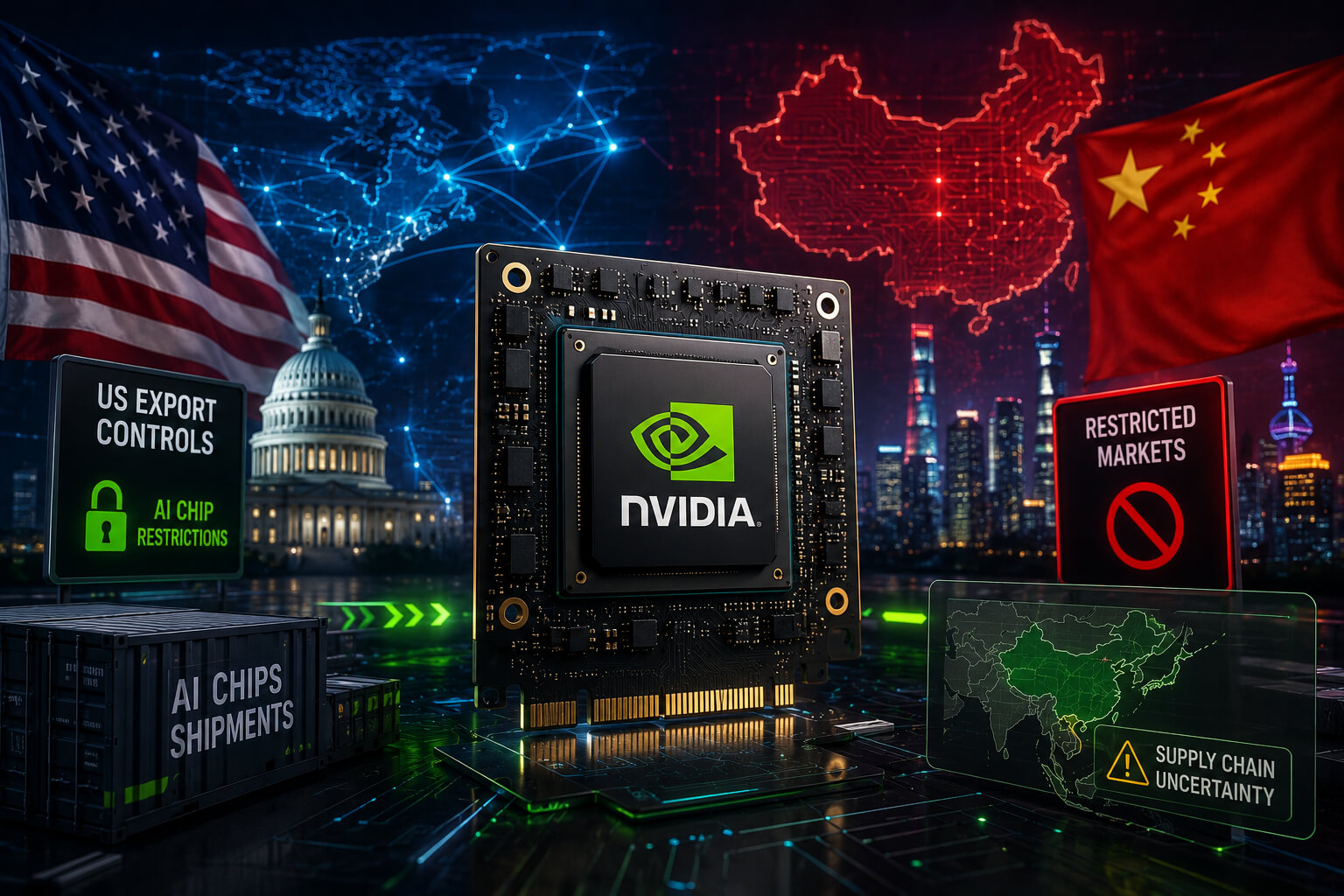
NVIDIA is no longer treating AI chip sales in Asia like a normal supply chain problem.
The company has reportedly reduced the number of approved Asian buyers for its advanced AI chips after introducing stricter customer checks. The move comes as Washington increases pressure on chipmakers to stop high-performance processors from reaching China through nearby markets.
That sounds technical. It is not just technical.
This is the AI race moving from model launches and benchmark charts into paperwork, site visits, customer lists, export rules, and geopolitical suspicion.
NVIDIA AI Chip Sales in Asia Face New Scrutiny
According to reports, NVIDIA has tightened its approval process for Asian customers buying advanced AI processors. The company has reportedly removed more than half of previously approved buyers from its sales list after tougher compliance checks.
The focus appears to be on markets such as Singapore, Malaysia, and Japan, where cloud providers and data center operators may be asked to prove exactly who is using the chips and where the computing power will end up.
This is not simple customer verification anymore.
NVIDIA staff are reportedly checking data centers, reviewing contracts, and examining end users before allowing purchases. Buyers that fail the process may be able to reapply after meeting compliance requirements.
That is a big shift. A chip sale is no longer just a sale. It is now a trust test.
Why the US Is Watching Asian AI Chip Routes
The concern is clear enough. The US has already restricted China’s access to the most advanced AI chips, especially those used to train and run powerful AI models. But restrictions on direct sales leave another question open.
What happens when the chips are bought somewhere else?
That is where Asia becomes important. Countries such as Singapore and Malaysia have major technology, cloud, and data center activity. They are legitimate markets. They are also close enough to China’s AI ecosystem to attract US attention.
Washington is worried that restricted chips could move through intermediaries, subsidiaries, or third-party cloud arrangements before eventually supporting Chinese AI development.
So now the enforcement seems to be moving deeper into the supply chain. Not just who buys the chip. Funding sources matter too. Data center control becomes another question. Access to compute also needs scrutiny. Finally, regulators want to know who the final user is.
Messy questions. Expensive questions. And for AI companies, potentially business-changing questions.
AI Hardware Is Becoming a Geopolitical Asset
This is the bigger story hiding under the compliance language.
AI chips are no longer seen only as commercial hardware. They are strategic infrastructure. The same chips that power chatbots, coding systems, image generators, and enterprise AI tools can also support military research, cyber operations, surveillance systems, and national-scale AI programs.
That is why governments are paying attention.
The US-China AI rivalry is not just about who builds the smartest model. It is about who gets access to the compute needed to build it. Advanced NVIDIA GPUs remain some of the most desired hardware in the global AI market, and that makes them politically sensitive.
NVIDIA is caught in the middle of that pressure. The company wants to sell chips. Governments want control. Customers want capacity. China wants access. None of those goals fit neatly together.
Southeast Asia Is Under More Pressure
Southeast Asia has become especially important in the AI chip discussion.
Malaysia has already moved to require permits for exports of high-performance US AI chips, a sign that local governments are also responding to concerns about possible diversion. Singapore, meanwhile, has faced scrutiny around investigations involving AI servers and alleged chip movement through regional channels.
These markets are not minor side notes. They are becoming part of the global AI infrastructure map.
Data centers are being built. Cloud capacity is expanding. AI companies are looking for compute wherever they can find it. That makes regional enforcement harder, because compute does not always behave like a physical product after the server is installed.
A chip can sit in one country while the AI workload comes from another.
That is exactly the kind of thing regulators are now trying to understand.
What This Means for AI Companies
For AI startups, cloud providers, and data center operators in Asia, the message is blunt.
Access to advanced AI chips may depend on compliance maturity as much as money.
Companies may need clearer ownership structures, better documentation, tighter end-user controls, and more transparency around customers. Those that cannot prove where the chips will be used may find themselves pushed out of the queue.
This could also make AI infrastructure more expensive. Extra checks slow down procurement. Fewer approved buyers mean tighter supply. Smaller cloud providers may struggle more than large firms with established compliance teams.
The AI boom already had a compute shortage problem. Now it has a trust shortage problem too.
NVIDIA’s Role Is Getting More Complicated
NVIDIA dominates the advanced AI chip market, but that dominance now comes with political weight.
Every major move the company makes is watched by investors, governments, cloud providers, and rivals. If it sells too freely, it risks regulatory backlash. If it tightens too much, customers complain and competitors gain openings.
There is no clean path here.
The company is operating in a world where AI chips are treated almost like controlled strategic resources. That means NVIDIA’s sales process may keep becoming more selective, especially in markets viewed as possible routes into restricted Chinese demand.
This is not just an Asia story. It is a preview of how AI hardware may be governed globally.
The AI Race Is Becoming Less Open
A few years ago, the AI race looked like a contest of talent, models, data, and capital.
Now it looks more restricted.
Chips are controlled. Cloud access is monitored. AI models face national security reviews. Governments are watching partnerships, subsidiaries, and even data center locations.
NVIDIA tightening AI chip sales in Asia shows how quickly the industry is changing. The future of AI may not only depend on who builds the best technology. It may depend on who is allowed to buy the machines needed to run it.
That is a very different kind of race.
Sources:
NVIDIA is no longer treating AI chip sales in Asia like a normal supply chain problem.
The company has reportedly reduced the number of approved Asian buyers for its advanced AI chips after introducing stricter customer checks. The move comes as Washington increases pressure on chipmakers to stop high-performance processors from reaching China through nearby markets.
That sounds technical. It is not just technical.
This is the AI race moving from model launches and benchmark charts into paperwork, site visits, customer lists, export rules, and geopolitical suspicion.
NVIDIA AI Chip Sales in Asia Face New Scrutiny
According to reports, NVIDIA has tightened its approval process for Asian customers buying advanced AI processors. The company has reportedly removed more than half of previously approved buyers from its sales list after tougher compliance checks.
The focus appears to be on markets such as Singapore, Malaysia, and Japan, where cloud providers and data center operators may be asked to prove exactly who is using the chips and where the computing power will end up.
This is not simple customer verification anymore.
NVIDIA staff are reportedly checking data centers, reviewing contracts, and examining end users before allowing purchases. Buyers that fail the process may be able to reapply after meeting compliance requirements.
That is a big shift. A chip sale is no longer just a sale. It is now a trust test.
Why the US Is Watching Asian AI Chip Routes
The concern is clear enough. The US has already restricted China’s access to the most advanced AI chips, especially those used to train and run powerful AI models. But restrictions on direct sales leave another question open.
What happens when the chips are bought somewhere else?
That is where Asia becomes important. Countries such as Singapore and Malaysia have major technology, cloud, and data center activity. They are legitimate markets. They are also close enough to China’s AI ecosystem to attract US attention.
Washington is worried that restricted chips could move through intermediaries, subsidiaries, or third-party cloud arrangements before eventually supporting Chinese AI development.
So now the enforcement seems to be moving deeper into the supply chain. Not just who buys the chip. Funding sources matter too. Data center control becomes another question. Access to compute also needs scrutiny. Finally, regulators want to know who the final user is.
Messy questions. Expensive questions. And for AI companies, potentially business-changing questions.
AI Hardware Is Becoming a Geopolitical Asset
This is the bigger story hiding under the compliance language.
AI chips are no longer seen only as commercial hardware. They are strategic infrastructure. The same chips that power chatbots, coding systems, image generators, and enterprise AI tools can also support military research, cyber operations, surveillance systems, and national-scale AI programs.
That is why governments are paying attention.
The US-China AI rivalry is not just about who builds the smartest model. It is about who gets access to the compute needed to build it. Advanced NVIDIA GPUs remain some of the most desired hardware in the global AI market, and that makes them politically sensitive.
NVIDIA is caught in the middle of that pressure. The company wants to sell chips. Governments want control. Customers want capacity. China wants access. None of those goals fit neatly together.
Southeast Asia Is Under More Pressure
Southeast Asia has become especially important in the AI chip discussion.
Malaysia has already moved to require permits for exports of high-performance US AI chips, a sign that local governments are also responding to concerns about possible diversion. Singapore, meanwhile, has faced scrutiny around investigations involving AI servers and alleged chip movement through regional channels.
These markets are not minor side notes. They are becoming part of the global AI infrastructure map.
Data centers are being built. Cloud capacity is expanding. AI companies are looking for compute wherever they can find it. That makes regional enforcement harder, because compute does not always behave like a physical product after the server is installed.
A chip can sit in one country while the AI workload comes from another.
That is exactly the kind of thing regulators are now trying to understand.
What This Means for AI Companies
For AI startups, cloud providers, and data center operators in Asia, the message is blunt.
Access to advanced AI chips may depend on compliance maturity as much as money.
Companies may need clearer ownership structures, better documentation, tighter end-user controls, and more transparency around customers. Those that cannot prove where the chips will be used may find themselves pushed out of the queue.
This could also make AI infrastructure more expensive. Extra checks slow down procurement. Fewer approved buyers mean tighter supply. Smaller cloud providers may struggle more than large firms with established compliance teams.
The AI boom already had a compute shortage problem. Now it has a trust shortage problem too.
NVIDIA’s Role Is Getting More Complicated
NVIDIA dominates the advanced AI chip market, but that dominance now comes with political weight.
Every major move the company makes is watched by investors, governments, cloud providers, and rivals. If it sells too freely, it risks regulatory backlash. If it tightens too much, customers complain and competitors gain openings.
There is no clean path here.
The company is operating in a world where AI chips are treated almost like controlled strategic resources. That means NVIDIA’s sales process may keep becoming more selective, especially in markets viewed as possible routes into restricted Chinese demand.
This is not just an Asia story. It is a preview of how AI hardware may be governed globally.
The AI Race Is Becoming Less Open
A few years ago, the AI race looked like a contest of talent, models, data, and capital.
Now it looks more restricted.
Chips are controlled. Cloud access is monitored. AI models face national security reviews. Governments are watching partnerships, subsidiaries, and even data center locations.
NVIDIA tightening AI chip sales in Asia shows how quickly the industry is changing. The future of AI may not only depend on who builds the best technology. It may depend on who is allowed to buy the machines needed to run it.
That is a very different kind of race.
Sources:
- Times of AI: NVIDIA AI Chip Sales in Asia
- Moneycontrol / Reuters: NVIDIA Creates AI Chip White List in Asia to Block China-Linked Sales
- Financial Times: NVIDIA Tightens Asian AI Chip Customer Checks
- BusinessMirror: Malaysia Requires Permits for AI Chip Exports
- Free Malaysia Today / Reuters: Singapore Files New Charges in NVIDIA Chip Fraud Case
