


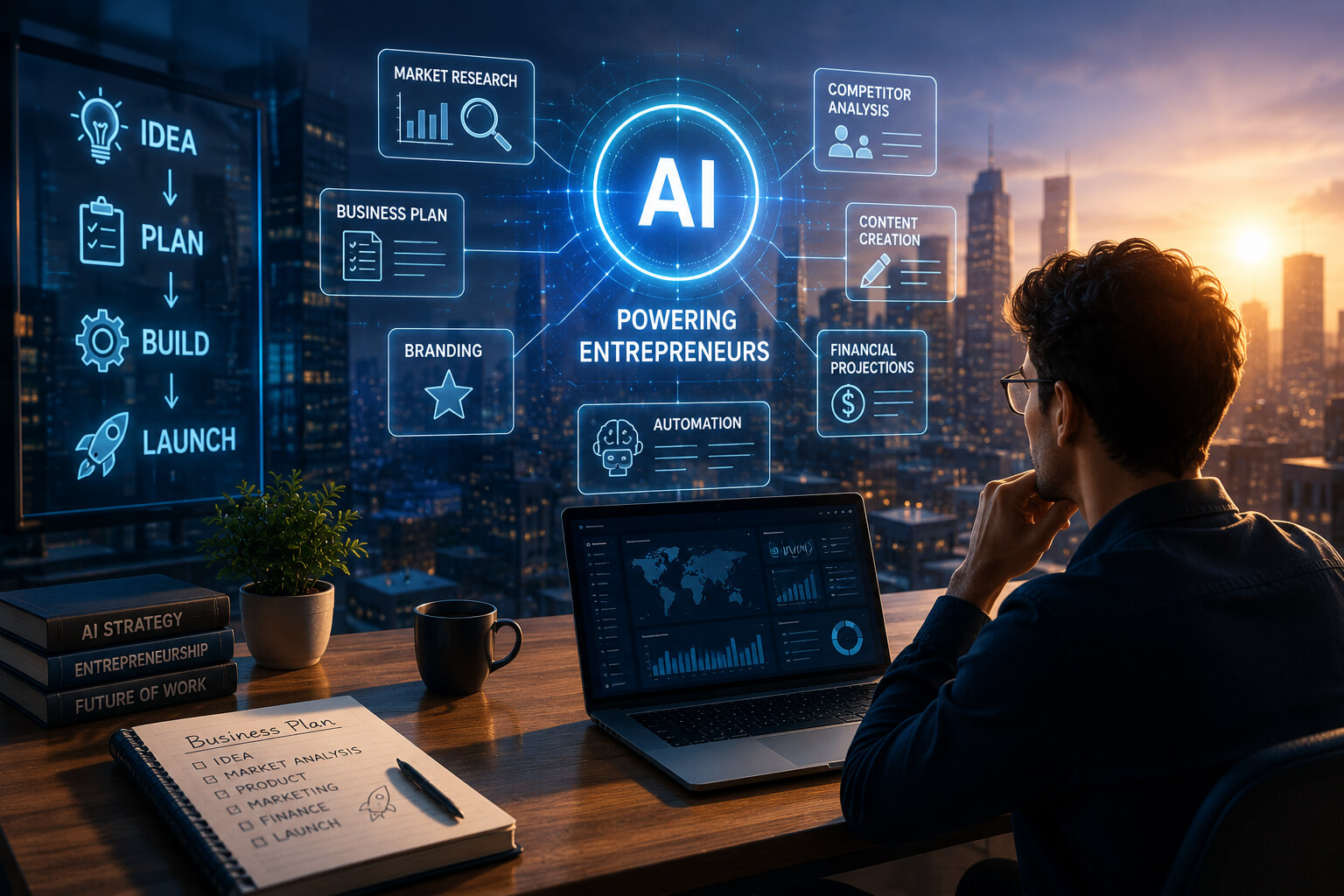
A new kind of founder is showing up everywhere now. Many of these are AI-powered entrepreneurs who are changing the landscape of modern business.
Not always backed by a huge team. Not always sitting inside a glossy startup office. Sometimes it is one person, a laptop, a stack of AI tools, and an idea that would have taken five employees to test a few years ago.
That is the shift now building around AI-powered entrepreneurs. According to recent business formation trends highlighted by Bloomberg, artificial intelligence is helping founders move faster, cut early costs, and launch companies with far fewer resources than before. The startup world is not suddenly easy. It is just less locked behind the old barriers.
And that difference is big.
AI Is Changing Who Gets to Start a Business
Starting a company used to come with a long list of painful early steps. Build a website. Write copy. Create pitch materials. Research the market. Handle customer support. Make product mockups. Test ads. Organize finances. Hire help before revenue even exists.
Now, AI can take a chunk of that early mess and make it manageable.
A Gusto report found that 60% of new business owners used AI to help launch their business in 2025, twice the level from two years earlier. The same report found that half of new founders said AI made starting a business significantly faster or less expensive. That does not mean AI created the business for them. It means AI removed enough friction for more people to try.
That is probably the real story here.
AI is not just helping giant companies automate internal work. It is also giving small founders access to tools they could not afford before. A solo entrepreneur can now draft a business plan, generate design options, analyze competitors, build marketing materials, and test ideas before spending heavily on agencies or full-time staff.
The Rise of the Solo Founder
The solo founder has always existed. But AI is making the model feel less extreme.
Axios recently reported that AI use is behind a rise in solo founders, with Nasdaq data pointing to a sharp increase in AI-enabled entrepreneurs building businesses on their own. The model is still new, and nobody really knows yet how many of these businesses will grow into durable companies. Still, the pattern is clear enough: one-person startups are getting more serious.
That changes the startup math.
A founder no longer has to wait until they can afford a designer, writer, analyst, assistant, and developer just to validate an idea. AI tools can cover enough of those early functions to get something into the market. Maybe rough. Maybe imperfect. But live.
And in business, live often beats perfect.
Gen Z Is Moving Into Entrepreneurship Faster
There is also a generational angle here.
Gusto’s findings show that Gen Z entrepreneurs started more businesses than Baby Boomers for the first time, accounting for 9% of new business starts in 2025 compared with 5% for Boomers. That is not a huge number by itself, but the direction matters. Younger founders are entering business creation earlier, and AI is part of the toolkit they already understand.
For many of them, using AI to write product descriptions, test brand names, edit videos, research markets, or automate admin work does not feel futuristic. It feels normal.
That is a quiet advantage.
Older startup culture often treated software tools as something to adopt after the company was already formed. Newer founders may treat AI as part of the company from day one.
AI Makes Launching Easier, But Not Winning
There is a catch, of course.
If AI makes it easier for everyone to start a business, it also makes the market more crowded. More stores. More apps. More newsletters. More agencies. More digital products. More “AI-powered” everything.
Research on more than 160,000 Product Hunt launches found that generative AI increased entrepreneurial entry, especially among solo founders. But it also found that team-based ventures still performed better at the top end. In other words, AI may help more people start, but it does not automatically help them build something great.
That feels important.
AI can speed up the first version. It can reduce blank-page panic. It can make a tiny team look bigger. But judgment still matters. So does taste. So does customer trust. So does distribution. So does knowing when an AI-generated answer is nonsense dressed up in confident language.
The launch is cheaper now. The hard part just moved somewhere else.
Small Businesses Could Feel the Biggest Impact
The AI startup conversation usually gets dominated by billion-dollar labs, massive funding rounds, and expensive chips. Fair enough. That is where much of the money is going.
But this founder boom may be just as important in a quieter way.
A local service business can use AI to manage bookings, write proposals, create social media posts, and respond to customers. A consultant can package expertise faster. A creator can turn content into products. A small online shop can test advertising angles without hiring a full marketing team.
The result is not always a Silicon Valley-style startup. Sometimes it is a real small business that becomes easier to launch and easier to run.
That matters because entrepreneurship is not only about unicorns. Most new businesses are not trying to become the next OpenAI. They are trying to survive, earn revenue, and give the founder more control over their work.
The Next Business Boom May Look Different
The record business formation story is not just about more people becoming founders. It is about a different type of founder.
Leaner. Faster. More experimental. Less dependent on early hiring. More comfortable using AI as a business partner, even if that partner still needs checking.
Some of these new companies will disappear quickly. That is normal. AI also makes it easier to launch weak ideas, copy trends, and flood markets with low-effort products. There will be noise. A lot of it.
But underneath that noise, something real is happening.
AI is lowering the cost of trying. And when the cost of trying drops, more people try.
That may be the biggest reason AI-powered entrepreneurs are set to launch a record number of new businesses. Not because AI magically turns everyone into a great founder. It does not.
It just gives more people a shot.
