


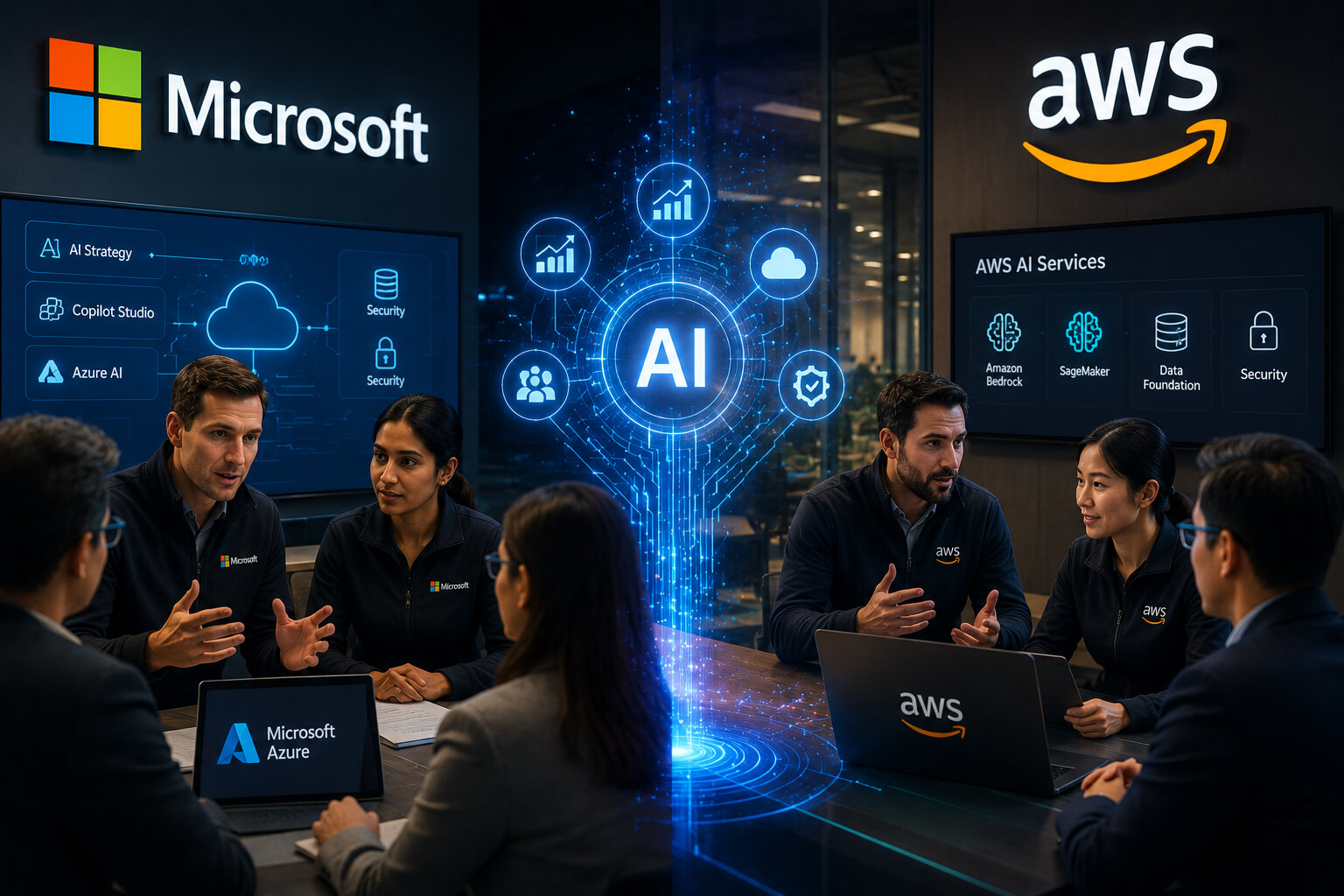
Microsoft and Amazon are taking a more direct route into the enterprise AI race. Instead of simply selling cloud tools, models, and software subscriptions, the companies are now putting AI-focused workers closer to their customers, sometimes directly inside client operations.
It says something important about where the market is right now. Businesses do not just want another AI demo. They want systems that work inside their actual mess. Old databases. Security rules. Slow approval chains. Industry-specific workflows. Teams that still use spreadsheets for critical operations. That is where many AI projects either become useful or quietly die.
This is why the new model feels different. Big Tech is moving from “here is the platform” to “we will help you make it work.”
Microsoft’s Frontier Company Pushes AI Into the Field
Microsoft has reportedly launched a new effort called Microsoft Frontier Company, designed to place thousands of resident engineers and industry experts with customers to help build and deploy enterprise AI systems. The reported initiative includes around 6,000 workers and a multibillion-dollar investment aimed at helping companies move from AI experiments to measurable business results.
That last part matters. Measurable results. Not excitement. Not internal pilots that look good in a slide deck. Actual improvements in operations, productivity, customer service, decision-making, or cost.
Microsoft already has a powerful enterprise base through Azure, Microsoft 365, Copilot, and its broader cloud ecosystem. But enterprise AI is proving to be harder than dropping a chatbot into the workplace. Companies need integration. They need governance. They need training. They need someone to connect the AI system to the way the business actually runs.
That is the gap Microsoft is trying to fill.
Amazon Is Putting Engineers Closer to AI Customers Too
Amazon Web Services is also making a major move in this direction. AWS has announced a $1 billion Forward Deployed Engineering initiative that sends expert engineers into customer organizations to help design, build, and integrate AI systems.
The focus is not only basic automation. AWS is aiming at more advanced AI deployments, including agentic AI systems that can support tasks across industries and workflows. The point is to help companies get past the early stage of AI adoption, where everyone has ideas but few have production-ready systems that survive contact with real business complexity.
AWS has said these teams will work closely with customer executives, engineers, security teams, and internal staff. That kind of setup is important because AI deployment is rarely just a technical problem. It touches data access, compliance, operations, employee trust, cybersecurity, and change management.
In plain terms, AI does not become useful just because a company pays for it.
Enterprise AI Has Hit the Hard Part
The early AI boom made adoption sound simple. Buy the tools. Connect the data. Automate the workflow. Save money. Move faster.
Real life has been less clean.
Many companies are still struggling to turn AI pilots into daily business systems. The model may be powerful, but the customer’s data may be scattered. The workflow may be undocumented. The compliance team may block deployment. Employees may not know how to use the tools properly. Executives may want fast results but underestimate how much internal change is required.
That is why embedding AI workers with customers is becoming attractive. It gives tech companies more control over implementation. It also gives customers access to people who understand the tools deeply enough to fix problems on the ground.
This is not glamorous work. It is closer to enterprise plumbing. But that may be exactly what AI needs right now.
AI Is Becoming a Services Business Again
There is a slightly old-school feeling to this shift. For years, cloud companies pushed scalable software, self-service dashboards, and platform-based growth. Now, with AI, some of the biggest companies in the world are leaning back into hands-on services.
That does not mean the cloud model is disappearing. It means AI is complicated enough that customers need more than access. They need help making the technology useful inside their own environment.
This is where the economics get interesting. If Microsoft and Amazon can embed teams with major customers, they can deepen relationships, lock in cloud usage, and shape how enterprise AI systems are built from the beginning. The customer gets help. The provider gets influence.
And probably more long-term revenue.
The Race Is Moving From Models to Deployment
The AI race used to be mostly about who had the best model, the biggest cloud, or the strongest infrastructure. Those things still matter. But the next fight is about deployment.
Who can help a bank automate compliance without breaking rules? Who can help an airline improve operations without disrupting safety systems? Who can help retailers, hospitals, manufacturers, logistics companies, and governments use AI in ways that actually survive the real world?
That is where Microsoft and Amazon are now competing more aggressively.
The companies that win enterprise AI may not only be the ones with the smartest models. They may be the ones that can sit with customers, understand the messy details, and build systems that produce results.
Customers Want AI That Works, Not AI Theater
There is also a growing impatience around AI spending. Many companies have invested in pilots, tools, and internal experiments. Some have seen real gains. Others are still trying to prove the value.
That creates pressure on cloud providers. If customers spend heavily on AI but do not see outcomes, budgets can tighten. Executives can become skeptical. AI can start to look like another expensive technology cycle with unclear returns.
By sending workers directly to customers, Microsoft and Amazon are trying to shorten that gap between promise and outcome. They are not waiting for customers to figure everything out alone. They are entering the implementation layer.
That may become one of the most important parts of the AI business.
The New AI Battle Is Happening Inside Customer Operations
The move by Microsoft and Amazon shows how enterprise AI is changing. The market is not only about flashy launches anymore. It is about integration, execution, and trust.
AI companies now have to prove they can turn powerful technology into something useful inside real organizations. That means sending engineers, specialists, and industry experts into the places where the work actually happens.
The future of enterprise AI may not be decided only in model labs or cloud data centers. It may be decided in customer offices, factory floors, support centers, airline operations, hospital systems, and government departments.
That is where AI has to stop sounding impressive and start doing the job.
