


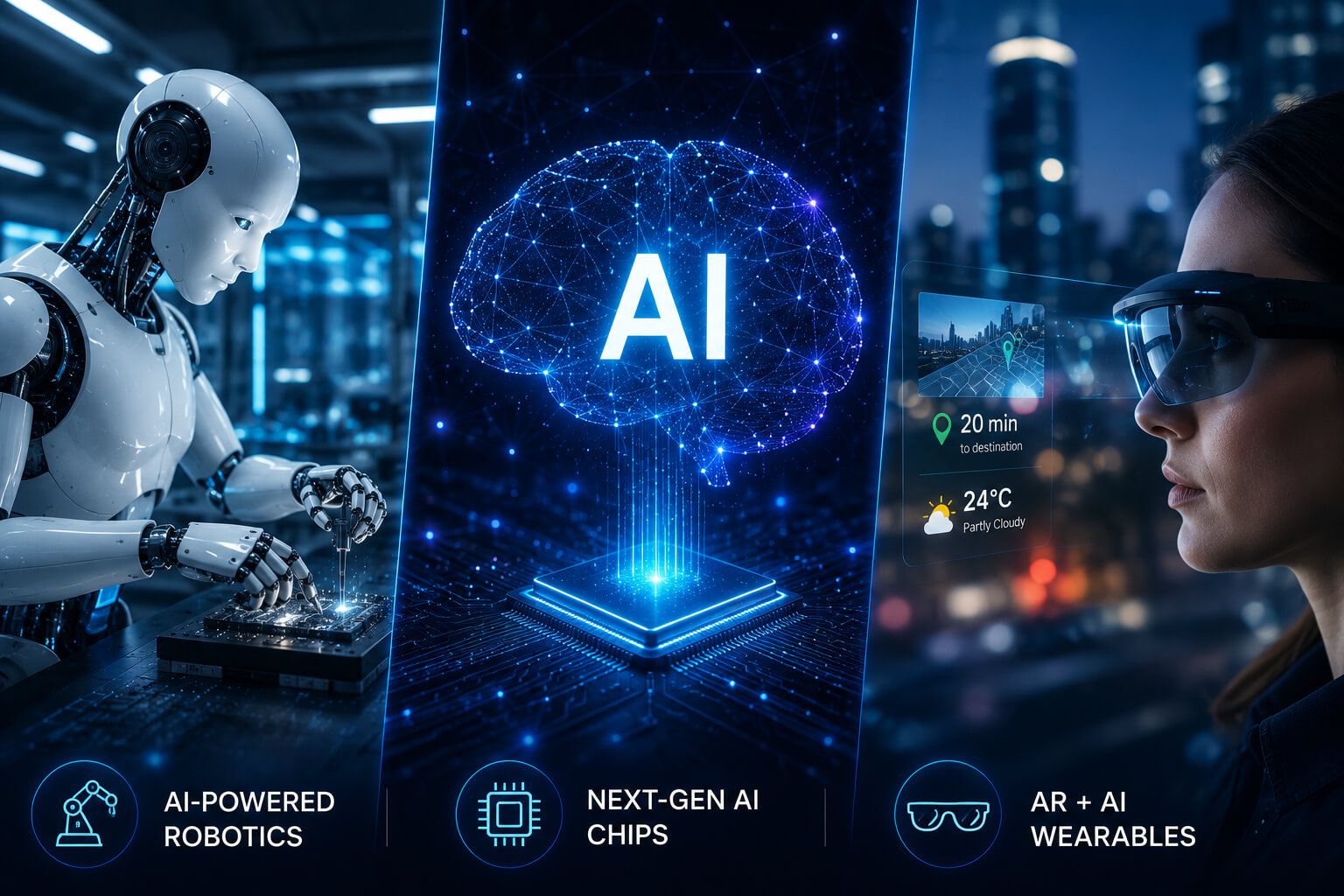
Technology in 2026 does not feel like it is only happening inside laptops anymore. This is because tech breakthroughs in 2026 are reshaping every aspect of our daily lives, from the home to the workplace and beyond.
That might be the most interesting part.
For years, the loudest tech stories were about apps, platforms, phones, social media, cloud software, AI chatbots, and whatever new digital product was fighting for attention. Useful, yes. Sometimes exhausting too.
But this year, some of the biggest breakthroughs are happening in places that feel much more physical. Fusion reactors. The International Space Station. Surgical research labs. Machines are not just answering prompts or sorting data. They are touching energy, space, medicine, robotics, and the limits of what humans can build.
A recent LEAP Insights article highlighted three major technology achievements in 2026, pointing to fusion research, autonomous robots in space, and humanoid robots assisting in surgical research as standout examples of how tech is moving back into the real world.
Fusion Research Pushes Past an Old Physics Barrier
Fusion energy has carried the same promise for decades: clean, powerful energy produced in a way similar to how stars create power.
Big promise. Very hard reality.
The challenge has always been control. Fusion reactors need to hold extremely hot plasma inside magnetic fields. Push the system too far, and the plasma becomes unstable. One of the long-standing limits in this area is known as the Greenwald density limit, which has shaped how researchers think about plasma density and reactor performance.
In 2026, researchers working with China’s EAST reactor, often called the “artificial sun,” reported experiments that went beyond that major limit. That does not mean fusion power plants are suddenly ready to power whole cities next year. Not even close.
Still, it matters.
Fusion research moves slowly, then suddenly a result appears that changes what scientists think might be possible. Exceeding this type of plasma density barrier suggests future reactors may be able to operate at higher performance levels than earlier assumptions allowed. That is the kind of progress that turns a far-off scientific dream into an engineering problem.
Still difficult. Expensive to build. And likely years away from commercial maturity.
But less fictional than it used to feel.
Robots Are Starting to Train in Space
Robots learning in orbit sounds like something pulled from an old science fiction poster.
Except it is now part of real robotics development.
In March 2026, Reuters reported that Voyager Technologies and Icarus Robotics planned to test a free-flying autonomous robot aboard the International Space Station. The idea may sound narrow at first. One robot. One space station. One experiment.
But the environment makes it important.
Space is brutal for machines. There is microgravity, limited room, delayed communication, tight safety margins, and almost no tolerance for careless movement. A robot that can operate in that setting has to be more than a machine following simple instructions. It has to adapt.
That is where robotics is heading anyway.
Most traditional robots have worked best in controlled environments. Factory floors. Warehouses. Defined routes. Repeated tasks. The next wave is different. Robots are being pushed toward messy, changing, human spaces where they need to recognize situations, adjust behavior, and handle uncertainty.
Training or testing autonomous systems in space could help researchers build robots that are more resilient on Earth too. The strange part is that orbit may become one of the training grounds for machines that eventually help in hospitals, disaster zones, factories, and homes.
It sounds dramatic. It also makes sense.
Humanoid Robots Move Into Surgical Research
The third breakthrough sits in one of the most delicate areas of all: surgery.
Researchers have demonstrated humanoid robotic systems assisting in endoscopic surgical environments in 2026, according to the LEAP Insights report. This is not a story about robot doctors replacing surgeons. That is not where the technology is. These systems remain experimental and still need strong human oversight.
The bigger point is the form.
Most surgical robots today are specialized machines. They are built for specific procedures, specific tools, and specific clinical setups. Humanoid robots are different because they may be able to work in spaces already designed for human hands, human movement, and human tools.
That difference could become huge.
Hospitals are not clean science fiction rooms. They are crowded, complex, equipment-heavy environments. A robot that can assist inside that world without requiring everything around it to be rebuilt could make medical robotics more flexible in the future.
Again, nobody should jump too far ahead. Experimental surgical assistance is not the same as safe everyday deployment. Medicine moves carefully for good reason.
But the direction is hard to ignore. Humanoid robots are no longer just being shown walking across stages or lifting boxes in demo videos. They are being tested near tasks where precision, trust, and human control matter deeply.
Technology Is Becoming Physical Again
The pattern across these breakthroughs is simple: technology is gaining weight.
Not metaphorical weight. Actual physical presence.
Fusion research deals with plasma at extreme temperatures. Space robotics deals with autonomous machines floating in orbit. Surgical robotics deals with tools, bodies, clinical environments, and real human stakes.
That is different from another app launch.
AI and advanced computing still sit underneath much of this progress. Data, simulation, automation, machine learning, sensing, and control systems all matter. But the result is no longer only a smarter dashboard or a better chatbot. It is technology stepping into the built world.
Energy. Space. Medicine. Infrastructure. Robotics.
This may be one of the bigger tech stories of 2026. Not just that machines are getting smarter, but that smarter machines are beginning to act in environments where failure is visible, costly, and sometimes dangerous.
That makes the progress more exciting.
It also makes it more serious.
Why These Tech Breakthroughs in 2026 Matter
The three examples are very different, but they point in the same direction.
Fusion research could reshape long-term clean energy possibilities. Space robotics could create tougher autonomous systems for extreme environments. Humanoid surgical research could open new ways for robots to assist in healthcare settings built around humans.
None of this is finished. That is important.
Fusion is not solved. Space robots are still being tested. Humanoid surgical assistants are not ready to take over operating rooms. But 2026 is showing that technology’s next chapter may not be defined only by screens, subscriptions, and software updates.
It may be defined by machines that can survive harder places, support human experts, and interact with the physical world with more intelligence than before. That same shift is already appearing in urban infrastructure, AI-assisted city planning, and the broader challenge of deploying AI at scale.
That is where things start to feel different.
Not perfect. Not fully proven. But different.
Source: LEAP
