


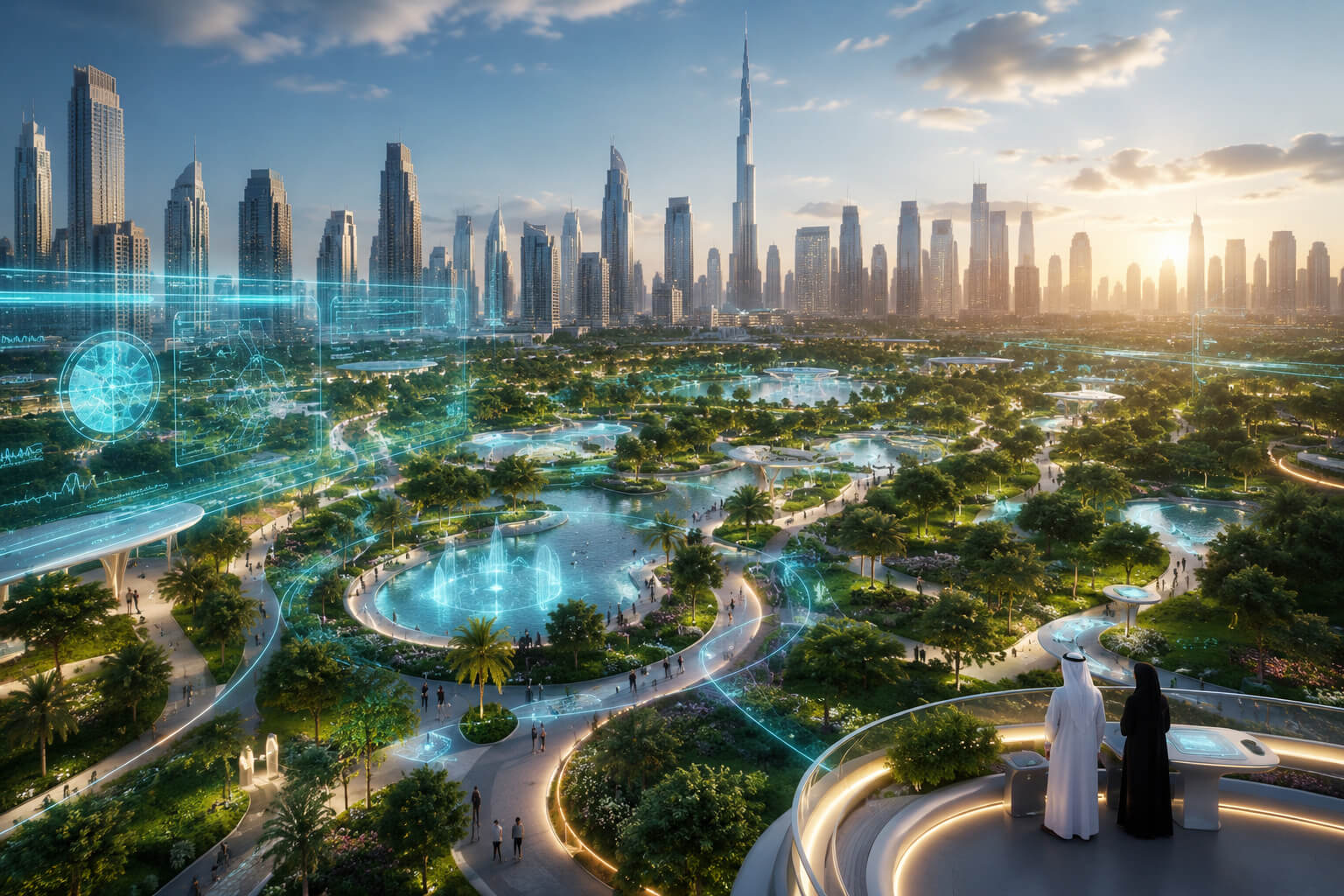
Dubai has launched the world’s first AI-powered park design challenge, inviting architects, designers, students, researchers, startups, and technology innovators to reimagine Al Safa 2 Park using artificial intelligence.
The initiative, launched by Dubai Municipality, aims to explore how AI can support the future of urban design. Through the challenge, participants will use artificial intelligence to create smarter, greener, and more people-focused public spaces.
The Dubai AI park design challenge reflects the emirate’s growing focus on combining technology, sustainability, and community wellbeing. It also highlights Dubai’s ambition to become a global leader in future-ready city planning.
Dubai Uses AI to Reimagine Public Parks
The challenge focuses on Al Safa 2 Park, one of Dubai’s public green spaces. Participants are expected to use AI tools to support different stages of the design process, including site analysis, concept development, spatial planning, environmental response, user experience, and visualisation.
Rather than replacing human creativity, artificial intelligence will act as a design support tool. It can help generate insights, test scenarios, improve layouts, and support more informed planning decisions.
Dubai Municipality said the initiative is designed to encourage practical and creative ideas that improve public spaces for residents and visitors. As a result, the challenge could help shape a new model for AI-assisted urban planning.
Who Can Join the Dubai AI Park Design Challenge?
The competition is open to a wide range of participants, including urban planners, architects, landscape architects, public space designers, undergraduate students, postgraduate researchers, startups, AI specialists, and technology innovators.
Participants must show how AI was used in the design process. This may include AI-assisted site analysis, microclimate planning, shade optimisation, accessibility improvements, sustainability modelling, user behaviour insights, and design visualisation.
Each proposal should present a complete master plan for Al Safa 2 Park. In addition, submissions should include drawings, data analysis, visual materials, and a clear explanation of how artificial intelligence influenced the final concept.
AED 200,000 Prize Pool for Winning Designs
The Dubai AI park design challenge offers a total prize pool of AED 200,000. The first-place winner will receive AED 100,000, while the second-place winner will receive AED 65,000. The third-place winner will receive AED 35,000.
Submissions are open until August 15, 2026. After the evaluation process, shortlisted designs will be reviewed by a judging panel. The community will also be invited to help select the winning entries.
This public participation element is important because it places residents at the center of the design process. Therefore, the final designs will not only focus on technology but also on real community needs.
Evaluation Criteria for AI-Powered Park Designs
Submissions will be assessed based on several factors. These include the quality of AI integration, design feasibility, sustainability, inclusivity, spatial intelligence, user experience, and clarity of the design story.
The challenge also encourages participants to consider local identity and the human experience. This means the winning designs should not only look futuristic. They should also be practical, accessible, comfortable, and connected to Dubai’s urban character.
By combining AI with human-centered design, Dubai Municipality aims to create public spaces that support social connection, wellbeing, and quality of life.
Why the Dubai AI Park Design Challenge Matters
The launch of the Dubai AI park design challenge shows how artificial intelligence is moving beyond offices, apps, and digital platforms. It is now becoming part of physical city planning, public infrastructure, and community development.
For Dubai, the initiative strengthens its position as a hub for urban innovation. It also supports the city’s wider goal of using emerging technologies to improve daily life.
At the same time, the challenge sends a clear message about the role of AI in design. Artificial intelligence is not only a tool for automation. It can also help planners, designers, and communities build more sustainable and inclusive spaces.
Dubai Positions Itself as a Future City Leader
Dubai has continued to invest in smart city projects, digital transformation, and AI-led innovation. With this new challenge, the city is applying those ambitions to public parks and urban environments.
If successful, the Al Safa 2 Park project could become a model for other cities exploring AI-powered public space design. It may also encourage wider use of artificial intelligence in landscape architecture, environmental planning, and community-focused development.
As cities around the world face rising pressure to become more sustainable, inclusive, and climate-resilient, Dubai’s AI-powered park design challenge could offer an early look at the future of urban design.
The project marks an important step in showing how artificial intelligence can support better parks, stronger communities, and smarter cities.
