


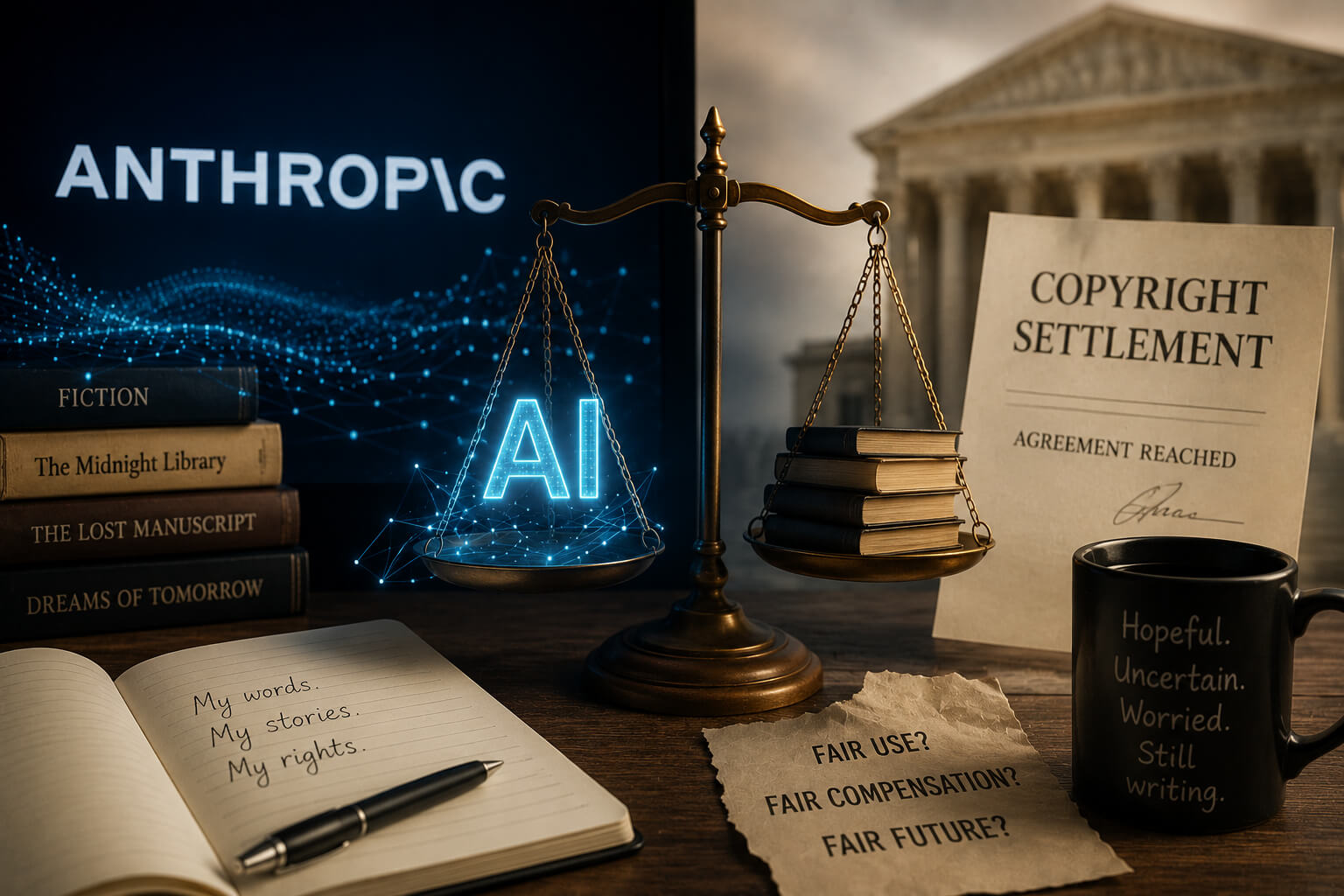
Anthropic’s record-breaking copyright settlement is finally moving towards payouts, but authors are not treating the case as a clean victory. A federal judge granted final approval to the $1.5 billion Anthropic AI copyright settlement on July 20, 2026, ending a closely watched class-action case over the company’s acquisition and copying of pirated books.
The money is substantial. The questions left behind are even bigger. Authors and publishers are still trying to work out what the deal changes for creative work, AI training and the fast-growing market for copyrighted data.
Anthropic Will Pay Authors and Publishers for Nearly 500,000 Books
The settlement covers close to half a million books allegedly downloaded from pirate libraries and added to Anthropic’s internal collection. Eligible rights holders are expected to receive roughly $3,000 to $3,100 per covered work, although individual payments may be divided between authors and publishers depending on publishing contracts and ownership arrangements.
The court described the payout as a strong result, particularly because taking the case through trial could have delayed compensation or left authors with nothing. It is believed to be the largest copyright class-action settlement approved in the United States.
Still, the final amount is far below the maximum damages that copyright law can allow in cases of wilful infringement. Some authors argued that Anthropic was escaping too cheaply after building a major AI business with access to material obtained without permission. The court rejected those objections and found that the settlement offered a reasonable outcome given the risks of continuing the case.
The Case Was About Pirated Books, Not AI Training Alone
That distinction matters. The lawsuit did not produce a broad ruling that training artificial intelligence systems on copyrighted books is automatically illegal.
In an earlier stage of the case, a federal judge found that using lawfully obtained books to train large language models could qualify as fair use because the process was transformative.
Anthropic faced greater legal trouble over how it acquired other material. The authors accused the Claude developer of downloading books from shadow libraries, including Library Genesis, commonly known as LibGen, and Pirate Library Mirror, or PiLiMi.
The settlement resolves claims connected to Anthropic’s past acquisition and copying of those pirated files. It does not settle every argument over whether AI companies must license copyrighted works before using them for model training. That fight is still wide open.
Authors See the Payout as Recognition, Not a Complete Answer
WGCU’s Gulf Coast Life recently spoke with authors Marty Ambrose-McLaughlin and Scott Turow about the settlement. They also discussed the wider pressure AI is placing on publishing. Both authors have books included in the case.
The discussion reflected a frustration shared across the writing industry. Authors spend months or years producing a book. Then they may discover that copies entered pirate databases and large AI development pipelines. The payment gives some recognition that the works had value. However, it does not create a lasting licensing system.
It also does not answer what happens next. Future AI models may train on books obtained through less obvious channels. Some works may be bought in bulk. Others may be accessed under contracts written before generative AI became commercially important.
Authors and publishers are now looking beyond one settlement. They want clearer control over whether their work enters an AI training dataset. They also want to know how companies use that work. Most importantly, they want compensation before training begins, not only after a lawsuit.
Anthropic Must Destroy Files Taken From Pirate Libraries
Money is only one part of the deal. Anthropic must destroy original book files downloaded or torrented from LibGen and PiLiMi, as well as copies created from those files, apart from material that must temporarily be preserved for legal reasons.
The company has said that those specific datasets were not included in the training corpus of its commercially released large language models.
That does not erase the controversy. Anthropic still built and maintained a large central library of material obtained from pirate sources, which became the key issue driving the settlement. The destruction requirement gives authors a tangible result, although there is no simple way for outsiders to inspect every dataset flowing through an AI company’s research and development systems.
The Settlement Does Not Protect Anthropic From Future Claims
The agreement is deliberately narrow. Class members release claims connected to Anthropic’s past acquisition and copying of covered works through August 25, 2025. They do not surrender claims concerning future conduct or material generated by Claude and other Anthropic systems.
Authors whose books are not included on the official works list also retain their rights. That leaves room for more lawsuits, particularly if writers believe AI outputs reproduce protected elements from their books or if Anthropic collects new training material without proper permission.
The official settlement website says the deadline for submitting claims passed on March 30, 2026. Deadlines for objections and opting out have also closed, meaning the case has now entered its distribution phase.
Other AI Copyright Cases Are Still Moving Through the Courts
Anthropic is not alone. Authors, publishers, visual artists, musicians and media companies have filed copyright cases against several major AI developers. The legal arguments differ, but most return to the same uncomfortable point: modern AI systems require enormous volumes of human-created material.
Publishing companies including Hachette, Macmillan and McGraw Hill have joined author Scott Turow in a separate case against Meta and CEO Mark Zuckerberg. Other lawsuits are targeting Google and additional AI businesses. Those cases may prove more important than the Anthropic settlement because they could test different methods of obtaining and using training data.
One court may view AI training as transformative. Another may focus on the market damaged when developers avoid buying licences. A company may legally purchase a book, scan it and use it for training, while downloading the same title from a pirate library creates a separate infringement risk. There is no single rule covering every dataset, model or generated response yet.
A $1.5 Billion Warning for the AI Industry
The settlement sends a blunt message even without resolving the entire fair-use debate. AI companies cannot assume that the size of a dataset makes its origin irrelevant.
Training models may be considered transformative in some circumstances, but building a private library from millions of pirated files creates a different legal problem. Anthropic chose to settle that problem for $1.5 billion rather than take it to trial.
Authors will get paid. Pirate files must be destroyed. Future claims remain possible. The larger battle over who controls the raw material behind generative AI is nowhere near finished.
