


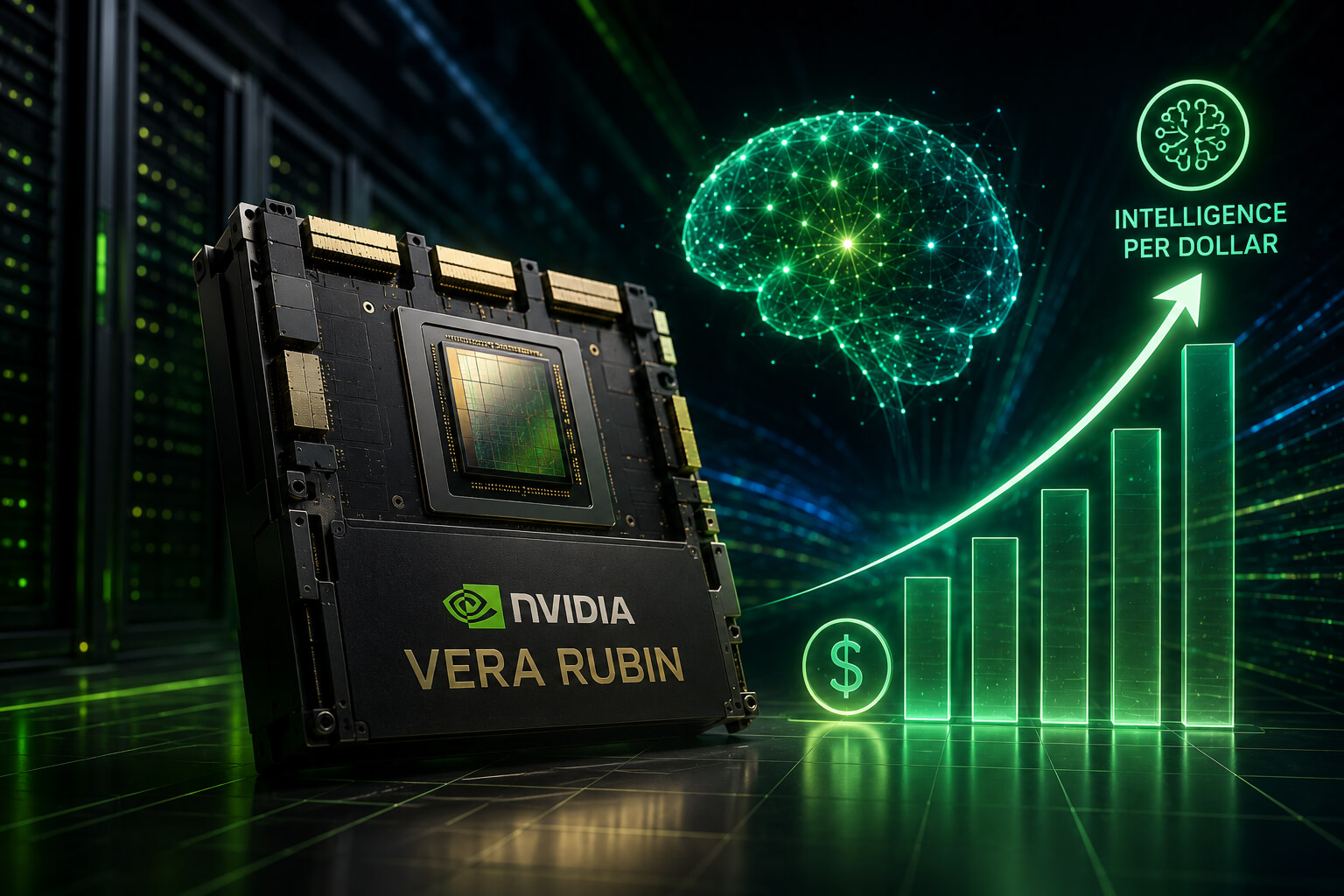
NVIDIA is trying to shift the AI infrastructure conversation again. Not just faster chips. Bigger models are not the whole story either. And this is not even the usual “cost per token” argument that has dominated AI economics for the past year.
This time, the company is talking about intelligence per dollar.
In a new NVIDIA blog post, the company says its upcoming Vera Rubin platform will make post-training more efficient for the agentic AI era. That sounds like chip-industry language, but the idea is fairly simple: AI models are no longer finished after training. Teams keep refining, testing, correcting, and adapting them after deployment. That constant improvement loop is becoming expensive, and NVIDIA wants its hardware and software stack to sit at the center of it.
Agentic AI Changes What Post-Training Means
Older generative AI systems were mostly judged by how well they responded to prompts. Ask a question, get an answer, move on.
Agentic AI is different. These systems are expected to plan tasks, use tools, write code, recover from mistakes, and keep working even when the environment changes. That means a model needs more than fluency. It needs behavior that can be tested, scored, and improved over time.
NVIDIA argues that this makes post-training a continuous workload, not a final polishing stage. Once an AI agent is deployed, new edge cases appear. Tools change. Company policies shift. Production environments expose problems that benchmark tests missed. So the model goes back into another post-training cycle, again and again.
That is where the compute bill starts to grow.
Why NVIDIA Is Talking About Intelligence per Dollar
For inference, companies often talk about cost per token. That measures how much it costs to deliver model output at scale.
NVIDIA’s “intelligence per dollar” idea sits above that. It asks a bigger question: how much does it cost to build a model that is actually worth serving, and how much does it cost to keep improving that model as the world around it changes?
In NVIDIA’s view, cheaper inference helps. Lower cost per token makes every model run more affordable. But post-training is where a model becomes more useful, especially for tasks like coding, planning, tool use, and autonomous decision-making. The more efficient that improvement process becomes, the more intelligence a company can squeeze out of every dollar spent on AI infrastructure.
It is a slightly awkward phrase, yes. But it points to where AI competition may be heading next.
Vera Rubin Is Built for the Post-Training Loop
NVIDIA says Vera Rubin extends the path started by Blackwell, with the platform designed around post-training workloads that require more rollouts, more environments, and faster training-to-inference loops.
The company says Vera Rubin can train the largest models using one-fourth the GPUs compared with the Blackwell generation. That matters because post-training for agentic AI is not just one giant run. It is many repeated runs, with models generating attempts, receiving rewards, updating weights, and being tested again.
In reinforcement learning, the model tries a task, gets scored, and improves from the result. Multiply that by millions of attempts across thousands of environments, and suddenly the infrastructure problem becomes much bigger than just having powerful GPUs.
NVIDIA is also tying this to its software stack, including NeMo Gym for training environments and NeMo RL for distributed post-training. The pitch is clear enough: make post-training less like custom research work and more like repeatable AI factory infrastructure.
Nemotron 3 Ultra Shows Where NVIDIA Wants This to Go
NVIDIA used Nemotron 3 Ultra, a 550-billion-parameter open-weight mixture-of-experts model, as an example of how post-training can improve model capability.
According to the company, Nemotron 3 Ultra scored 71.7% on SWE-bench verified, a real-world coding benchmark where models are tested against actual software bugs from open-source projects. NVIDIA says the model produced working fixes for roughly seven in 10 verified software bugs in that benchmark setting.
That part is important because coding has become one of the clearest tests for agentic AI. A model cannot just sound smart. It has to make changes that pass tests. If it breaks something, the mistake shows up quickly.
For NVIDIA, stronger coding performance is not only a model story. It is also an infrastructure story. Better post-training means better models, and better models make every future inference token more valuable.
Prime Intellect, Perplexity, and Together AI Enter the Picture
NVIDIA also highlighted several companies already working around post-training infrastructure.
Prime Intellect is using NVIDIA Blackwell and NVIDIA Dynamo for post-training and inference orchestration. With Vera Rubin, it plans to scale reinforcement learning environments, produce more rollouts per run, and speed up training-to-inference iteration loops. NVIDIA also says Prime Intellect found Vera CPUs delivered around 30% greater throughput per CPU compared with alternative x86 architectures in realistic reinforcement learning sandbox workloads.
Perplexity is using reinforcement learning post-training across hundreds of NVIDIA GPUs, with an RDMA-based weight transfer engine that syncs trillion-parameter models in under two seconds between training and inference nodes, according to NVIDIA. Its post-trained Qwen3 235B models are then served on NVIDIA GB200 NVL72 systems.
Together AI is offering post-training as a service, including supervised fine-tuning, reinforcement learning, and direct preference optimization. NVIDIA says the company has been running on NVIDIA platforms and optimized kernel libraries, while also looking toward Vera Rubin.
These examples are not random customer mentions. They show the larger bet: post-training could become its own infrastructure market.
The Bigger AI Infrastructure Shift
The AI race used to sound simpler. Bigger model. More GPUs. Better benchmark.
Now the picture is messier.
AI companies need infrastructure that can train large models, serve them cheaply, improve them continuously, and move updated weights between training and inference systems without slowing everything down. That is why NVIDIA keeps using the phrase AI factory. The company wants AI development to look less like a single model launch and more like an industrial process.
Vera Rubin fits that story. It is not just being sold as another powerful platform. It is being positioned as infrastructure for AI systems that keep learning after release.
That could matter a lot as enterprises move from chatbots to agents. A customer support bot can be imperfect and still useful. An AI agent that touches code, finance, business systems, or internal tools needs much tighter performance. Every mistake can cost money, trust, or security.
So post-training becomes less optional.
NVIDIA’s Real Message Is About AI Economics
The main message behind Vera Rubin is not only technical. It is economic. NVIDIA is telling companies that the next AI bottleneck may not be model size alone. It may be the cost of making models better after they are already deployed.
That is a very different kind of competition. The winner is not simply the company with the biggest model. It may be the company that can improve models faster, test them more often, and serve them at a lower cost while still increasing capability. That is what NVIDIA means by intelligence per dollar. Not the cleanest phrase. But probably one worth watching.
Source: NVIDIA Blog — NVIDIA Vera Rubin Maximizes Intelligence per Dollar for Post-Training Workloads:
