


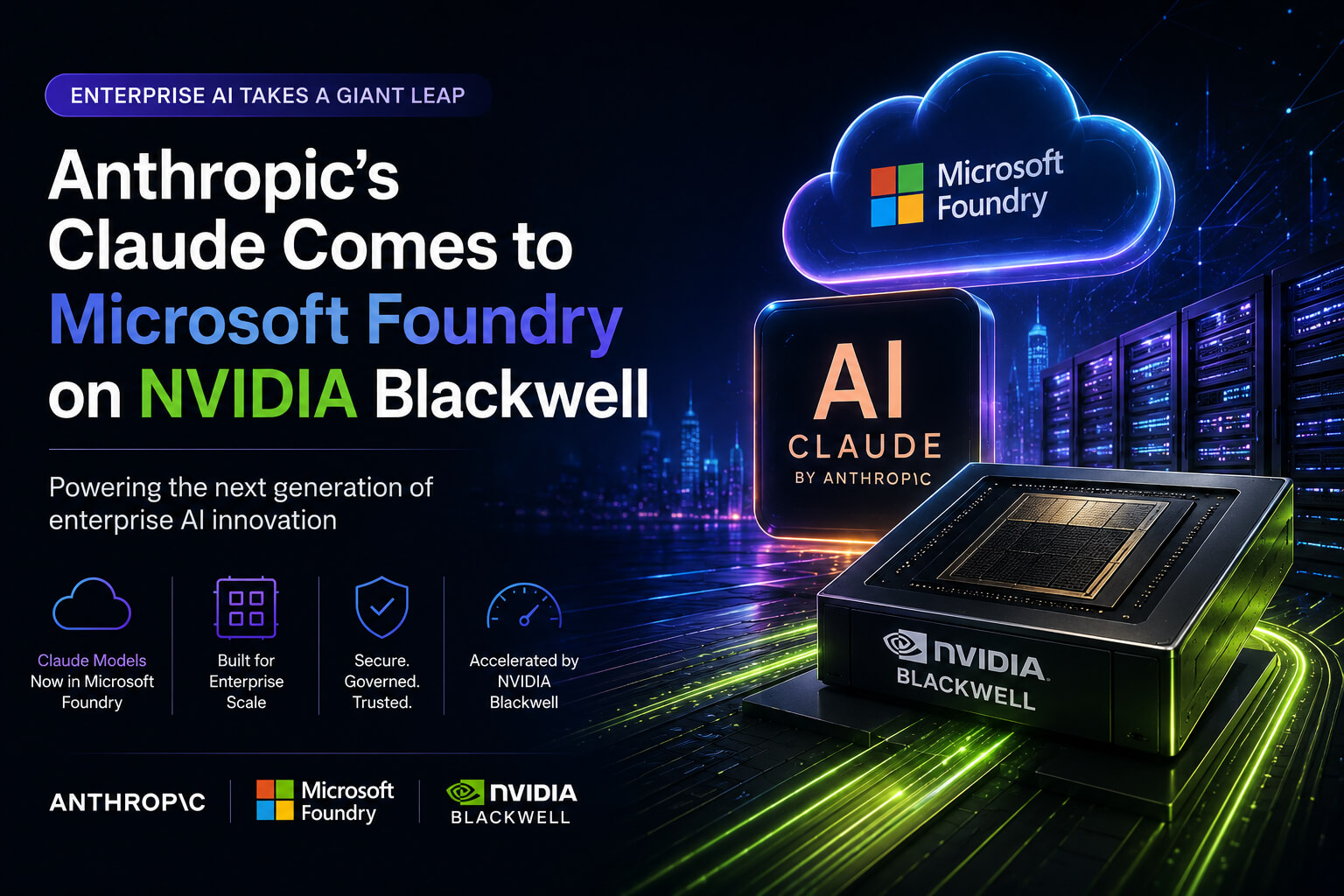
Anthropic’s Claude is no longer just sitting in the familiar chatbot and API conversation. It is moving deeper into the enterprise infrastructure layer, this time through Microsoft Foundry with support from NVIDIA’s Blackwell GPU systems.
The move brings Claude models into Microsoft’s Azure-centered AI ecosystem, giving organizations another route to build and deploy advanced AI agents inside a more controlled enterprise environment. Not just “use a model.” That part is old news now. The bigger story is how AI models are being packaged with compute, cloud infrastructure, security design, and deployment tools.
That is where this announcement gets more interesting.
Microsoft Foundry Becomes a Home for Claude
With Claude available through Microsoft Foundry, Azure-focused companies can access Anthropic’s models inside a platform many of them already use for AI development and deployment. This matters because large organizations rarely want loose AI tools floating around their operations. They want governance. They want control. They want systems that connect with existing workflows without creating another technical mess.
Foundry gives Claude a more practical enterprise setting. Companies can use it to build AI agents, connect those agents to business processes, and run them in cloud environments designed for scale. The pitch is not only about model performance. It is about making Claude usable in production, where security teams, compliance officers, developers, and operations leaders all have a say.
That is usually where AI adoption slows down. Not because the model is weak, but because the system around it is not ready.
NVIDIA Blackwell Adds the Muscle Behind the Move
The NVIDIA side of the announcement is about infrastructure. Claude models in this setup are supported by NVIDIA’s Blackwell-powered systems, including GB300 Blackwell Ultra GPUs. That gives the stack the kind of accelerated computing needed for heavier AI workloads, especially as companies move from simple prompts to agentic systems that run tasks, call tools, process context, and operate across business functions.
Inference efficiency becomes a big deal here. Agents do not behave like one-off chatbot sessions. They can run repeatedly, check information, make decisions, trigger workflows, and interact with other systems. That means cost and speed start to matter a lot more.
A slow AI agent is annoying. An expensive one is worse. A fast but uncontrolled one is a problem nobody wants.
This Is About Agents, Not Just Models
A lot of AI news still treats model access like the main event. This announcement feels different because the real focus is agentic AI. Companies are trying to build AI systems that can do more than answer questions. They want agents that can work across sales, support, operations, finance, infrastructure, aviation, logistics, cybersecurity, and other specialized environments.
Claude inside Microsoft Foundry gives enterprises a way to experiment with that kind of AI while staying closer to familiar cloud controls. NVIDIA adds the hardware and agent tooling layer. Microsoft provides the platform environment. Anthropic brings the model.
Three different pieces. One larger enterprise AI stack.
That is probably the direction more AI partnerships will take. Less standalone model access. More bundled infrastructure.
Sovereign and Regulated AI Gets More Attention
The announcement also points toward a bigger trend: sovereign and regulated AI. Enterprises and governments are becoming more careful about where AI runs, how it accesses data, and who controls the environment around it.
Claude running through Microsoft Foundry on Azure gives organizations a route to build AI agents while keeping more control over infrastructure, policies, and deployment rules. NVIDIA’s Secure Agent Workspaces reference design also adds another layer to the story, especially for companies that need clearer boundaries around agent behavior, credentials, runtime policies, and data access.
That sounds technical because it is. But the business point is simple: AI agents need rules before they start doing real work.
You cannot bolt governance on later and hope nothing breaks.
The AI Race Is Moving Toward Full-Stack Delivery
This is where the announcement says something larger about the AI market. The race is no longer only about which company has the best model. Enterprises are asking different questions now.
Can this model run inside our cloud setup? Can it scale? Can we secure it? Can we control agent access? Can we keep costs realistic? Can it work with our existing systems? Can we trust it enough for production?
That is why Microsoft, NVIDIA, and Anthropic working together matters. It gives enterprise customers a more complete path: Claude for reasoning and language intelligence, NVIDIA for accelerated computing, and Microsoft Foundry for deployment and operational control.
Not perfect. Not magic. But more enterprise-ready than simply handing companies another model endpoint and telling them to build everything else themselves.
Why This Matters for Enterprise AI Adoption
Claude coming to Microsoft Foundry on NVIDIA Blackwell shows how AI adoption is becoming more infrastructure-heavy. The companies that win enterprise AI may not be the ones with the loudest model launch. They may be the ones that make AI easier to deploy, manage, secure, and scale.
For Azure-centered organizations, this could make Claude more accessible for real business workloads. For Anthropic, it expands Claude’s presence inside a major enterprise cloud ecosystem. For NVIDIA, it reinforces the role of GPUs as the backbone of the agentic AI wave. For Microsoft, it gives Foundry another serious model option as companies move deeper into production AI.
The bigger shift is hard to miss. AI is moving from demos into operations. From chat windows into workflow systems. From model access into full-stack infrastructure.
And that changes the competition completely.
