


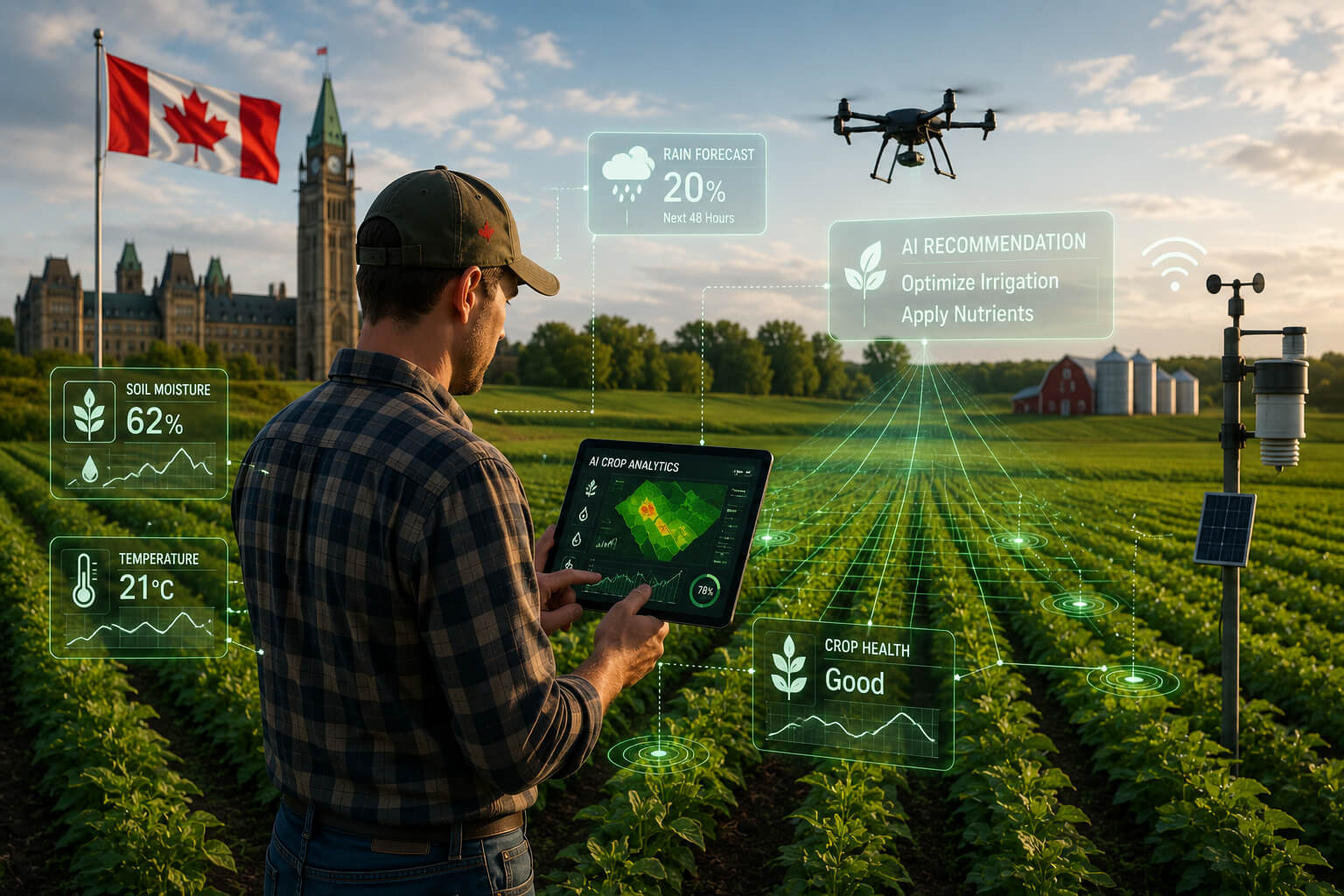
Ottawa is putting new money behind artificial intelligence for farming, and this one is not about robots replacing workers or some glossy “farm of the future” pitch.
It is more practical than that.
The Government of Canada is investing up to $1.65 million in A.U.G. Signals Ltd., a Toronto-based technology company, to develop AI and remote sensing tools for climate-smart agriculture. The goal is fairly direct: help farmers see what is happening in their fields earlier, more clearly, and with better data.
The project will focus on crop health monitoring, yield forecasting and climate resilience. In a farming environment where drought, extreme weather and shifting growing conditions are becoming harder to ignore, that kind of information can matter quickly.
AI Moves Deeper Into the Field
The three-year project will combine satellite imagery, drone data and field observations to create AI-powered tools for producers. These tools are expected to help assess crop emergence, above-ground biomass, drought conditions and yield predictions during the growing season.
That may sound technical, but the farm-level use case is simple.
A producer needs to know whether a crop is developing properly. They need to spot drought stress before it becomes obvious from the road. They need a better sense of yield potential before harvest decisions pile up. AI can help by pulling different data sources together and turning them into something closer to real-time field intelligence.
Not perfect answers. Better signals.
That is the difference.
Why A.U.G. Signals Is Involved
A.U.G. Signals Ltd. will lead the research and technology development. The company works in signal processing and remote sensing, areas that fit naturally with agricultural monitoring. In this project, its work will center on building AI-driven systems that can interpret crop and environmental data from multiple sources.
The company will also work with scientists from Agriculture and Agri-Food Canada. Their role includes field data collection and validation of the AI models, which is important because farm AI is only useful if it works outside clean laboratory conditions.
Fields are messy. Weather changes. Soil varies. One bad model can give a confident answer that is still wrong.
So validation matters here.
Climate-Smart Farming Needs Better Timing
The phrase “climate-smart agriculture” gets used a lot, sometimes too loosely. In this case, it means giving farmers better tools to respond to changing growing conditions.
A drought signal detected earlier can affect irrigation planning, crop protection decisions, input use or yield expectations. Biomass estimates can help farmers understand how crops are developing. Yield forecasting can support business planning, logistics and risk management.
The value is not only in collecting data. Farmers already deal with plenty of data. The harder part is making that data useful at the right moment.
That is where AI keeps finding its opening in agriculture.
The Bigger Funding Picture
The investment is being delivered through the AgriScience Program – Projects Component, under the Sustainable Canadian Agricultural Partnership. That partnership is a five-year, $3.5-billion agreement between federal, provincial and territorial governments designed to support innovation, competitiveness and resilience across Canada’s agriculture and agri-food sector.
This makes the A.U.G. Signals project part of a wider push to move agricultural research closer to commercial and practical use.
It also shows how governments are starting to treat AI less as a general technology trend and more as infrastructure for specific industries. Farming is one of the clearest examples, because the problems are physical, seasonal and expensive when they go wrong.
AI in Agriculture Is Becoming Less Optional
For Canadian farmers, this kind of technology will not solve every problem. AI will not stop drought. It will not remove input costs. It will not make every season predictable.
But it can improve visibility.
That is already a big shift.
The farms that gain faster insight into crop stress, yield risk and field performance may have more room to act before problems become losses. For governments, that supports food security and climate adaptation. For agtech companies, it opens another lane for AI beyond office software and consumer apps.
Agriculture may not always get the loudest AI headlines.
Still, this is where the technology starts to feel real: crops, weather, risk and decisions that cannot wait for a perfect forecast.
Sources
- WestCentralOnline: Ottawa invests $1.65 million in AI technology for climate-smart farming.
- Government of Canada / Agriculture and Agri-Food Canada coverage via Dairy Producer: Government of Canada invests in AI and remote sensing research for climate-smart agriculture.
- OneStop ESG: Canada invests $1.65 million in AI crop monitoring for climate-smart farming.
- Syngenta Canada Market News: Ottawa invests in AI tools to help monitor crops.
- Top Crop Manager: Canada invests in AI remote sensing tool.
