


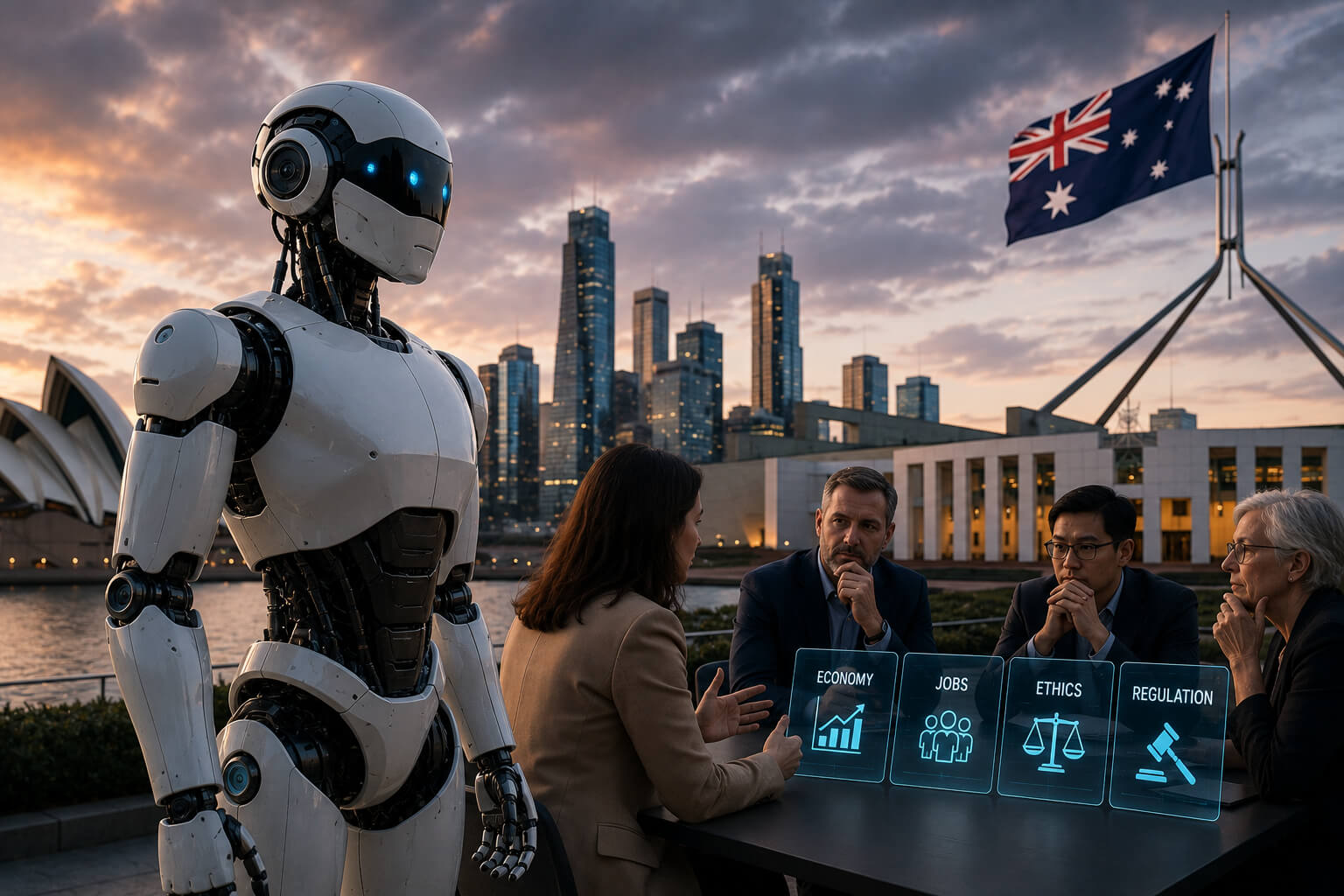
Australia’s AI debate has moved past chatbots. That part is important. For a while, artificial intelligence mostly looked like software. Search tools. Writing assistants. Image generators. Workplace copilots. Useful, strange, sometimes annoying, but still mostly trapped behind a screen.
Now the conversation is getting physical. Humanoid robots are entering aged care, warehouses, shops and manufacturing. AI data centres are expanding. Frontier AI companies are calling for model testing before release. Governments are suddenly trying to work out who should regulate what, and how fast.
That is the messy part. AI is no longer one issue. It is infrastructure, labour, safety, copyright, national security, emotional relationships and robotics all at once.
Australia Is Trying to Grab the AI Steering Wheel
ABC News reported that Prime Minister Anthony Albanese has moved to take closer control of Australia’s AI strategy, with the issue now stretching across several parts of government. The new Office of AI inside the Department of Prime Minister and Cabinet is expected to focus heavily on data centres, because they involve planning approvals, electricity, water use and coordination with state governments.
That sounds bureaucratic, but it matters.
AI does not run on magic. It runs on chips, power, cooling systems, land, water and huge data centre buildouts. If governments treat AI as only a software problem, they miss half the story.
Australia’s current AI workstreams reportedly cover safety, national security, jobs, copyright and research, alongside the growing data centre issue. That gives a better picture of where the technology is going. Not one policy lane. Many lanes, all moving at once.
AI Model Testing Is Becoming a Serious Fight
The pressure around AI safety is also changing.
Google DeepMind chief Demis Hassabis recently backed pre-release testing for frontier AI models, according to ABC News. Other major AI figures, including OpenAI’s Sam Altman, Microsoft CEO Satya Nadella, Elon Musk and Anthropic co-founder Jack Clark, also responded positively to the idea of stronger third-party testing and standards.
That is a big shift.
For years, AI companies mostly wanted freedom to launch fast and fix problems later. Now some of the biggest names in the industry are talking about testing powerful models before they reach the market.
Of course, there is another side to this.
ABC’s analysis points to rising competition from Chinese AI models, including newer open-source systems that may be cheaper than leading US models. So yes, safety is part of the conversation. But market pressure is sitting right beside it.
The uncomfortable question: is model testing about public protection, or is it also about slowing down rivals?
Probably both.
Data Centres Are Becoming the Physical Face of AI
People often talk about AI as if it lives in the cloud. That phrase hides the real thing.
The cloud is buildings. Servers. Electricity. Water. Cooling systems. Local planning fights. Grid pressure.
Australia’s AI strategy now has to deal with this reality because data centres are multiplying as demand for AI computing rises. ABC noted that the Office of AI will mainly handle data centre coordination because these projects involve state-level planning and resource questions.
This is where AI infrastructure starts looking less like a tech trend and more like national infrastructure. A country that wants AI growth needs computing capacity. But that same computing capacity can collide with energy targets, water concerns and community planning. No simple slogan fixes that.
Humanoid Robots Bring AI Out of the Screen
Then come the robots. ABC highlighted Andromeda, a South Melbourne startup selling an AI robot called Abi to aged care facilities around the world. The company describes Abi as an empathetic companion designed to create connection and reduce isolation.
That is where the story gets more complicated. In aged care, a companion robot may help people feel less alone. It may support staff. It may make daily care feel warmer. But it also raises questions that are hard to answer neatly.
How human should a robot seem? Should vulnerable people form emotional bonds with machines? Who is responsible if the system behaves badly? And who decides what “safe” emotional interaction looks like?
Australia is not alone in dealing with this. China has already introduced rules around human-like interactive AI services, including restrictions on virtual close relationships for minors and requirements for providers to respond when users show extreme emotions. That says a lot. Emotional AI is no longer theoretical. Regulators are already reacting.
China Is Moving Fast on Humanoid Robots
The humanoid robot market is also becoming another China-led industrial race.
ABC reported that Chinese humanoid robot company AgiBot recently had its Australian launch, with robots performing on stage. The report also noted that these machines currently cost around US$40,000 to US$50,000, while Chinese production is reportedly reaching 100,000 units this year.
The dancing robot demo is the fun part. The less flashy part is more important. Humanoid robots are being positioned for repetitive assembly work, warehouses, concierge roles, retail and sales assistance. That puts them directly inside labour markets.
Not someday. Not in a far-off sci-fi setting. The early version is already here. And as production scales, prices are likely to fall. Once that happens, the adoption question changes from “Can companies afford humanoid robots?” to “Where will companies put them first?”
The Real AI Debate Is Not Just About Safety
AI safety matters. So does testing. So does regulation. But the bigger debate is about power. Who owns the models? Who controls the robots? Who gets replaced, assisted or monitored? Who pays for the energy? Who gets the productivity gains? Who absorbs the risks?
Australia’s AI moment is interesting because it shows the technology becoming harder to separate into clean categories. A humanoid robot in an aged care home is not just a robotics product. It is healthcare, labour, emotional support, privacy, safety and ethics in one machine.
A data centre is not just a tech facility. It is energy policy. A frontier AI model is not just software. It may become a national competitiveness issue.
This is why governments are moving closer. They may not move perfectly. They probably will not move fast enough in every area. But sitting back is no longer realistic. AI has left the laptop screen. Now it has a body, a power bill, a factory role, and maybe a face.
Sources
ABC News: Humanoid robot markets expand as Australia reckons with AI revolution
https://www.abc.net.au/news/2026-07-20/artificial-intelligence-testing-models-humanoids-data-centres/106928550
