


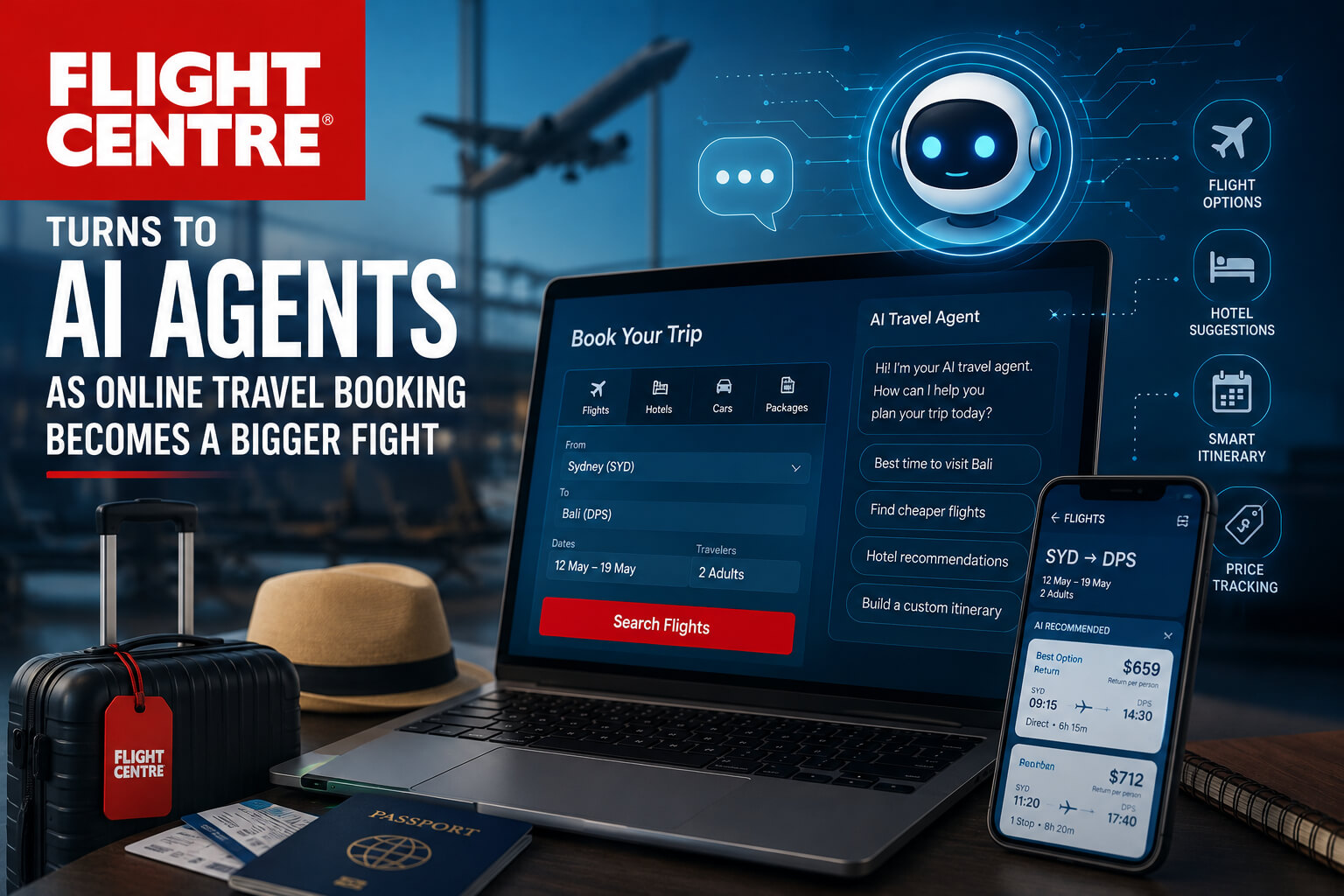
Flight Centre is moving deeper into AI, and this time it is not just about adding smarter tools behind the scenes.
The travel company has appointed Christopher Steiner as chief AI officer and Rob New as head of digital commerce, a move that points to something bigger happening inside the business. Flight Centre wants AI agents to help reshape how its leisure travel brands work, sell, and support customers online.
Online bookings already make up almost half of Flight Centre’s total booking volume, according to iTnews. That number alone explains why the company is taking this seriously. Travel customers are not waiting around for slow systems anymore. They compare, book, change plans, and expect answers fast.
AI is now part of that pressure.
Flight Centre Wants AI Agents Inside Its Operating Model
Christopher Steiner will lead what Flight Centre calls an “agentic accelerator program.” In plain terms, this means the company wants AI agents to become part of how its leisure business gets work done.
Not just chatbots sitting on a website. Not just automated FAQ replies.
AI agents are being positioned as productivity tools for staff and business operations. Steiner said the goal is to make Flight Centre’s people “sharper, faster and better informed,” with AI agents working across leisure brands and functions.
That line matters because it shows Flight Centre is not only chasing customer-facing AI. It is also looking at the boring but important stuff: internal workflows, decision-making, booking support, commercial operations, and how teams move faster without adding more manual work.
This is where AI is starting to become less flashy and more useful.
A New Chief AI Officer Signals a Bigger Shift
Steiner is not new to Flight Centre. He has been with the company for almost 24 years, starting in software engineering before moving into digital strategy and later becoming CIO of one of the group’s business units.
That background gives the appointment a different feel. Flight Centre is not bringing in an outside AI celebrity just for headlines. It is putting someone with deep internal knowledge in charge of turning AI into something the business can actually use.
That may be important.
A lot of companies are still trying to figure out where AI belongs. Marketing likes it. Customer service tests it. Tech teams experiment with it. But getting AI into the operating model is harder. It touches people, process, data, software, and risk.
Flight Centre seems to be treating AI as a structural change, not a side project.
Ecommerce Consolidation Becomes Part of the AI Push
Rob New’s role is also important. As head of digital commerce, he will work on bringing together the ecommerce platforms and capabilities that support how customers discover, book, and manage travel across Flight Centre Travel Group’s digital portfolio.
That sounds like a standard digital transformation line, but there is a real business problem underneath it.
Flight Centre has many brands and a large digital footprint. When those systems operate separately, the customer experience can feel scattered. Data gets fragmented. Offers may not connect properly. Booking journeys become harder to optimize.
New described the job as unlocking what the portfolio can do when it operates as “one connected commercial engine.”
That is probably where AI and ecommerce start to overlap. AI agents are only as useful as the systems they can access. If the ecommerce side is messy, AI becomes limited. If the platforms are connected, AI can do more.
Travel Companies Are Being Forced to Move Faster
Flight Centre’s global leisure CEO James Kavanagh said customer expectations are being reshaped in real time by AI, while the economics of online and person-to-person travel are shifting with them.
That is the real story here.
Travel used to be split more cleanly between online booking and human advice. Now the line is getting blurry. Customers may search online, ask AI for itinerary ideas, compare prices, message an agent, change dates, and expect everything to stay connected.
For travel companies, that creates a difficult challenge. They need digital systems that are fast and scalable, but they also need human service that still feels useful. AI agents could sit in the middle of that.
They can help staff handle information faster. Customers may also get support before a human steps in. Booking flows can become smarter. In some cases, AI agents may reduce the repetitive work that slows travel consultants down.
Maybe. Execution is everything.
Why This Matters for AI in Travel
Flight Centre’s move shows how AI agents are starting to enter traditional industries in a more serious way.
The travel sector is a natural fit. It has complex products, constant customer questions, price changes, personal preferences, cancellations, loyalty systems, and huge amounts of operational detail. AI can help with that, but only if companies build the right structure around it.
The chief AI officer appointment suggests Flight Centre wants one person focused on that structure. The digital commerce appointment suggests the company also knows AI cannot succeed if the ecommerce foundation stays fragmented.
This is not a small chatbot update. It is more like Flight Centre preparing for a travel market where online booking, human consultants, and AI support are all part of the same customer journey.
And honestly, that is probably where the industry is heading.
Sources
iTnews – Flight Centre to embrace AI agents, ecommerce consolidation
