


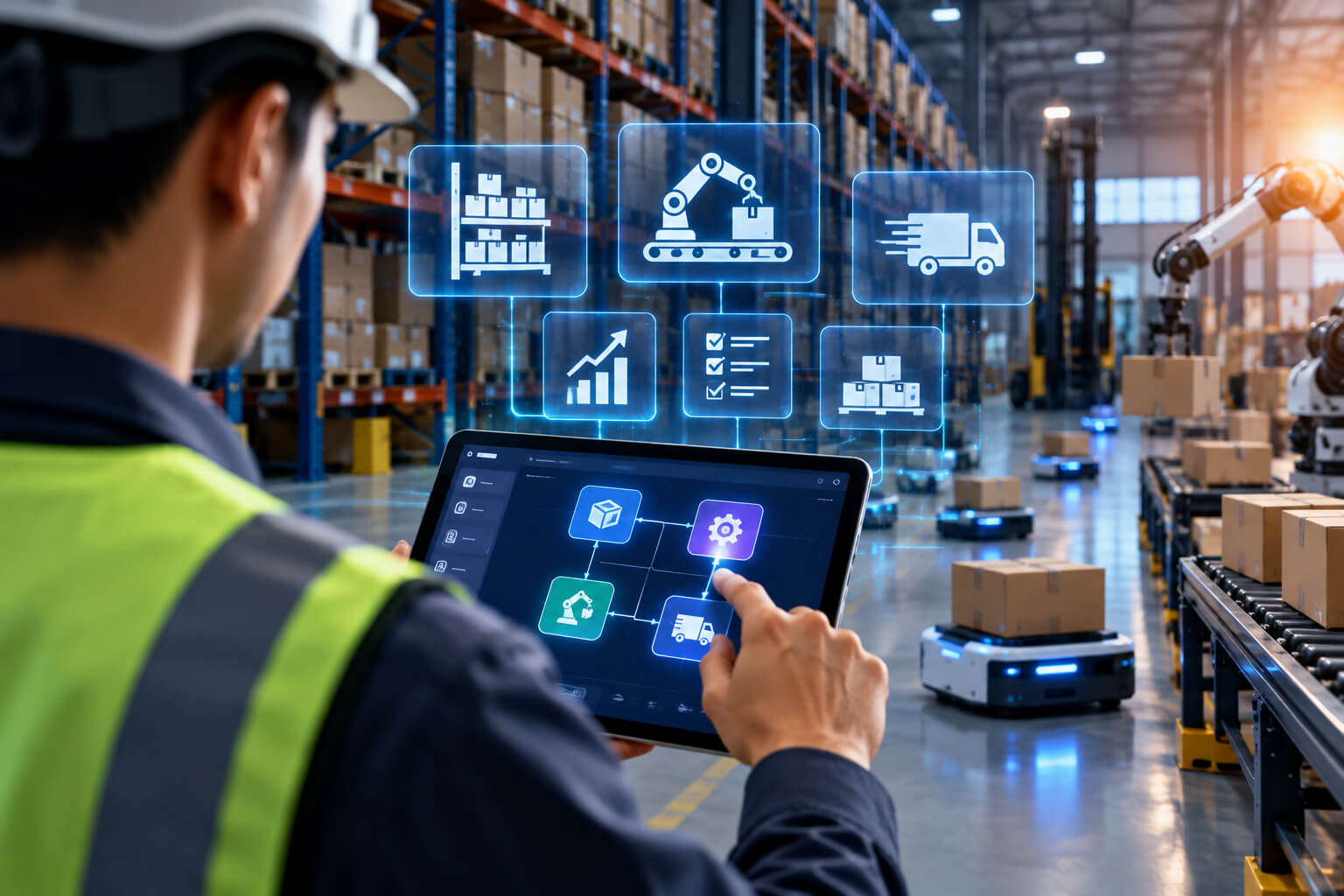
AutoScheduler.AI is pushing warehouse AI beyond dashboards and recommendations. Its new AI App Builder gives warehouse planners, supervisors, and site leaders a way to create their own operational applications. They can do this using plain-language instructions.
The tool sits inside the company’s Warehouse AI Platform and works with live facility data. Instead of sending another software request to IT or waiting months for a vendor update, warehouse teams can build applications around problems they are already dealing with on the floor.
It is a practical shift in how AI could enter logistics operations. The people closest to a warehouse problem may no longer need to wait for a developer to turn that problem into software.
Warehouse Teams Can Build Apps Without Waiting for IT
Warehouses already depend on warehouse management systems, ERP platforms, labor tools, yard management software, automation systems, and internal dashboards. Those platforms handle much of the core operation. However, gaps still appear when a facility has a workflow that does not fit neatly into the existing software.
That is where AutoScheduler wants its AI App Builder to sit. Users can describe what they need in ordinary language, and the platform can turn that request into an application using warehouse data already available inside AutoScheduler’s environment. The idea is to give operational staff more control over small but important software needs. It does this without forcing every request through a development queue.
For logistics teams, that could mean less dependence on spreadsheets, manually updated reports, or temporary workarounds that slowly become permanent.
AutoScheduler Connects AI With Live Warehouse Data
The AI App Builder is not being positioned as a generic no-code platform. AutoScheduler says it works with its existing warehouse semantic layer, which is designed to understand operational information coming from warehouse management, ERP, labor, yard, and automation systems.
That warehouse context is important because logistics applications need to work with real constraints. Inventory has to be available. Labor has to be assigned. Dock schedules have to align with arrivals and departures. Shipping deadlines still matter even if the application itself was created with a prompt.
AutoScheduler combines that warehouse data layer with optimization algorithms that can support operational decisions. This gives users a way to build applications that do more than display information. Additionally, depending on the use case, the apps can help analyze conditions, recommend actions, monitor performance, or support execution inside warehouse workflows.
Logistics Teams Are Already Building Their Own Tools
AutoScheduler says customers have used the platform to create applications for labor forecasting, replenishment monitoring, inventory flow, production planning, wave optimization, inbound cross-dock prioritization, dock-door schedule compliance, OTIF monitoring, gamification, dashboards, and site-specific alerts.
The range of examples points to one of the bigger advantages of the model. A warehouse does not always need another large enterprise system. Sometimes it needs a small application built around one very specific operational problem.
A distribution center may need better visibility into replenishment delays. Another facility may want to identify dock congestion earlier in the day. A third may simply need a better way to track labor against outbound workload.
AI-generated applications could make those smaller projects easier to build without changing the systems underneath them.
One Warehouse App Was Built in Under 15 Minutes
AutoScheduler says one functioning application was created in less than 15 minutes during a customer working session. The company also reports that customers have started building multiple applications themselves rather than depending entirely on AutoScheduler engineers.
In another example, a site planner reportedly built a replenishment-monitoring application that produced enough operational value for the facility to allocate a six-figure annual budget to the tool.
These are company-reported examples rather than independent performance studies, so the results should be viewed in that context. Still, they show what AutoScheduler is trying to prove: warehouse software development does not always need to be a long project.
If employees can move from an operational problem to a working application in a short period, the usual relationship between warehouse teams and enterprise software starts to change.
AI App Builders Could Change Who Creates Enterprise Software
Generative AI has already lowered some of the technical barriers around software development. Coding assistants, no-code platforms, and prompt-based development tools are allowing more people to create software without following a traditional development process.
AutoScheduler is applying that idea to a much narrower environment. Instead of asking users to build general-purpose software, the platform focuses on warehouse operations where the underlying data, terminology, and workflow are already understood.
That distinction could matter. Warehouse employees usually know their operational problems better than an outside developer. They know which reports are missing, which handoffs create delays, and which parts of the shift still depend on manual work.
Giving those employees a way to turn that knowledge into software could shorten development cycles and produce tools that are more closely aligned with actual warehouse conditions.
Domain Knowledge May Be the Real Advantage
The ability to create an application from plain language is becoming more common across the software industry. The harder part is making sure the resulting application understands the business environment it is supposed to support.
AutoScheduler’s advantage may come from the warehouse context already built into its platform. The company says its semantic layer has been developed through work across nearly 100 sites and is paired with warehouse optimization technology.
That matters because an AI system can generate a dashboard without necessarily understanding what the numbers mean operationally. Replenishment timing, labor availability, dock assignments, wave releases, and outbound shipping performance are closely connected.
A warehouse-focused AI system has to understand those relationships if it is going to build applications that are genuinely useful on the floor.
AutoScheduler AI App Builder Is Generally Available
AutoScheduler has made AI App Builder generally available through its Warehouse AI Platform. Customers can use it to create warehouse-specific applications. Meanwhile, the company also provides specialists who can help organizations develop their first tools.
The launch expands AutoScheduler’s role beyond warehouse orchestration. Its platform is increasingly positioned as both an optimization layer and an environment where warehouse teams can create their own operational software.
That could become an important direction for industrial AI. The biggest changes may not always come from replacing entire systems or deploying autonomous machines. Sometimes the useful shift is much smaller: giving the person who sees the problem every day the ability to build the tool that fixes it.
Sources
Artificial Intelligence News — AutoScheduler launches warehouse app builder for logistics teams
https://www.artificialintelligence-news.com/news/autoscheduler-warehouse-app-builder-for-logistics-teams/
AutoScheduler.AI — Warehouse AI Platform
https://autoscheduler.ai/
AutoScheduler.AI / GlobeNewswire — AI App Builder announcement
https://www.globenewswire.com/news-release/2026/09/21/3365593/0/en/autoscheduler-ai-expands-warehouse-ai-platform-with-ai-app-builder-letting-warehouse-teams-build-their-own-applications.html
Logistics Business — AI App Builder Added to Warehouse Platform
https://logisticsbusiness.com/it-in-logistics/ai/ai-app-builder-added-to-warehouse-platform/
