


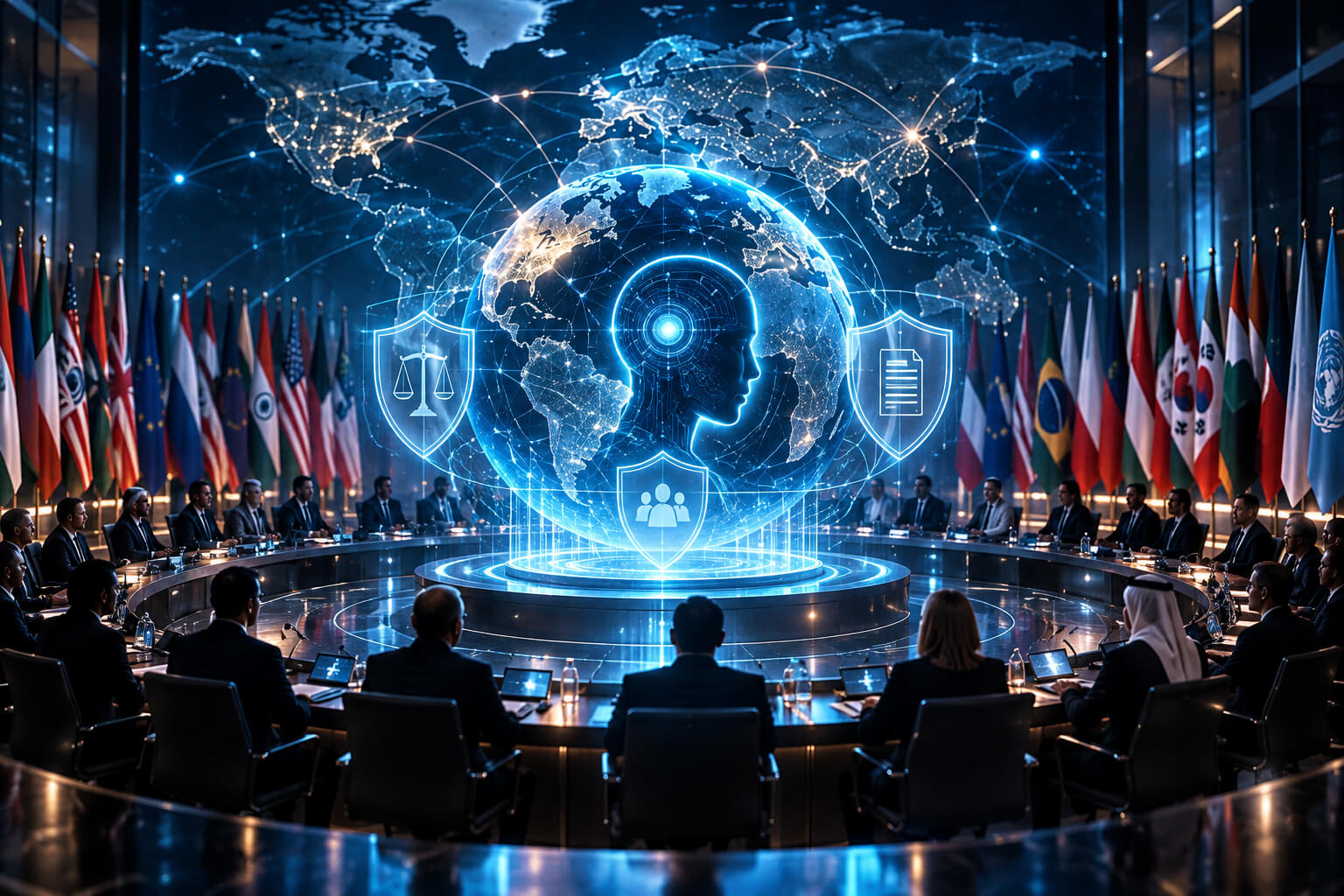
Artificial intelligence is moving across borders far faster than the rules designed to govern it.
Now, 20 countries are calling for stronger international oversight of AI, adding fresh momentum to a debate that has grown alongside more capable models. The debate has also grown alongside autonomous systems and wider AI adoption across governments, businesses and everyday digital services.
The argument is simple enough. National laws can only go so far when an AI model is developed in one country and hosted in another. People can then use it almost everywhere.
Governments still disagree over what global AI oversight should actually look like. Some favor stronger coordination and common safety standards. Meanwhile, others remain cautious about creating international bodies with too much regulatory power.
What is becoming harder to ignore is the scale of the issue.
AI Governance Is Becoming an International Problem
AI regulation has mostly developed country by country. Governments have introduced their own national strategies, voluntary standards, sector rules and legislation. However, that approach becomes more complicated when advanced AI systems can be released globally almost instantly. A single model may be trained in one jurisdiction and hosted on infrastructure somewhere else. Users in dozens of countries, all operating under different legal requirements, may then access it.
That uneven regulatory landscape creates gaps. Safety testing, transparency standards, reporting requirements and accountability mechanisms can vary widely from one jurisdiction to another. Supporters of stronger international cooperation argue that this makes it difficult to manage risks consistently. This is especially true when advanced AI systems can have cross-border effects. Additionally, AI itself does not operate neatly within national boundaries, even if regulators still do.
Calls Grow for Independent AI Oversight
The debate is also shifting beyond voluntary commitments and high-level ethical principles. One emerging question is whether governments need independent institutions capable of reviewing advanced AI systems. These institutions could also share technical information and coordinate responses when major risks appear. Such structures could potentially support common testing methods, safety evaluations, incident reporting and broader oversight of powerful AI models.
The challenge is deciding how much authority those institutions should have. A network that simply allows regulators to exchange information is very different from a global body that inspects models. A global body could also influence whether certain systems can be deployed. Governments have not reached that level of agreement, but calls for independent oversight show that policymakers are increasingly uncomfortable relying only on companies to set their own safety standards.
The World Still Has a Patchwork of AI Rules
Global AI regulation remains fragmented despite growing international cooperation. The European Union has introduced a risk-based regulatory system through the EU AI Act. Meanwhile, other countries are pursuing their own approaches built around transparency, safety, innovation and industry-specific rules. International organizations are also trying to create common principles that countries can use as reference points.
UNESCO’s Recommendation on the Ethics of Artificial Intelligence was adopted by 193 member states in 2021 and promotes transparency, accountability, auditability and human oversight. UNESCO has also launched the Global Network of AI Supervisory Authorities, giving regulators a platform to share experience on areas such as audits, regulatory sandboxes and impact assessments. These initiatives increase coordination. Still, they fall short of creating a single binding global system for AI governance.
Frontier AI Is Making Coordination More Urgent
The push for international oversight is becoming more urgent as AI systems gain greater autonomy. Modern models are no longer limited to generating text, images or code. Instead, AI agents can increasingly interact with software, access digital tools, automate workflows and carry out sequences of actions with limited human involvement.
That changes the risk picture. A chatbot producing an inaccurate answer creates one kind of problem, while an autonomous system interacting with financial platforms, company databases or critical infrastructure creates another. Regulators therefore face a moving target. Rules written around today’s AI systems may quickly become outdated as new capabilities appear. This makes coordinated testing and safety standards more attractive to governments trying to keep pace.
Global Oversight Still Faces a Political Reality
Agreement that AI needs stronger oversight does not mean countries agree on who should provide it. Governments have different economic interests, security priorities and regulatory philosophies. Major AI powers such as the United States, European Union and China also approach technology policy from different strategic positions. This makes any global framework politically difficult.
Representation creates another challenge. If international AI rules are shaped mainly by countries that already dominate advanced computing and model development, smaller and developing economies may have limited influence over standards that still affect them. That means any serious global governance effort will likely need to address more than technical safety. For example, questions around access to computing power, economic development, data rights, competition and digital sovereignty are increasingly part of the same discussion.
AI Companies Could Face More External Scrutiny
Stronger international coordination could eventually mean greater scrutiny for companies developing advanced AI systems. Developers may face more pressure to provide detailed safety evaluations, clearer documentation and stronger reporting when serious incidents occur. Regulators could also seek more evidence about how companies manage cybersecurity risks, model misuse and increasingly autonomous behavior.
The final shape of these requirements remains uncertain, but the direction is becoming clearer. AI governance is gradually moving away from a system based mainly on voluntary corporate commitments. Governments want a larger role in defining acceptable risk and verifying whether companies are meeting those expectations.
The Bigger Question Is Who Sets the Rules
Artificial intelligence has become too international for regulation to remain entirely domestic. The fact that 20 countries are calling for stronger global oversight does not mean the world is close to creating a single international AI regulator. However, it does show that governments are becoming more concerned about fragmented rules.
The next phase will be harder because countries still need to decide what international cooperation should actually involve. It could mean shared information, common safety testing, coordinated regulatory standards or, eventually, institutions with real oversight authority. The central debate is shifting away from whether AI should be governed and toward who gets to write the rules. It is also about who checks compliance and how much power global institutions should be given.
Sources
NBC News:
https://www.nbcnews.com/tech/tech-news/20-countries-call-global-ai-oversight-rcna599062
UNESCO – Global Network of AI Supervisory Authorities:
https://www.unesco.org/ethics-ai/en/global-network-ai-supervisory-authorities
UNESCO – AI Supervision and Governance:
https://www.unesco.org/ethics-ai/en/articles/defining-ai-supervision-readiness-across-diverse-governance-ecosystems
