


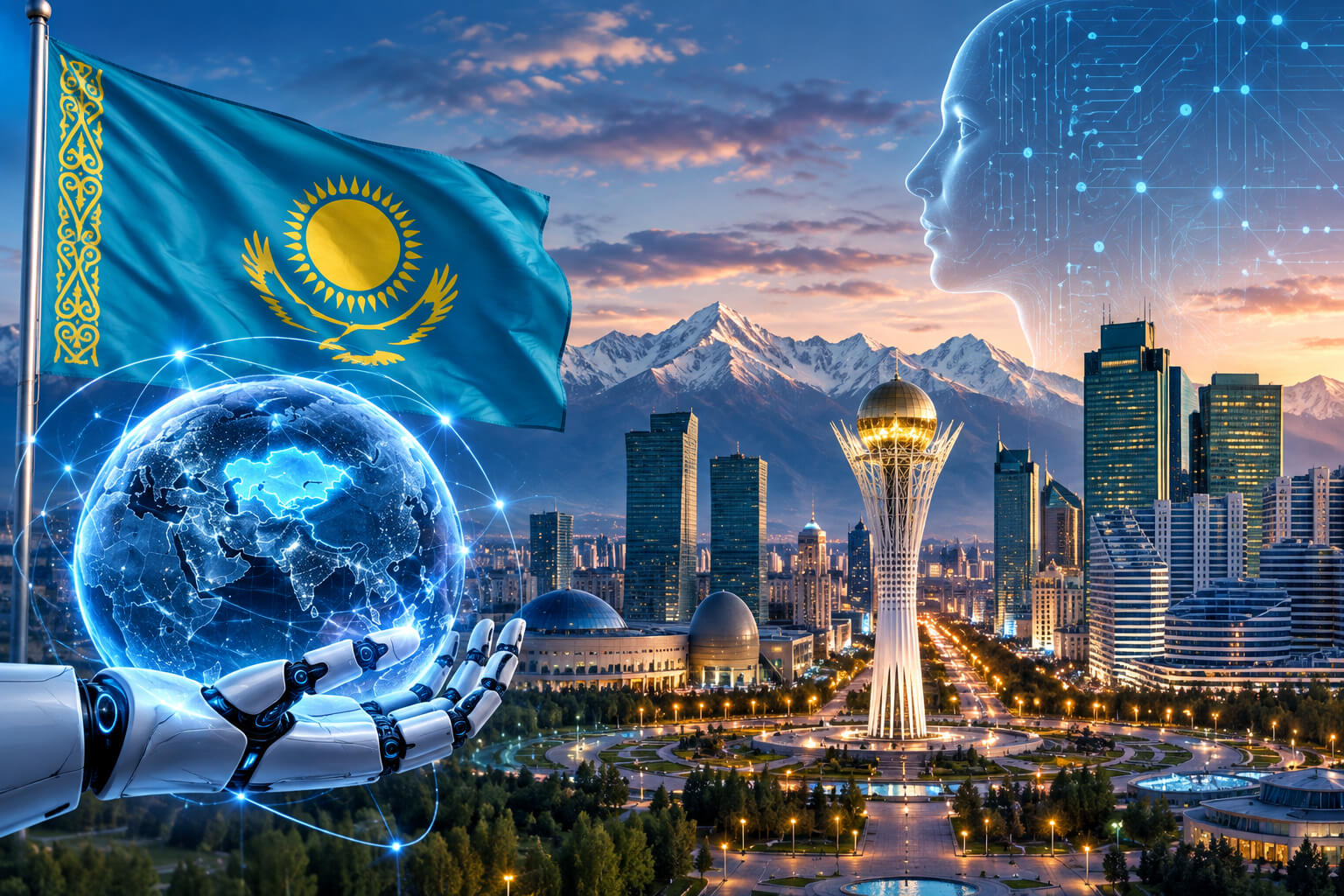
Kazakhstan is making artificial intelligence part of a much bigger economic bet.
The Central Asian country is investing in AI infrastructure, local models, startup development and technical education as it tries to build a technology economy that reaches beyond oil, minerals and other raw materials. The effort has become increasingly visible in Astana, where AI projects now stretch from government institutions and universities to startup accelerators and public-facing technology centres.
President Kassym-Jomart Tokayev declared 2026 the Year of Digitalisation and Artificial Intelligence, putting advanced technology near the centre of the country’s economic agenda. Kazakhstan also established a dedicated Ministry of Artificial Intelligence and Digital Development in 2025 and has developed plans to expand AI across education, healthcare, taxation, energy and public services.
The ambition is fairly clear: Kazakhstan wants to become a serious AI centre for Central Asia rather than simply a market consuming technology developed elsewhere.
Kazakhstan Builds AI Into Its National Strategy
Artificial intelligence in Kazakhstan is increasingly being treated as infrastructure rather than another experimental technology. The government wants AI tools deployed across multiple areas of the economy while building domestic technical skills at the same time. Kazakhstan has also moved into AI regulation, passing legislation intended to govern how artificial intelligence is developed and used.
That push now extends into international positioning. Kazakhstan is using major technology programmes, conferences and government-backed initiatives to attract developers, investors and global AI companies. The country is trying to assemble several pieces of an AI ecosystem at once: talent, computing capacity, startups, regulation and foreign technology partnerships.
Astana Hub Becomes a Training Ground for AI Talent
A major part of Kazakhstan’s strategy runs through Astana Hub, the country’s technology and innovation cluster. Its programmes cover programming, generative AI, animation and broader digital skills, giving students and career changers more direct routes into the technology sector.
One initiative, Tomorrow School, targets adults who want to transition into technology careers. According to Al Jazeera, around 25,000 people applied to the programme, with fewer than 2 percent accepted through its selection process. Tomorrow School had trained roughly 500 people after its first 18 months and was expanding beyond Astana into other parts of Kazakhstan.
The wider talent strategy also includes the alem.ai ecosystem, which brings together AI education, research, startups and product development. Kazakhstan is clearly trying to grow its own technical workforce rather than relying entirely on imported expertise.
Startups Are Part of Kazakhstan’s AI Equation
Training developers is only one piece of Kazakhstan’s AI plan. The country also wants more of those developers to launch companies capable of competing outside the domestic market.
Astana Hub operates startup programmes designed to help technical teams turn ideas into commercial products. The hub has also built links with technology ecosystems in markets including Dubai, Shanghai, Malaysia and the United Kingdom, giving Kazakhstan-based startups greater exposure to international investors and potential customers.
One of the most prominent companies associated with the ecosystem is Higgsfield, an AI video-generation startup that reached unicorn status. Kazakhstan hopes examples like this can encourage more founders to build globally focused AI companies from Central Asia.
The larger question is whether those successes can become repeatable. A sustainable AI hub needs more than a handful of standout startups. It needs a pipeline of companies that can attract investment, hire technical talent and sell beyond Kazakhstan’s borders.
Kazakhstan Wants AI That Speaks Its Language
Kazakhstan’s AI ambitions also have a distinctly local dimension. Researchers have been working on artificial intelligence systems that better understand Kazakh language, culture and historical context rather than depending entirely on models developed for much larger language markets.
Researchers at Nazarbayev University’s Institute of Smart Systems and Artificial Intelligence began developing local language technology after recognising how poorly mainstream voice assistants handled Kazakh. That work eventually led to systems designed around the linguistic needs of the country.
One of those models, MagniSoz, supports text and audio across multiple languages. Its successor, Oylan, adds image capabilities and supports Kazakh, Russian and English alongside reasoning and web-search functions. Some of these systems can also operate locally rather than sending sensitive information to overseas infrastructure.
For Kazakhstan, that matters. Building domestic AI is not simply about competing with the world’s largest model developers. It is also about making sure local languages are properly represented in the next generation of digital tools.
Global AI Partnerships Are Moving Into Astana
Kazakhstan is also using international partnerships to bring more global technology companies into its domestic AI ecosystem. Events in Astana increasingly serve as meeting points for developers, investors, government officials and international AI firms.
One example is HackAlem AI, which brings developers together to build AI products using technologies from international partners. OpenAI is among the companies involved in the programme, giving participants access to tools and resources while connecting Kazakhstan’s local developer community with a broader global ecosystem.
The initiative feeds into larger technology events such as AI & Digital Bridge 2026, where Kazakhstan expects thousands of participants and dozens of technology companies. These events give Astana more visibility as a regional meeting point for the AI industry and create opportunities for local startups to meet investors and potential partners directly.
Data Centres Bring a Tougher Infrastructure Question
Kazakhstan’s AI plans eventually run into a physical reality: artificial intelligence requires huge amounts of computing power, and computing power requires electricity.
The country wants to expand its data centre infrastructure, but parts of Kazakhstan’s electricity network are ageing and demand is already putting pressure on the system. During periods of peak consumption, Kazakhstan has at times relied on imported electricity.
Cooling is another consideration. Large data centres can consume significant amounts of power and water, depending on the cooling systems being used. Government officials have discussed technologies such as immersion cooling as one possible way to reduce pressure on water resources.
This is where Kazakhstan’s digital ambitions become much more practical. AI growth depends not only on software engineers and startup funding, but also on power generation, transmission infrastructure, cooling systems and suitable land for computing facilities.
AI Governance and Surveillance Remain Under Scrutiny
Kazakhstan’s growing use of AI also raises questions about privacy, biometric identification and government surveillance.
The country has introduced legislation governing artificial intelligence, but the effectiveness of those protections will depend heavily on enforcement. As facial recognition and other biometric technologies become more widely deployed, civil society groups are likely to pay closer attention to how personal data is collected, stored and used.
Supporters of Kazakhstan’s digitalisation push argue that AI could improve government efficiency and public services. Critics, however, have raised concerns that the same tools could expand the state’s ability to monitor individuals.
That tension is unlikely to disappear. The real test will be whether Kazakhstan can expand the use of AI while maintaining credible safeguards around privacy, transparency and accountability.
Kazakhstan’s Regional AI Ambition Is Taking Shape
Kazakhstan is not trying to recreate Silicon Valley. Its opportunity looks different.
The country sits between major European and Asian markets, has a growing technology ecosystem and is putting government resources behind AI education, startups, infrastructure and locally developed models. That combination gives Kazakhstan a realistic opportunity to become a more influential technology centre within Central Asia.
There are still clear pressure points. Electricity capacity must keep pace with data centre development. Regulation needs meaningful enforcement. Startups also need international customers rather than relying indefinitely on domestic support programmes.
Still, Kazakhstan has moved beyond simply announcing an AI strategy. It is building institutions, training developers, hosting international technology events and creating AI systems designed for local languages and needs.
The next test is whether those pieces can grow into an ecosystem that remains competitive long after the current surge of government attention.
Sources
Al Jazeera — Inside Kazakhstan’s push to become a regional AI centre
https://www.aljazeera.com/news/2026/9/21/inside-kazakhstans-push-to-become-a-regional-ai-centre
Ministry of Artificial Intelligence and Digital Development of Kazakhstan
https://www.gov.kz/memleket/entities/maidd
HackAlem AI — Official Event Website
https://www.hackalem.ai/
