


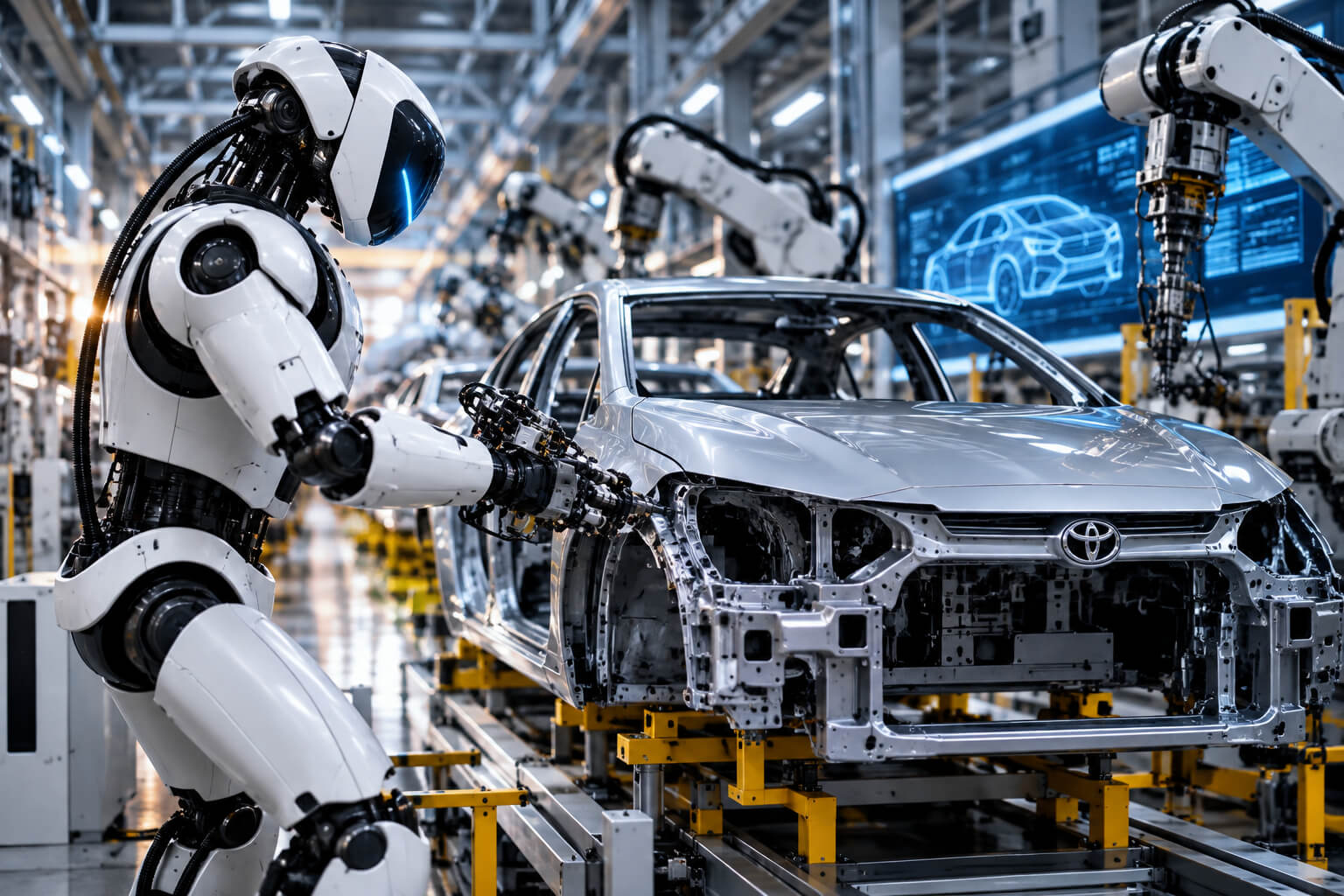
Toyota is looking at factory automation on a scale that makes the usual robotics pilot look small. In fact, Toyota physical AI factory robots are playing a key role in this new wave of innovation.
The Japanese automaker estimates that modernising factories across Toyota, its group companies and major suppliers could require roughly 400,000 robots and annual spending of around 1 trillion yen, or about $6.4 billion, from 2028. The figure covers existing machines that need replacing as well as new robotic systems, including conventional industrial robots and emerging humanoid machines.
There is an important caveat. Toyota has not confirmed that it will actually spend the full amount every year, nor has it said how long investment at that level might continue. Still, the estimate gives a sense of where one of the world’s biggest manufacturers thinks factory automation could be heading.
And this is not simply about installing more robot arms.
Toyota is pushing deeper into physical AI, where machines use sensors, AI models and learned behaviours to understand what is happening around them and act in the physical world.
Toyota’s 400,000-Robot Estimate Goes Beyond Humanoids
The headline number is enormous, but the 400,000 robots should not be mistaken for 400,000 humanoids walking around Toyota factories. The estimate covers a much broader automation network that includes industrial robots, automated logistics equipment, replacement machinery and newer robotic systems. Human-robot collaboration on production floors is also part of the wider picture.
That makes Toyota’s potential investment less about one spectacular machine and more about reshaping manufacturing infrastructure around increasingly capable automation. The company already has experience in this area. At its Kamigo Plant in Japan, for example, a piston assembly line introduced robotic automation in January 2025 and eventually progressed from requiring three workers to operating without direct human involvement.
Toyota has also learned that automation does not automatically solve every production problem. Some heavily automated systems became difficult to maintain when factories expanded overseas, particularly where local facilities lacked enough specialised maintenance skills. In some cases, Toyota temporarily returned certain processes to manual production so workers could better understand the task and develop improved tools and methods before introducing automation again.
Physical AI Changes What Factory Robots Can Do
Traditional industrial robots work best when their environment stays predictable. If the same component appears in the same position thousands of times, a robot can repeat the same movement with remarkable precision. Real factories, however, are rarely that neat.
Parts shift, materials arrive at slightly different angles, equipment wears down and sensors do not always produce perfect readings. Physical AI is designed to help robots deal with those inconsistencies by allowing machines to interpret their surroundings, make decisions and adjust their actions as conditions change.
Toyota’s KumiPro parts-picking system is one example. Rather than requiring components to sit in carefully predetermined positions, cameras help the system locate and handle loosely arranged parts. Toyota has already deployed the technology on production lines at Toyota Motor East Japan.
Force-feedback control adds another layer of adaptability. If a robot’s camera does not perfectly judge an object’s position, the machine can detect resistance and adjust its movement while placing a component into a narrow space. The process looks less like rigid automation and more like the way a human worker might see, feel and correct a movement in real time.
ELEY Takes Toyota Deeper Into Embodied AI
Toyota is also developing ELEY, short for Embodied Learning robot for Enhanced Yield. The experimental system has two human-like arms mounted on an omnidirectional mobile base and is designed for jobs that require physical interaction with objects in less predictable environments.
The real challenge is not simply getting ELEY to complete a task once. Toyota needs the robot to repeat those tasks accurately over long periods while coping with the small variations that happen constantly on a production line. Precision, durability and reliable data collection all remain central development issues.
Toyota plans to continue testing ELEY in conditions that more closely resemble real manufacturing environments. Both successful and failed attempts can provide useful training information. For physical AI, failure is not necessarily wasted effort. It becomes part of the dataset that helps future models understand what not to do.
Toyota Is Training Robots in Simulation
Toyota is also using simulated environments to accelerate robot training. Instead of teaching one physical machine at a time, developers can run thousands of virtual robots simultaneously and allow them to learn through reinforcement learning.
Those virtual environments give robots a chance to practise movements, fail repeatedly and refine their behaviour without damaging expensive equipment or interrupting a live production line. Skills learned in simulation can later be transferred to physical machines.
That transfer creates its own problem, often called the Sim2Real gap. A digital environment cannot perfectly reproduce the friction of a factory floor, the behaviour of real motors or the inconsistencies found in sensors and mechanical components. Toyota attempts to reduce this gap by deliberately adding variation during simulation training and feeding real-world robot data back into the development process.
The aim is not to build a perfect copy of reality. It is to train machines that can keep working when reality turns out to be slightly different from the simulation.
Toyota Research Institute Is Building Large Behavior Models
Toyota’s work on physical AI also extends through Toyota Research Institute, which has been developing Large Behavior Models designed to teach robots a broader range of physical skills.
The idea shares some similarities with large language models, although the output is very different. Instead of generating text, the models learn sequences of physical behaviour. Researchers can demonstrate a task to a robot, provide training data and allow the system to learn the movement rather than manually programming every individual action.
Toyota Research Institute has previously demonstrated robots learning tasks such as handling deformable objects, manipulating tools and pouring liquids. These are surprisingly difficult jobs for machines because they require constant adjustments rather than a single fixed motion.
TRI is also working with Boston Dynamics on AI control systems for the Atlas humanoid robot. Demonstrations have shown Atlas performing sequences that involve walking, lifting objects, sorting items and packing them while relying on a unified behaviour model.
Automakers Are Treating Robotics as a Bigger AI Bet
Toyota is not alone in pushing robotics deeper into automotive manufacturing. Hyundai Motor Group is also preparing to introduce humanoid systems into its production operations, including plans involving Boston Dynamics’ Atlas robot.
Hyundai has indicated that Atlas could begin operating at Hyundai Motor Group Metaplant America in Georgia from 2028, initially handling parts-sequencing tasks. More complicated assembly work could follow later as the technology matures.
The wider industrial robotics market shows why automakers are paying close attention. Japan already operates hundreds of thousands of industrial robots, with automotive manufacturing remaining one of the largest users of automated systems.
Toyota’s proposed scale goes further because its estimate includes replacement machines, new automation technologies and multiple types of robots spread across Toyota facilities, group companies and major suppliers.
Physical AI Could Become the Next Factory Technology Race
Generative AI has spent the past few years largely living behind screens. Physical AI pushes the technology somewhere much harder: factories, warehouses, vehicles and other environments where software has to interact with the real world.
Toyota’s estimate of potentially spending around $6.4 billion annually on factory automation from 2028 shows how expensive that transition could become. Building robots is only part of the challenge. Companies also need training data, simulation systems, AI models, reliable sensors and machines capable of performing repetitive jobs without constant intervention.
Factories may become one of the strongest testing grounds for physical AI because the commercial incentive is already clear. Manufacturers want greater productivity, more flexibility and automation that can deal with changing conditions instead of requiring every task to remain perfectly structured.
Toyota is not promising that 400,000 intelligent robots will suddenly appear in 2028. The estimate includes conventional equipment, replacement systems and newer robotics, and the company has not committed to spending the entire projected amount.
What the number does reveal is the scale Toyota is considering.
Physical AI is moving beyond research labs and staged robot demonstrations. For Toyota, the next major AI platform may not be a chatbot.
It could be the factory floor.
Sources
Artificial Intelligence News reported on Toyota’s estimate for factory automation spending, physical AI development, KumiPro, ELEY, simulation training and broader robotics plans. Source: https://www.artificialintelligence-news.com/news/toyota-physical-ai-factory-robotics/
Reuters reported that Toyota estimates factory automation could require roughly 1 trillion yen in annual spending from 2028, while noting that the company has not committed to maintaining that spending level. Source: https://www.investing.com/news/stock-market-news/toyota-estimates-factory-automation-could-cost-64-billion-per-year-from-2028-4906790
Toyota Research Institute has published details on its generative AI approach to teaching robots dexterous behaviours and developing systems capable of learning physical tasks from demonstrations. Source: https://pressroom.toyota.com/?generate_pdf=87244
