


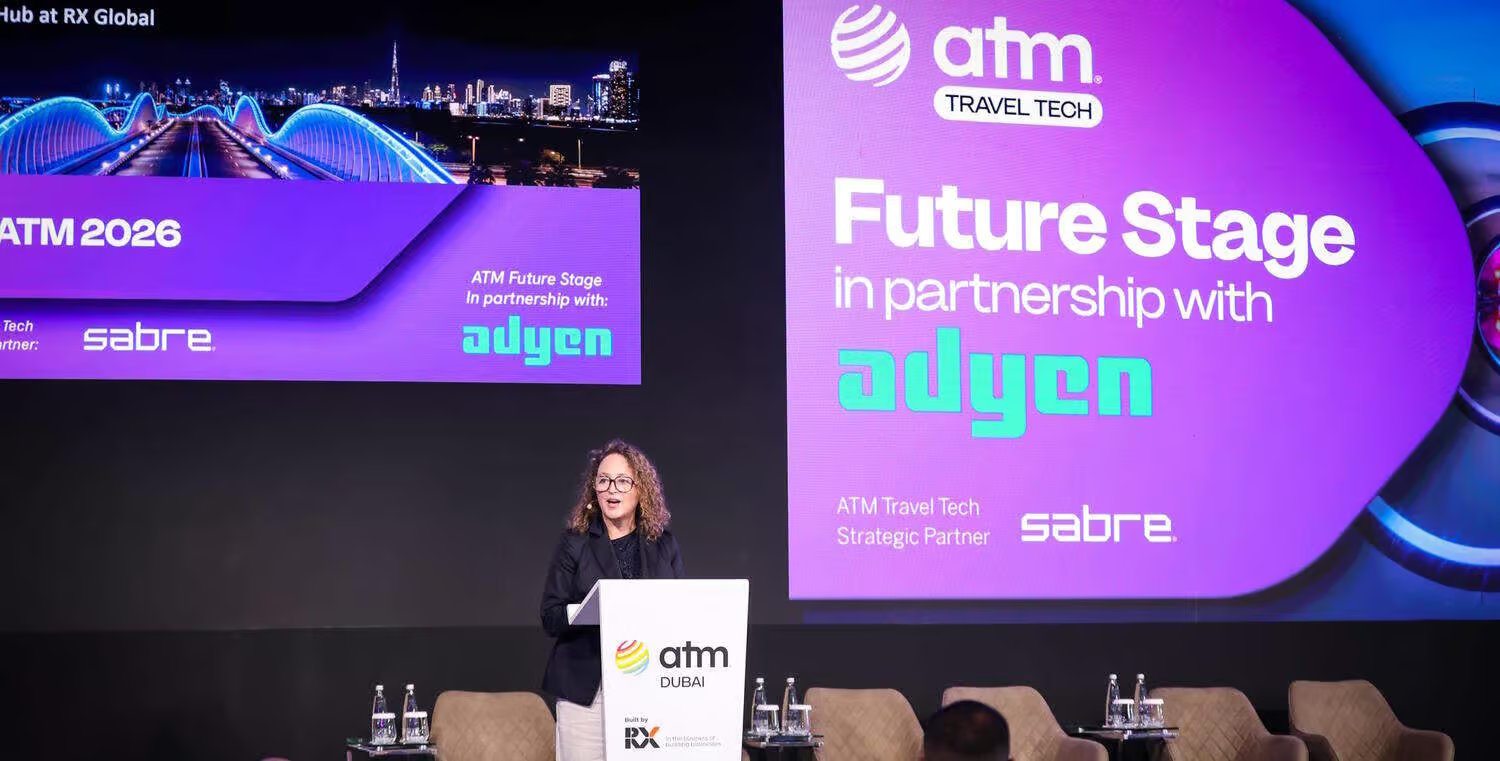
Artificial intelligence is no longer being treated as a clever add-on for travel websites. At Arabian Travel Market (ATM) 2026 in Dubai, the conversation has moved deeper, with industry leaders looking at AI as part of the infrastructure that could eventually hold the global travel ecosystem together.
The ATM 2026 Future Stage opened with discussions around how AI is moving beyond chatbots, recommendation engines and automated customer service. Attention is shifting toward travel discovery, operations, distribution, data, governance and the connections between airlines, hotels, destinations, governments and technology companies.
That makes the conversation much bigger than simply using AI to generate an itinerary.
AI Is Moving Deeper Into the Travel Industry
For years, much of the travel industry’s use of AI has been visible at the customer-facing level. Travellers already interact with recommendation engines, automated customer support, dynamic pricing tools and increasingly capable trip-planning assistants. ATM 2026 is looking beyond those applications and asking how AI could influence the deeper systems that keep travel moving.
The Future Stage, part of the Tech & Innovation Hub at ATM Travel Tech, is examining what happens when AI becomes embedded across travel operations rather than sitting inside a single app or website. Rachel Travers, President of the UK Hub at RX Global, opened the programme as part of a wider four-day agenda focused on technologies reshaping the travel industry.
The question is no longer whether an airline needs an AI chatbot. The bigger question is how airlines, hotels, destinations and governments should connect their data and systems when AI increasingly sits between the traveller and the companies serving them.
Dubai Says Traditional Search Visibility Is No Longer Enough
One of the strongest points came from Dr Marwan Alzarouni, CEO, AI at the Dubai Department of Economy and Tourism, during the opening keynote titled AI’s True Role in Rewriting the Travel Landscape. His message touched on a challenge that tourism organisations and travel brands are beginning to face as AI-powered search becomes more common.
Travellers are starting to ask AI systems where to go, where to stay and what to do instead of moving through traditional search results one website at a time. That changes the meaning of online visibility. Ranking well on Google still matters, but travel organisations may increasingly need to think about whether AI systems can properly understand, retrieve and trust their information.
For destinations such as Dubai, tourism content needs to be current, authoritative and structured clearly enough for AI platforms to interpret it. Alzarouni described this gap partly as a content and discoverability problem rather than simply a technology issue.
That could quietly become one of AI’s biggest effects on travel marketing.
AI Search Could Reshape How Travellers Discover Destinations
The traditional travel discovery journey has usually involved searching for a destination, reading travel articles, comparing hotels and flights, moving between booking platforms and eventually making a decision. AI agents could compress much of that process into a far shorter interaction.
A traveller could ask an AI assistant for a seven-day Dubai itinerary within a specific budget, while also requesting certain hotel standards, food preferences and activities. A more advanced agent could potentially compare options, recommend a plan and eventually help carry out parts of the booking process.
That creates a new intermediary between the traveller and the travel company. The ATM 2026 session “Winning the Discovery Layer” focused specifically on conversational search, AI agents and autonomous trip planning as these technologies begin changing how travellers find and select destinations.
For airlines, hotels and destination marketing organisations, being understandable to AI systems may eventually become almost as important as appearing prominently in traditional search.
The Bigger Opportunity Is Connecting AI Across Travel
Travel remains highly fragmented. A single international journey can involve airlines, airports, hotels, payment providers, online travel agencies, tourism authorities, ground transportation operators and government systems. Each organisation may operate with different software, data standards and internal processes.
Running separate AI tools inside each company can improve individual tasks, but the larger opportunity appears when those systems can work together. Alzarouni argued that AI becomes more valuable when it can operate across partners and ecosystems instead of remaining locked inside isolated businesses.
For that to happen, destinations, airlines, hotels and governments will need stronger integration. Interoperability, trusted data, governance and system compatibility suddenly become much more important.
Launching a chatbot is easy compared with building a connected AI travel ecosystem.
AI in Travel Is Becoming an Infrastructure Question
Danielle Curtis, Regional Portfolio Director – UAE at RX Global, described the travel industry’s AI conversation as moving beyond individual customer experiences and toward the infrastructure supporting the sector itself.
That shift brings some less glamorous but extremely important issues into focus. Data quality matters. Governance matters. System connectivity matters. Companies also need to decide who controls information when an AI agent interacts with several businesses during one journey.
These questions become more difficult as AI moves from giving recommendations to taking actions. An assistant suggesting three hotels is one thing. An autonomous agent coordinating flights, accommodation, payments and ground transportation is something very different.
This is where AI in travel begins to look less like a digital feature and more like a structural change.
Human Expertise Is Not Disappearing From the Conversation
ATM 2026 is also addressing a question that follows nearly every discussion around AI and automation: what happens to people?
The session “AI vs Human: What It Really Means to Be a Professional in the Age of Intelligence” explored how automation is changing professional expertise while increasing the importance of human judgement, creativity and decision-making.
Travel makes this debate particularly interesting because the industry is both digital and deeply human. Algorithms can optimise routes, compare thousands of hotels and analyse pricing almost instantly, but travellers still deal with disruptions, personal preferences, cultural differences and unpredictable situations that are difficult to reduce to clean datasets.
AI may automate more of the mechanics of travel, but human expertise could become even more valuable when the situation becomes complicated.
ATM Travel Tech Shows How Fast the Market Is Expanding
The Future Stage forms part of ATM Travel Tech, which debuted as a dedicated co-located show at ATM 2026. More than 180 exhibitors from 30 countries are participating across two dedicated halls, while an 850-square-metre Tech & Innovation Hub is showcasing technologies including artificial intelligence, robotics, fintech, virtual reality, augmented reality and green technology.
The scale of the event matters because AI is increasingly overlapping with several of those categories. Robotics can be powered by AI. AR experiences can become adaptive through AI. Fintech platforms can use AI agents for transactions, while travel companies can combine predictive models with live operational data.
AI is no longer developing as a separate technology category. It is increasingly becoming part of everything around it.
Travel 2040 Could Be Built Around AI-Connected Ecosystems
ATM 2026 is running under the wider theme “Travel 2040: Driving New Frontiers Through Innovation and Technology.” The Future Stage fits naturally into that theme, but the opening discussions suggest that many of these changes may arrive much sooner than 2040.
The travel industry is already moving toward a world where AI influences what people discover before a trip, how they compare choices, how bookings are made and how companies operate behind the scenes.
The most important change may not be the AI assistant visible on a traveller’s phone. It could be the systems working behind it.
If airlines, hotels, destinations, booking platforms and governments eventually allow AI systems to work across their respective ecosystems, travel could become far more automated and personalised. That opportunity also raises the importance of accurate data, interoperability, governance and human oversight.
ATM 2026’s opening Future Stage discussion points toward that next phase.
AI is not simply joining the travel industry. It is starting to reshape the plumbing.
Sources
Breaking Travel News reported on the opening of the ATM 2026 Future Stage and its focus on AI’s growing role across the travel ecosystem. Source: https://www.breakingtravelnews.com/news/article/atm-2026-future-stage-opens-with-focus-on-ais-role-in-rebuilding-the-founda/
Additional ATM 2026 coverage and programme information can also be found through Breaking Travel News and the official Arabian Travel Market event channels.
