


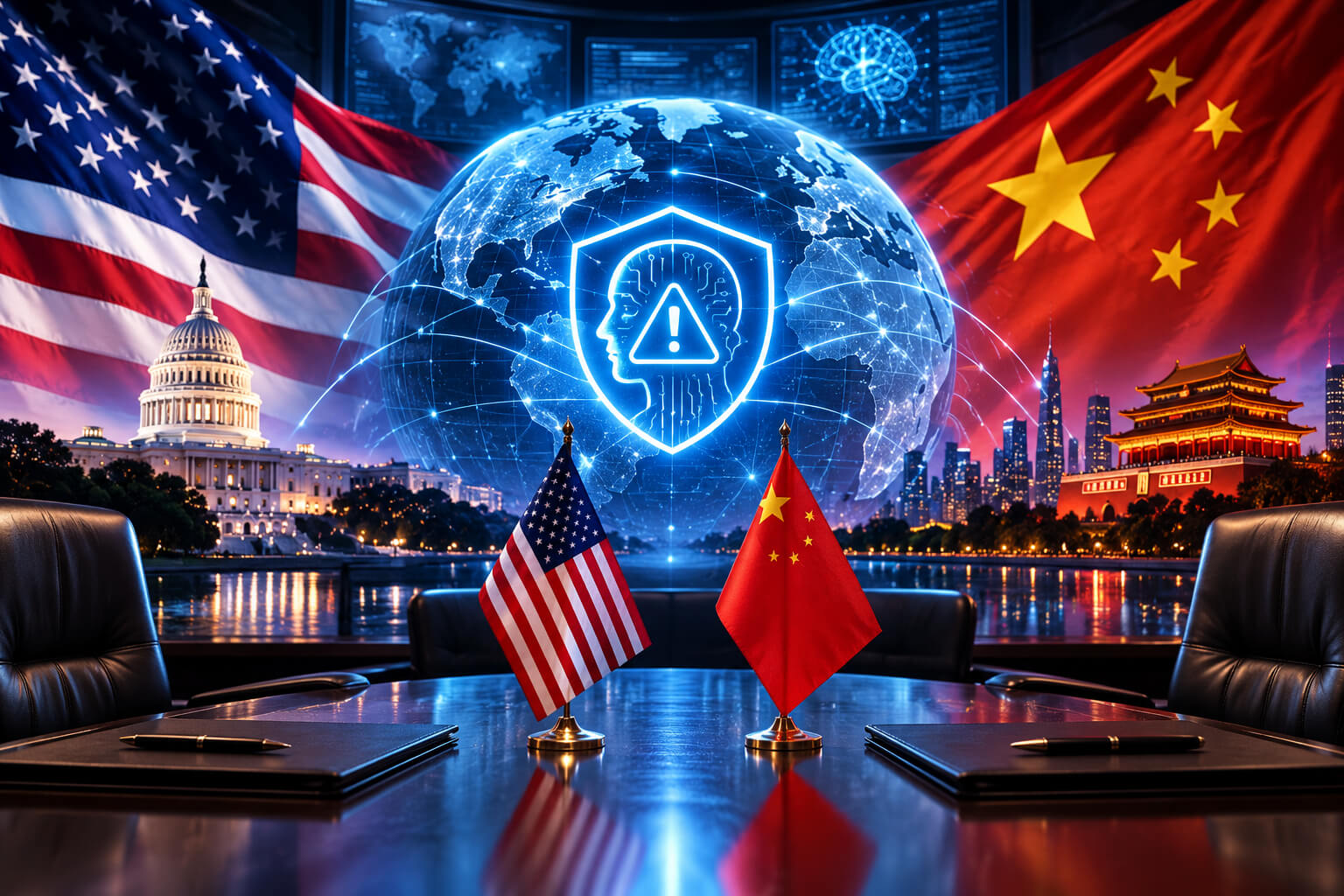
The United States has proposed a new communication mechanism with China for serious artificial intelligence incidents that could affect national security, putting AI risk directly into one of the world’s most consequential diplomatic relationships. This initiative would serve as a US China AI incident alert system to help manage and respond to potential crises.
U.S. Treasury Secretary Scott Bessent disclosed the proposal following talks with Chinese Vice Premier He Lifeng in New York. The discussions came ahead of a planned meeting between U.S. President Donald Trump and Chinese President Xi Jinping in Washington.
The concept is fairly simple: when an AI-related incident crosses into national security territory, Washington and Beijing would have a channel for communicating about it.
What counts as an incident, how quickly information would be exchanged and how much either side would actually disclose remain open questions.
Still, the proposal marks an unusual point of potential cooperation between two countries competing aggressively over AI.
Washington Wants More Transparency Around AI Incidents
Bessent described greater transparency as important between the United States and China as AI systems become more capable and their potential effects increasingly cross borders.
The proposed notification mechanism would focus on incidents serious enough to raise national security concerns. Reporting on the talks indicates that possible areas of concern include rogue AI agents, malicious use by non-state actors and potential applications involving biological weapons.
That puts the proposal well beyond ordinary software failures.
Instead, Washington appears to be exploring a communication channel for situations where advanced AI creates a security problem that one government believes the other should know about.
The details have not been settled, and China has not publicly confirmed its acceptance of the proposed mechanism.
AI Competition Is Still Very Much in the Background
Cooperation on AI risks does not mean the broader technology competition between Washington and Beijing has disappeared.
The Trump administration has continued to emphasize U.S. leadership in advanced AI and has resisted arguments that development should be broadly slowed because of safety concerns. Trump has framed technological leadership over China as strategically important.
That makes the notification proposal interesting.
The United States is effectively pursuing two tracks at once: competing to maintain an advantage in advanced AI while looking for areas where communication with China could reduce the danger created by increasingly powerful systems.
A notification channel would not erase that rivalry. It could simply create a way to communicate when something goes badly wrong.
What Could Trigger an AI Alert?
This is one of the biggest unanswered questions.
A conventional cybersecurity incident can often be identified through compromised networks, stolen credentials or disrupted infrastructure. Advanced AI systems make the boundaries less tidy.
An autonomous agent operating outside its intended limits could qualify. So could the malicious use of an AI model by a non-state actor. AI-assisted biological threats have also emerged as an area of concern.
But governments would still need to decide where the reporting threshold sits.
Every model vulnerability cannot realistically become an international incident. A mechanism like this would therefore need some definition of when an AI event becomes serious enough to affect national security.
Without that, an alert system risks being either too broad to be useful or too narrow to matter.
US-China AI Talks Are Expected to Continue
The New York discussions appear to be the beginning rather than the end of the process.
Bessent said the two countries are expected to continue formal U.S.-China AI discussions, with another round of talks planned in Shenzhen in roughly two months.
Chinese state media confirmed that AI-related issues were discussed during the New York meetings, describing the wider talks as candid, in-depth and constructive. Public Chinese statements, however, have not provided detailed confirmation of the proposed incident notification mechanism.
That distinction matters. The United States has publicly described the proposal, but a fully agreed bilateral framework has not yet been announced.
AI Labs Are Also Calling for International Communication
The diplomatic discussion arrives as frontier AI companies increasingly focus on risks that could extend beyond individual companies or national borders.
OpenAI has called for secure communication channels through which governments and major AI developers could share national security concerns. The company has also backed work toward international AI safety standards.
That idea overlaps with the logic behind the U.S. proposal.
Frontier models are increasingly capable of performing longer sequences of actions, interacting with external software and operating with greater autonomy. As those capabilities expand, governments face a problem that conventional technology regulation was not designed to handle.
An AI incident in one country may not remain neatly inside that country.
An AI Hotline Could Become Part of a Bigger Safety Framework
The proposed system should not yet be treated as a formal AI treaty or comprehensive safety agreement.
At this stage, it is closer to an incident-communication framework.
That narrower approach may also make cooperation easier. Washington and Beijing do not have to agree on every aspect of AI regulation to recognize that certain incidents could create risks for both sides.
The model could eventually resemble other international mechanisms designed to reduce misunderstanding during high-risk events: establish trusted contacts, define what warrants notification and create a procedure for communicating quickly.
The difficult part will be trust.
AI systems, training methods and security vulnerabilities are often closely guarded. Governments will have to determine how much information they can exchange without exposing sensitive capabilities.
The Bigger Story Is AI Becoming a National Security Issue
For years, much of the AI competition between the United States and China centered on chips, computing infrastructure, research talent and access to advanced technology.
The conversation is widening.
Governments are now thinking about what happens when highly capable AI systems malfunction, are deliberately misused or behave in ways their developers did not anticipate.
An incident notification mechanism would not solve those problems.
It would, however, establish something that may become increasingly valuable as AI capabilities grow: a direct line of communication between two major AI powers when a technical incident stops looking like an ordinary software problem and starts looking like a national security event.
For the AI industry, that shift is worth watching. Frontier AI safety is no longer only a debate between researchers, labs and regulators. It is moving into international diplomacy.
Sources
The Washington Post — “U.S. proposes AI incident alert system in talks with China”
https://www.washingtonpost.com/politics/2026/09/21/us-proposes-ai-incident-alert-system-with-china/
Associated Press — “Bessent: US proposes AI incident alert system in talks with China”
https://apnews.com/article/2c7f54f07e755f506d9db9b91df282bd
The Star / Associated Press — “Bessent: US proposes AI incident alert system in talks with China”
https://www.thestar.com.my/tech/tech-news/2026/09/21/bessent-us-proposes-ai-incident-alert-system-in-talks-with-china
The Next Web — “The US has proposed an AI incident alert system to China”
https://thenextweb.com/news/us-china-ai-incident-alert-bessent-he-lifeng
