


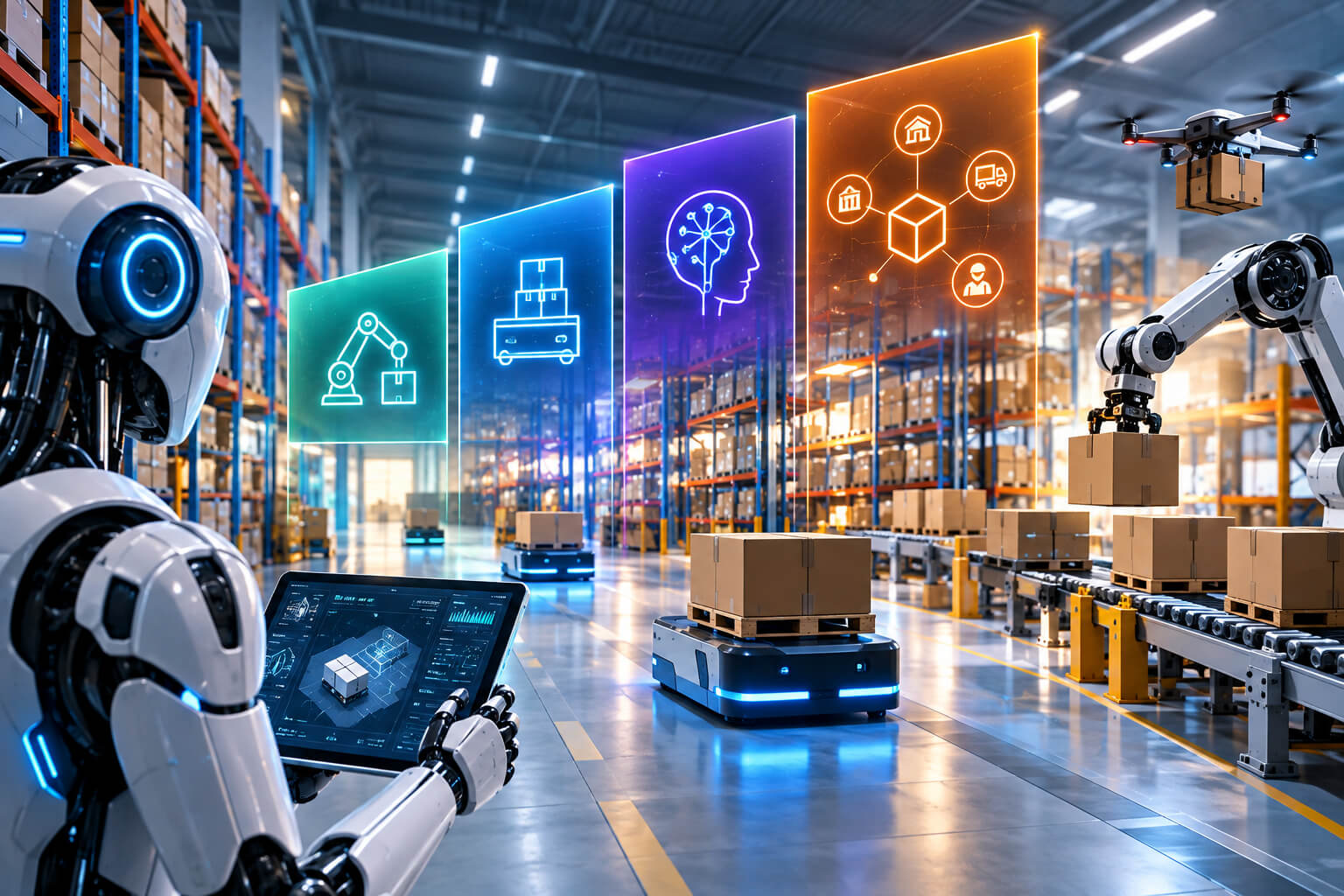
Artificial intelligence is moving deeper into warehouse operations, and the change goes far beyond basic software upgrades. Gartner has identified four emerging AI tiers that are shaping the next stage of warehouse automation, ranging from smarter optimisation tools to AI agents and physical systems that can directly carry out tasks on the warehouse floor.
The shift comes as logistics operators face pressure to move goods faster, manage labour shortages and improve operational efficiency. At the same time, AI systems and autonomous technologies have become more practical for real-world deployment, creating a clearer path toward smarter warehouses.
Gartner Sees Warehouse AI Moving Into Real Operations
Warehouse operators have experimented with AI for years, but Gartner’s latest analysis suggests the technology is moving beyond isolated pilots and into broader operational use. The research firm looks at warehouse AI through two main dimensions: how intelligent the technology is and how directly it can influence or perform operational tasks.
At one end of the spectrum are systems that analyse data and recommend improvements. Further along are AI agents that can coordinate workflows and respond to changing conditions. At the physical end are intelligent machines capable of carrying out warehouse tasks themselves.
Federica Stufano, Senior Principal Analyst in Gartner’s Supply Chain practice, said these trends point toward warehouses becoming more intelligent, adaptive and resilient. Human oversight still remains important, particularly when businesses need visibility into how automated systems make decisions.
Tier One: Smarter Optimisation Becomes the Foundation
The first tier focuses on advanced optimisation. These systems have moved beyond static spreadsheets and rigid decision rules. They can process live warehouse information and continuously adjust recommendations as conditions change.
Warehouse management platforms can use optimisation models for demand forecasting, labour planning, picking routes and inventory placement. If order volumes suddenly shift, the system can recalculate where products should be positioned or how workers should be assigned.
This type of AI can also provide clearer decision trails, which is valuable for companies that need predictable processes and operational accountability. For many warehouses, optimisation remains one of the most practical starting points for introducing AI because it addresses specific problems without requiring a move toward full autonomy.
Tier Two: Generative AI Turns Warehouse Data Into Useful Instructions
Generative AI introduces a different layer of capability by helping warehouse teams work with information that is often scattered across reports, maintenance logs, delivery documents and operating procedures.
AI models can process this material and turn it into practical instructions for employees. A system could generate revised picking guidance after a supplier delay, create updated procedures when operating conditions change or help technicians identify maintenance steps based on historical equipment records.
The value is less about generating content for its own sake and more about making operational knowledge easier to access. In a fast-moving warehouse, workers often need the right information quickly, and generative AI can reduce the time spent searching through documents or manuals.
Tier Three: AI Agents Start Coordinating Warehouse Work
Agentic AI moves warehouse software from passive analysis toward active coordination. These systems can monitor workflows, identify bottlenecks and recommend changes based on what is happening across the facility.
An AI agent could suggest redistributing equipment between loading areas, changing picking assignments or adjusting workflows when congestion starts to build. In more advanced environments, the agent may be allowed to carry out certain low-risk actions automatically.
Human oversight can still remain part of the process, especially for sensitive or high-value decisions. This creates a middle ground between traditional decision-support software and fully autonomous operations, allowing companies to introduce AI agents gradually instead of handing over control all at once.
Tier Four: Physical AI Brings Intelligence Onto the Warehouse Floor
The fourth tier takes AI beyond software and puts it directly into physical warehouse operations. Machine learning can work alongside robotics, sensors and autonomous equipment to support tasks such as picking, packing, sorting and pallet movement.
This is where AI becomes much more visible inside the warehouse. Autonomous machines can operate for long periods, maintain consistent movement and handle repetitive or physically demanding tasks that are difficult to staff.
Physical AI may also contribute to workplace safety by taking over activities that involve heavy lifting, repetitive motion or other high-risk processes. Rather than creating a fully autonomous warehouse immediately, many companies are more likely to automate individual processes first and expand gradually as the technology proves reliable.
Labour Shortages Are Accelerating Warehouse Automation
The growing interest in warehouse AI is not being driven by technology alone. Labour shortages remain a major challenge for logistics businesses, particularly in facilities where repetitive or physically demanding roles are difficult to fill.
Automation gives operators another way to maintain throughput when staffing levels are tight. At the same time, newer commercial models are reducing some of the large upfront costs that previously made automation difficult for smaller operators.
Combined with more reliable AI systems and autonomous equipment, these changes are making warehouse automation more accessible. That does not mean every process should be automated, but it does make AI projects easier to test and scale.
Gartner Urges Warehouses to Start With Proven AI Use Cases
Gartner’s approach remains practical rather than aggressive. The recommendation is to begin with established applications such as labour forecasting, warehouse slotting and optimisation before moving into more complex AI systems.
This allows businesses to prove the value of automation in specific areas before introducing generative tools, AI agents or autonomous machinery. It also gives workers time to adjust to new systems and understand how AI fits into daily operations.
A warehouse may begin with inventory optimisation, then add generative AI for operational guidance, followed by AI agents for selected workflows and eventually autonomous vehicles or robotic systems. The order will vary depending on the facility, but the key is to connect each layer of AI to a clear operational need.
Warehouse Automation Is Becoming an AI Stack
Gartner’s framework also shows that warehouse AI is no longer a single technology. Optimisation, generative AI, autonomous agents and physical automation can operate together as part of the same wider system.
One tool may predict demand, another may interpret operational data, an AI agent may coordinate the response, and an autonomous machine may eventually carry out the physical task. Each layer adds a different type of intelligence.
This structure mirrors the wider direction of enterprise AI, where businesses are moving from systems that analyse information toward systems that can generate, reason, coordinate and act.
What Comes Next for AI in Warehousing?
The next phase of warehouse automation is unlikely to mean fully autonomous facilities with almost no human involvement. A more realistic outcome is a mixed environment where employees work alongside AI assistants, autonomous agents, robotics and conventional warehouse software.
The real challenge will be deciding which tasks should remain under human control and which can safely move toward greater autonomy. Businesses will also need clear oversight, reliable data and transparent decision-making processes if they want AI systems to become a trusted part of daily warehouse operations.
Gartner’s four-tier framework offers a practical way to understand that progression. Warehouse AI is moving from systems that simply analyse what is happening toward systems that can recommend actions, coordinate workflows and increasingly perform physical tasks themselves.
Sources
Artificial Intelligence News — Gartner outlines four AI tiers in warehouse automation
https://www.artificialintelligence-news.com/news/gartner-outlines-four-ai-tiers-in-warehouse-automation/
Gartner
https://www.gartner.com/Artificial intelligence is moving deeper into warehouse operations, and the change goes far beyond basic software upgrades. Gartner has identified four emerging AI tiers that are shaping the next stage of warehouse automation, ranging from smarter optimisation tools to AI agents and physical systems that can directly carry out tasks on the warehouse floor.
The shift comes as logistics operators face pressure to move goods faster, manage labour shortages and improve operational efficiency. At the same time, AI systems and autonomous technologies have become more practical for real-world deployment, creating a clearer path toward smarter warehouses.
Gartner Sees Warehouse AI Moving Into Real Operations
Warehouse operators have experimented with AI for years, but Gartner’s latest analysis suggests the technology is moving beyond isolated pilots and into broader operational use. The research firm looks at warehouse AI through two main dimensions: how intelligent the technology is and how directly it can influence or perform operational tasks.
At one end of the spectrum are systems that analyse data and recommend improvements. Further along are AI agents that can coordinate workflows and respond to changing conditions. At the physical end are intelligent machines capable of carrying out warehouse tasks themselves.
Federica Stufano, Senior Principal Analyst in Gartner’s Supply Chain practice, said these trends point toward warehouses becoming more intelligent, adaptive and resilient. Human oversight still remains important, particularly when businesses need visibility into how automated systems make decisions.
Tier One: Smarter Optimisation Becomes the Foundation
The first tier focuses on advanced optimisation. These systems have moved beyond static spreadsheets and rigid decision rules. They can process live warehouse information and continuously adjust recommendations as conditions change.
Warehouse management platforms can use optimisation models for demand forecasting, labour planning, picking routes and inventory placement. If order volumes suddenly shift, the system can recalculate where products should be positioned or how workers should be assigned.
This type of AI can also provide clearer decision trails, which is valuable for companies that need predictable processes and operational accountability. For many warehouses, optimisation remains one of the most practical starting points for introducing AI because it addresses specific problems without requiring a move toward full autonomy.
Tier Two: Generative AI Turns Warehouse Data Into Useful Instructions
Generative AI introduces a different layer of capability by helping warehouse teams work with information that is often scattered across reports, maintenance logs, delivery documents and operating procedures.
AI models can process this material and turn it into practical instructions for employees. A system could generate revised picking guidance after a supplier delay, create updated procedures when operating conditions change or help technicians identify maintenance steps based on historical equipment records.
The value is less about generating content for its own sake and more about making operational knowledge easier to access. In a fast-moving warehouse, workers often need the right information quickly, and generative AI can reduce the time spent searching through documents or manuals.
Tier Three: AI Agents Start Coordinating Warehouse Work
Agentic AI moves warehouse software from passive analysis toward active coordination. These systems can monitor workflows, identify bottlenecks and recommend changes based on what is happening across the facility.
An AI agent could suggest redistributing equipment between loading areas, changing picking assignments or adjusting workflows when congestion starts to build. In more advanced environments, the agent may be allowed to carry out certain low-risk actions automatically.
Human oversight can still remain part of the process, especially for sensitive or high-value decisions. This creates a middle ground between traditional decision-support software and fully autonomous operations, allowing companies to introduce AI agents gradually instead of handing over control all at once.
Tier Four: Physical AI Brings Intelligence Onto the Warehouse Floor
The fourth tier takes AI beyond software and puts it directly into physical warehouse operations. Machine learning can work alongside robotics, sensors and autonomous equipment to support tasks such as picking, packing, sorting and pallet movement.
This is where AI becomes much more visible inside the warehouse. Autonomous machines can operate for long periods, maintain consistent movement and handle repetitive or physically demanding tasks that are difficult to staff.
Physical AI may also contribute to workplace safety by taking over activities that involve heavy lifting, repetitive motion or other high-risk processes. Rather than creating a fully autonomous warehouse immediately, many companies are more likely to automate individual processes first and expand gradually as the technology proves reliable.
Labour Shortages Are Accelerating Warehouse Automation
The growing interest in warehouse AI is not being driven by technology alone. Labour shortages remain a major challenge for logistics businesses, particularly in facilities where repetitive or physically demanding roles are difficult to fill.
Automation gives operators another way to maintain throughput when staffing levels are tight. At the same time, newer commercial models are reducing some of the large upfront costs that previously made automation difficult for smaller operators.
Combined with more reliable AI systems and autonomous equipment, these changes are making warehouse automation more accessible. That does not mean every process should be automated, but it does make AI projects easier to test and scale.
Gartner Urges Warehouses to Start With Proven AI Use Cases
Gartner’s approach remains practical rather than aggressive. The recommendation is to begin with established applications such as labour forecasting, warehouse slotting and optimisation before moving into more complex AI systems.
This allows businesses to prove the value of automation in specific areas before introducing generative tools, AI agents or autonomous machinery. It also gives workers time to adjust to new systems and understand how AI fits into daily operations.
A warehouse may begin with inventory optimisation, then add generative AI for operational guidance, followed by AI agents for selected workflows and eventually autonomous vehicles or robotic systems. The order will vary depending on the facility, but the key is to connect each layer of AI to a clear operational need.
Warehouse Automation Is Becoming an AI Stack
Gartner’s framework also shows that warehouse AI is no longer a single technology. Optimisation, generative AI, autonomous agents and physical automation can operate together as part of the same wider system.
One tool may predict demand, another may interpret operational data, an AI agent may coordinate the response, and an autonomous machine may eventually carry out the physical task. Each layer adds a different type of intelligence.
This structure mirrors the wider direction of enterprise AI, where businesses are moving from systems that analyse information toward systems that can generate, reason, coordinate and act.
What Comes Next for AI in Warehousing?
The next phase of warehouse automation is unlikely to mean fully autonomous facilities with almost no human involvement. A more realistic outcome is a mixed environment where employees work alongside AI assistants, autonomous agents, robotics and conventional warehouse software.
The real challenge will be deciding which tasks should remain under human control and which can safely move toward greater autonomy. Businesses will also need clear oversight, reliable data and transparent decision-making processes if they want AI systems to become a trusted part of daily warehouse operations.
Gartner’s four-tier framework offers a practical way to understand that progression. Warehouse AI is moving from systems that simply analyse what is happening toward systems that can recommend actions, coordinate workflows and increasingly perform physical tasks themselves.
Sources
Artificial Intelligence News — Gartner outlines four AI tiers in warehouse automation
https://www.artificialintelligence-news.com/news/gartner-outlines-four-ai-tiers-in-warehouse-automation/
Gartner
https://www.gartner.com/
