


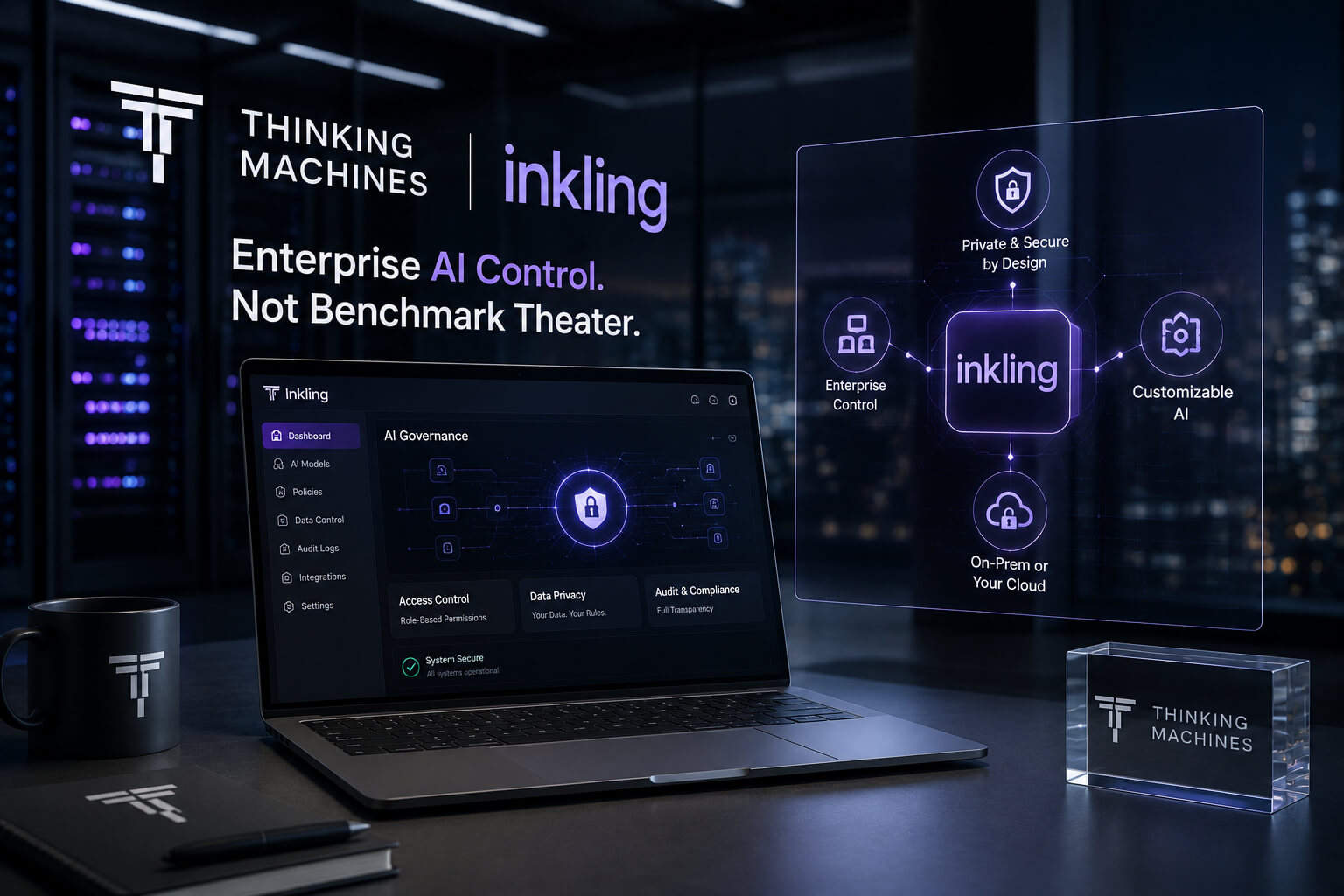
Thinking Machines has finally shown what it has been building.
The AI startup founded by former OpenAI CTO Mira Murati has launched Inkling, its first major AI model, and the message is pretty clear. This is not another model release trying to win the internet for a day with leaderboard screenshots. Inkling is being positioned around something less flashy but probably more important for businesses: control.
For enterprises, that word matters. A lot. Most companies using AI today are still renting intelligence from someone else. They plug into a closed API, send prompts, wait for responses, and hope the model behaves well enough inside their workflows. Inkling is aimed at a different kind of customer, the one that wants to customize, fine-tune, inspect, and possibly run AI closer to its own data and operations.
What Is Thinking Machines Inkling?
Inkling is an open-weight AI model from Thinking Machines Lab, released as the company’s first in-house model. It is built for general AI tasks, but the real pitch is not just general intelligence. It is adaptability.
Reports describe Inkling as a large open-weight model that developers and enterprises can fine-tune for their own needs. That gives companies more room to shape the model around specific workflows, internal knowledge, industry requirements, and product use cases instead of depending entirely on a closed model provider.
That makes the launch interesting because Thinking Machines is not trying to sound like every other AI lab. The company is not simply saying its model is smarter than everyone else’s. It is saying businesses may need AI systems they can actually control. And honestly, that may be the more practical argument.
Why Inkling Is Different From the Usual AI Model Launch
AI model launches often follow the same script. A company announces a bigger model. Then comes the benchmark chart. Then the demo video. Then everyone argues for 48 hours about whether it beats OpenAI, Anthropic, Google, Meta, or some Chinese open model. Inkling takes a slightly different route.
Thinking Machines is focusing on open weights, customization, and enterprise use. According to reports, Inkling is available through Hugging Face and is designed to be fine-tuned, inspected, and adapted by developers. The company also has Tinker, a platform that helps users customize AI models without building the entire infrastructure stack themselves.
That matters because many businesses do not want a model that only performs well in a public test. They want one that works inside their messier, stranger, more specific reality. Customer support workflows. Internal research. Coding agents. Legal review. Finance operations. Healthcare documentation. Industrial systems. Enterprise AI gets boring very quickly when the model cannot understand the business behind the prompt.
Enterprise AI Is Moving Toward Custom Models
The launch of Inkling fits into a bigger shift happening across AI. Companies are starting to ask whether relying only on closed, general-purpose models is enough. For some use cases, it is fine. For others, it becomes a limitation. Data privacy, cost, latency, compliance, vendor lock-in, and workflow control all become serious issues once AI moves from experiments into daily operations.
Inkling’s open-weight approach gives enterprises another option. Instead of treating AI as a rented black box, they can work with a model that can be adjusted around their own systems.
That does not mean every company will suddenly run its own AI model. Most will not. It is expensive. It is technically difficult. It requires serious AI infrastructure and talent. But the direction is still important. Enterprise AI is starting to split into two worlds. One is plug-and-play AI. The other is owned, customized, deeply integrated AI. Inkling is clearly aiming for the second one.
Mira Murati’s Thinking Machines Makes Its First Big Move
Thinking Machines has attracted attention partly because of who founded it. Mira Murati, formerly OpenAI’s chief technology officer, became one of the most visible figures in the AI industry before launching Thinking Machines. The startup reportedly raised major funding before releasing a public product, which created plenty of curiosity about what it would actually build.
Now Inkling gives the company its first real test. The model does not just need to impress AI researchers. It needs to convince enterprises that Thinking Machines can offer something useful in a crowded field. OpenAI, Anthropic, Google, Meta, Mistral, xAI, and others are already fighting for developer and enterprise attention.
So Thinking Machines is picking a lane: not just the smartest model, but the model businesses can shape. That is a smart lane, if it works.
Open Weights Could Matter More Than Open Hype
The phrase “open-weight” gets thrown around a lot, but it is important here. Open weights mean developers can access the model’s trained parameters, giving them more flexibility than they would have with a closed model API. It is not always the same as fully open-source AI, but it still gives users more technical control than a purely hosted system.
For businesses, that can mean more customization. More transparency. More freedom to fine-tune. More ability to test how the model behaves before putting it into production.
Of course, open-weight models also come with risks. Companies need security controls, responsible deployment practices, and technical teams that know what they are doing. A powerful model does not magically become safe just because it is customizable. Still, the demand is real. Enterprises want AI that fits their environment instead of forcing their environment to fit the AI.
Why Inkling Could Appeal to Businesses
Inkling’s biggest selling point may not be raw intelligence. It may be ownership. A business using AI for serious internal work does not always want to send everything through a third-party system. It may need model behavior tuned to its internal terminology, product catalog, compliance rules, or operational workflows. That is where a customizable model becomes attractive.
A bank might want AI that understands its risk language. A logistics company might want AI that works around routing, contracts, and shipment data. A software company might want coding agents trained around its own repositories and engineering patterns. Generic AI can help with all of that. But specialized AI can go deeper. Inkling appears built for that argument.
The Benchmark Race Is Not Over, But It Is Not Everything
None of this means benchmarks no longer matter. They still do. Enterprises need models that are capable, reliable, fast, and cost-effective. If Inkling performs poorly, customization alone will not save it. But Thinking Machines seems to be betting that the next phase of AI adoption will not be decided only by who tops a leaderboard.
That feels realistic. In production, businesses care about boring things. Can the model follow instructions? Can it be adapted? Can it handle company-specific data? Can it reduce costs? Can it be deployed safely? Can teams understand enough about it to trust it? Benchmark scores do not answer all of those questions.
Thinking Machines Is Entering a Tough Market
Inkling arrives in a brutal market. Open-weight AI is already competitive. Meta has pushed Llama hard. Mistral has built strong open models. Chinese AI labs have released powerful systems that put pressure on US startups. At the same time, closed-model companies are still moving fast and offering polished enterprise tools.
The competition is also becoming more geopolitical as the United States and China restrict AI models and treat advanced systems as strategic assets.
Thinking Machines needs to prove that Inkling is not only technically interesting but commercially useful. That means documentation, developer experience, fine-tuning tools, reliability, pricing, security, and support will matter almost as much as the model itself. Maybe more.
What Inkling Means for the Future of Enterprise AI
Inkling is not just another AI model name to remember. It points to where enterprise AI may be heading. The first wave was about access. Businesses wanted to use ChatGPT-like systems. The next wave is about fit. Businesses want AI that understands their work, their data, their rules, and their customers.
As tools such as ChatGPT move deeper into workplace operations, companies will have to decide how much intelligence they want to rent and how much they want to customize or control. Thinking Machines is betting that companies will not be satisfied with one-size-fits-all AI forever.
That bet makes sense. The question now is whether Inkling can move from an interesting launch to a real enterprise AI platform. Because in this market, attention is easy to get for one day. Trust is harder. Deployment is harder still.
Sources
- Times of AI – What Is Inkling? Thinking Machines’ Enterprise AI
- Axios – Mira Murati’s Thinking Machines Debuts Its First AI Model
- TechCrunch – Thinking Machines Bets Against One-Size-Fits-All AI With Inkling
- InfoWorld – Thinking Machines Offers Enterprises a US Alternative in Open-Weight AI
- The Indian Express – What Is Thinking Machines’ First AI Model, Inkling
