


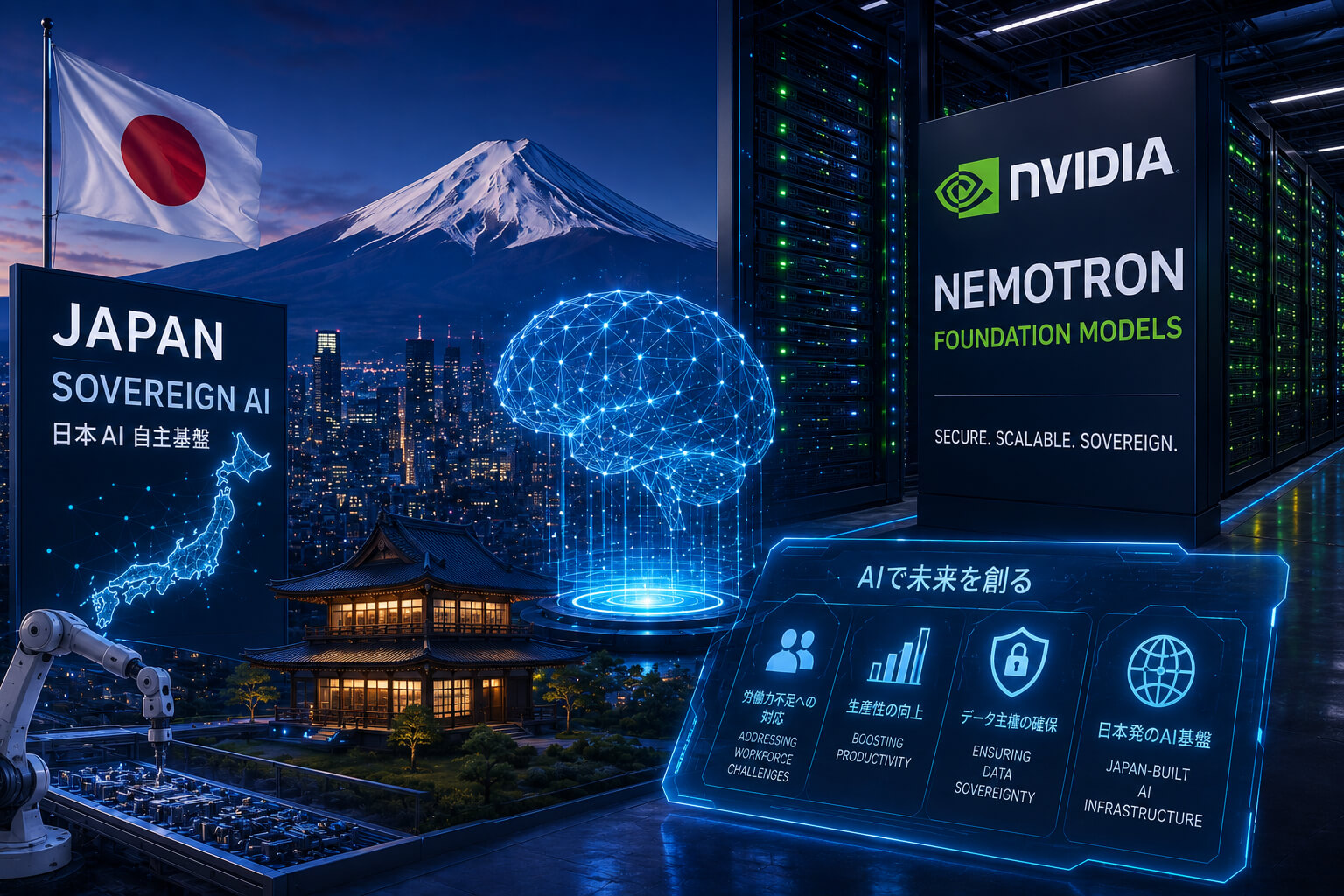
The country is moving deeper into sovereign AI, with Japanese universities, startups, telecom players, manufacturers, and major enterprises building localized AI systems on top of NVIDIA Nemotron open models. The goal is not just to use smarter chatbots. Japan wants AI that understands Japanese language, Japanese industries, Japanese regulations, and Japan’s very real workforce problem.
That last part matters.
Japan’s aging population and shrinking labor force are not abstract policy issues. They are already reshaping factories, hospitals, telecom networks, public services, customer support, and enterprise operations. So the country’s AI strategy has a practical edge: build systems that can support productivity where human labor is getting harder to find.
Why Japan Is Building Its Own AI
Japan’s sovereign AI push is partly about control. NVIDIA said Japanese organizations including the Institute of Science Tokyo, SoftBank Corp.’s SB Intuitions, and Stockmark are using Nemotron to build locally developed AI models for Japanese users, businesses, and institutions. These are not generic global models being awkwardly adapted at the last minute. They are being trained, tuned, and deployed for domestic use cases from the start.
The Institute of Science Tokyo has developed its Swallow family of open foundation models using NVIDIA Nemotron datasets and NVIDIA NeMo software. The models are designed to improve Japanese-language reasoning while keeping strong English, math, and coding capabilities. That combination is important because many enterprise tasks in Japan still need multilingual accuracy, technical reasoning, and local context in the same workflow.
SoftBank’s SB Intuitions has also trained its Sarashina series of homegrown generative AI models using NVIDIA Nemotron tools. One model, Sarashina3 mini, has been selected by Japan’s Digital Agency for specialized public-sector AI use cases. That tells you where this is heading. Sovereign AI is not just for private companies anymore. It is moving into government infrastructure too.
NVIDIA Nemotron Becomes Part of Japan’s AI Stack
NVIDIA’s role here is not only about chips. It is about open models, datasets, libraries, and deployment tools that Japanese organizations can customize. Nemotron open models give companies a foundation they can inspect, fine-tune, evaluate, and deploy closer to their own data. For Japan, that matters because sensitive enterprise knowledge, public-sector workflows, telecom operations, medical communication, and industrial systems cannot always be handed over to outside platforms without concern.
This is the quiet appeal of sovereign AI. It lets countries and companies build AI systems that remain more aligned with their own rules, language, and operational needs. NVIDIA CEO Jensen Huang framed open models as a way for countries and companies to own and control their intelligence infrastructure. That sounds like a big statement, but in Japan’s case it fits the moment. The country is not trying to win the AI race by copying Silicon Valley’s consumer chatbot playbook. It is trying to build AI into the machinery of its own economy.
Japanese Companies Are Taking AI Into Real Industries
The most interesting part is where the technology is being used. avatarin is using NVIDIA Nemotron and NeMo to develop Japanese-language speech and reasoning capabilities for enterprise AI agents. ENEOS Holdings is applying Nemotron models to agentic AI workflows for energy and materials research, including technical document search, vision-language analysis, and molecular screening.
NTT DATA is using Nemotron-Personas-Japan to improve training data for its tsuzumi 2 model, while also exploring multi-agent systems that can route work across different models. Hitachi is using Nemotron and NVIDIA Cosmos open models for physical AI, connecting IT and operational technology across complex enterprise processes.
That is a very different story from “Japan adopts AI.” This is more specific and more industrial. AI is being pushed into telecom networks, energy research, robotics, manufacturing, customer service, and enterprise knowledge systems. Not flashy. Very serious.
Sovereign AI Is Becoming a Geopolitical Strategy
Japan’s move also sits inside a bigger global shift. The United States and China are tightening their grip on AI chips, frontier models, data infrastructure, and technology supply chains. For countries like Japan, relying too heavily on foreign AI platforms creates risk. Not just technical risk, but economic and strategic risk.
Building local AI capacity gives Japan more room to move. Open-weight models are useful here because they let organizations customize systems without fully depending on closed foreign platforms. They also make it easier to meet local data, security, and governance needs. In AI, control is becoming almost as important as performance.
That is why sovereign AI keeps appearing in national technology strategies. Countries want models that speak their language, follow their laws, run on trusted infrastructure, and support domestic industries. Japan is making that shift now.
The Workforce Problem Gives This AI Push More Urgency
Japan’s demographic pressure gives the whole strategy a sharper edge. Aging populations and labor shortages can slow growth, strain public services, and make it harder for companies to maintain productivity. AI will not magically solve that. It will not replace the need for workers, training, immigration policy, or business reform.
But it can help reduce friction. AI agents can support contact centers. Specialized models can process technical documents faster. Robotics systems can assist in factories and logistics. Telecom models can help automate network operations. Medical and enterprise tools can support workers who are already stretched thin.
That is the more realistic version of AI adoption. Not a grand replacement story. More like thousands of small productivity gains across industries that badly need them.
Japan’s AI Strategy Is About Ownership, Not Just Innovation
Japan’s sovereign AI push shows where the market is going. The next stage of AI will not be only about who has the biggest model or the best benchmark score. It will also be about who can adapt AI to local economies, local languages, local laws, and local industries.
For Japan, NVIDIA Nemotron offers a foundation for that approach. The country gets open models and tools it can shape around its own needs. Japanese companies get more control over deployment. Public institutions get models that can be aligned with domestic requirements. It is not the loudest AI strategy in the world. But it may be one of the more practical ones.
Sources
- Times of AI – Japan Is Building Its Own AI Because It’s Running Out of Workers
- NVIDIA Newsroom – Japan’s Enterprises and Startups Build Industry-Specialized AI With NVIDIA Nemotron Open Models
- NVIDIA Investor Relations – Press Release Details on Japan and NVIDIA Nemotron
