


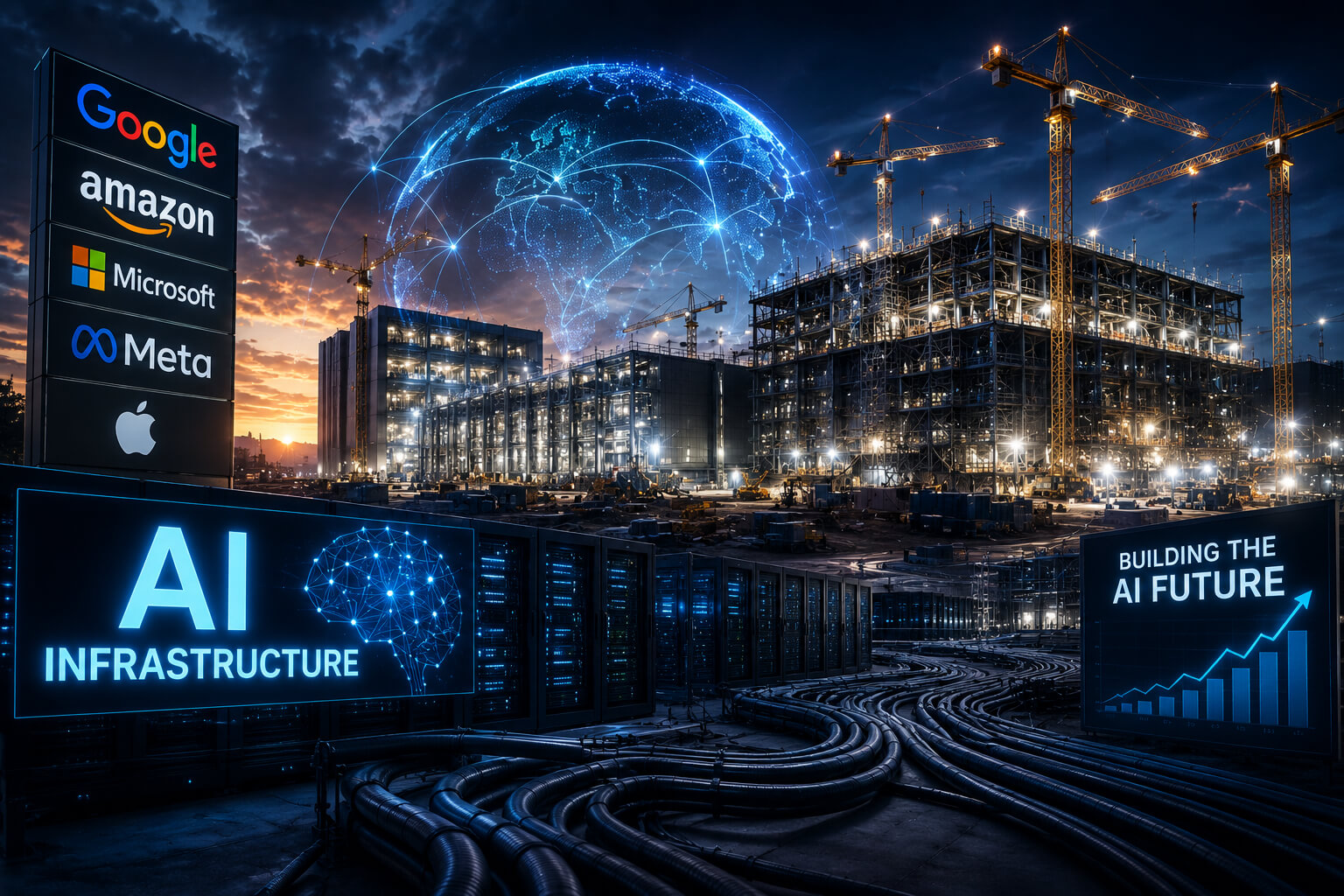
Big Tech is still spending like the AI race has no pause button.
Alphabet, Amazon, Meta, Microsoft, and Oracle have reportedly added around $350 billion to their debt obligations as they expand artificial intelligence infrastructure, with AI data centers becoming one of the most expensive bets in the technology industry right now. PYMNTS reported that the five companies spending the most on AI data centers in the United States doubled their debt load over the past five years to help fund those plans.
That is not a small shift. For years, software companies were loved by investors because they could grow with high margins and comparatively lighter capital needs. Build the product. Sell subscriptions. Scale fast. Keep the infrastructure manageable.
AI is changing that equation.
AI Data Centers Are Turning Software Into a Capital-Heavy Game
The new AI boom is not just about smarter chatbots or better productivity tools. Behind all of that sits a much more physical business: land, chips, cooling systems, electricity, cloud capacity, networking hardware, and massive AI data centers.
That part is expensive. Very expensive.
Cloud computing already pushed Big Tech into large infrastructure spending. AI has taken that requirement and stretched it further. Training and running advanced AI models needs huge amounts of compute, and companies do not want to be caught short if demand keeps rising.
So they are building. Borrowing. Expanding. Locking in capacity.
The question is not whether AI infrastructure matters. It clearly does. The question is whether the return arrives fast enough to justify the scale of the spending.
Investors Are Watching the Payoff, Not Just the Hype
Wall Street is no longer only asking who has the most advanced AI model. That conversation is still there, of course, but the money question has become louder.
When does this spending turn into durable revenue?
When does AI improve margins instead of eating into them?
When do data centers, chips, and compute capacity become a financial advantage rather than a giant bill?
PYMNTS noted that debt market investors are expected to watch upcoming quarterly earnings closely for signs of how these companies are funding expansion and when the payoff may appear.
That is where the AI story gets more complicated. Big Tech executives keep saying demand will support the spending. Investors are not fully dismissing that argument. But they want proof.
Not promises. Numbers.
Meta and Amazon Are Still Defending the AI Bet
Meta has already lifted its capital expenditure guidance for the year, pointing to higher memory pricing and the need for more data center capacity. The company also said it had underestimated its compute needs, which says a lot about how quickly AI demand is moving inside these businesses.
Amazon CEO Andy Jassy has also defended the company’s aggressive AI investment strategy. In an April shareholder letter cited by PYMNTS, Jassy argued that AI is not overhyped for Amazon and that the company expects strong returns from the technology over time.
That confidence matters because Amazon Web Services sits at the center of enterprise AI adoption. If companies keep building AI tools, agents, search systems, automation platforms, and internal copilots, cloud providers could benefit heavily.
But that future still has to arrive at the right scale.
The AI Race Is Now About Infrastructure Power
There was a time when AI competition looked mostly like a model race. Who had the best chatbot? Who had the most impressive benchmark? Who could launch the flashiest demo?
Now the race looks more industrial.
The winners may be the companies with enough money, power access, chips, cloud capacity, and data center strategy to keep scaling. That gives Big Tech an advantage, but it also raises the cost of staying in the lead.
Smaller AI companies may struggle to match that infrastructure depth unless they partner with cloud giants or raise enormous amounts of capital. Even OpenAI, Anthropic, and other major AI labs depend heavily on compute partnerships and cloud arrangements.
AI is becoming less lightweight as a business. The software may feel instant to users. The backend is anything but.
Big Tech’s AI Spending May Define the Next Phase of the Industry
The current AI infrastructure buildout could become one of two things.
It could become the foundation for the next era of digital business, where AI agents, enterprise automation, consumer AI devices, and intelligent software services create new revenue streams across the economy.
Or it could become a painful overbuild if adoption slows, monetization disappoints, or companies discover that users like AI tools more than they are willing to pay for them.
Right now, Big Tech appears willing to take that risk.
The spending is huge. The debt is rising. The pressure is building.
And the AI race is no longer just about who can make the smartest model. It is about who can afford to keep the machines running.
