


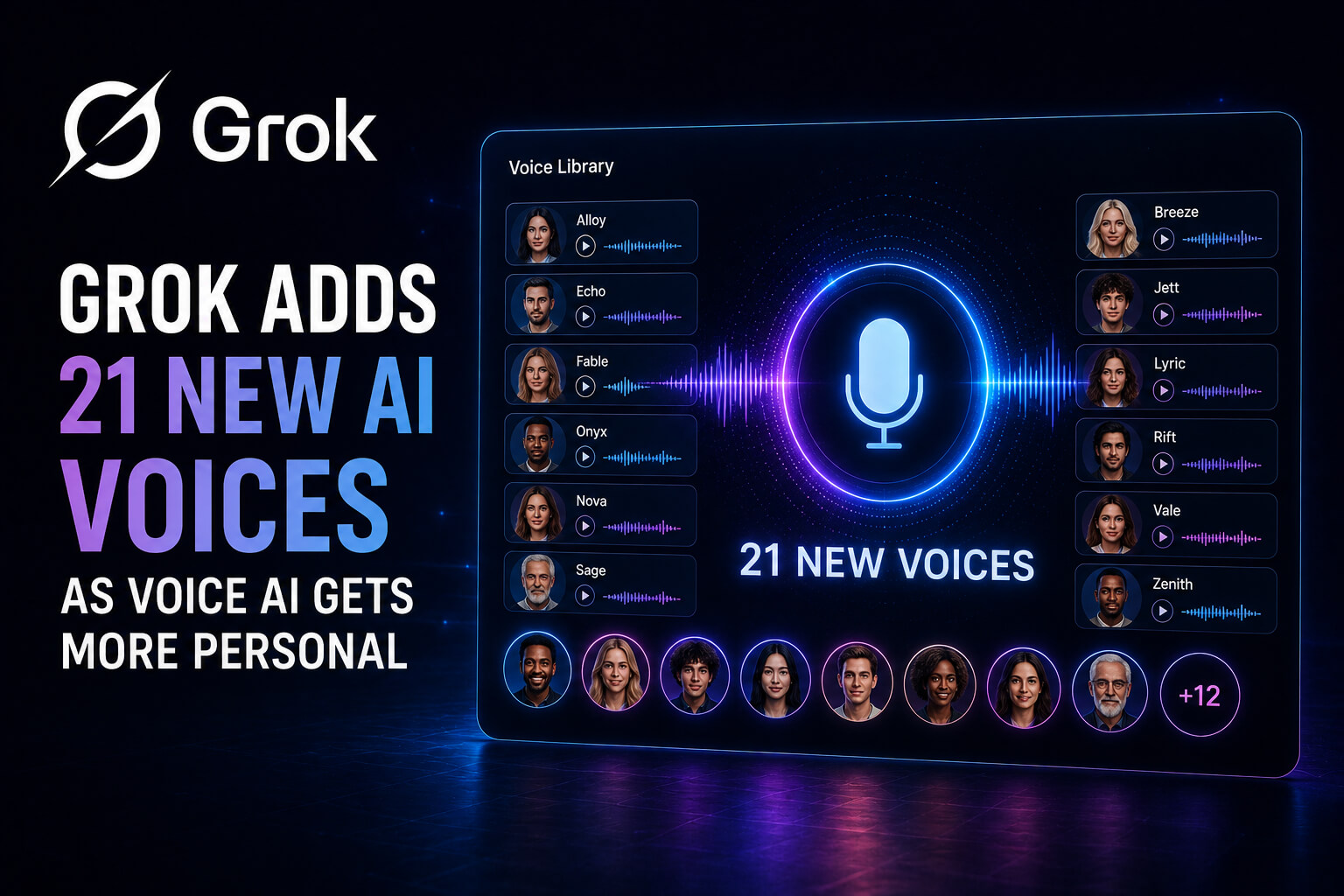
Grok is getting a much bigger voice.
xAI has expanded Grok’s voice features with 21 new flagship AI voices, bringing the total number of available voices from 5 to 26. The update is now available through the xAI Console and is aimed mainly at developers building voice-driven apps, assistants, support tools, podcasts, education products, and other conversational AI experiences.
The move sounds simple at first. More voices. More options. But it also shows where AI platforms are heading next. Text chat is no longer enough. Companies want AI agents that can speak naturally, pause properly, shift tone, and feel less like a machine reading from a script.
Grok’s New Voice Library Gets a Big Upgrade
The new Grok voice lineup includes Carina, Zagan, Helix, Orion, Luna, Iris, Altair, Zenith, Perseus, Helios, Lux, Kepler, Rigel, Cosmo, Celeste, Ursa, Sirius, Lumen, Castor, Naksh, and Atlas.
That is a lot of names. Some sound like satellites. Some sound like fantasy characters. Very xAI, honestly.
The original five voices, Ara, Eve, Leo, Rex, and Sal, have also been retrained. xAI says they now sound more natural and expressive, with better pacing and phrasing. That part matters more than the number itself. A bigger voice library is useful, but awkward delivery can still ruin an AI assistant in seconds.
Why Developers May Care About This
The update is clearly built for developers, not just casual Grok users.
xAI is positioning the expanded voice system for customer support, AI assistants, sales, education, advertising, podcasts, audiobooks, narration, commentary, wellness apps, and character-style experiences. The company is also offering the tools through its Real-time Voice Agent API, Text-to-Speech API, and Grok Voice Agent Builder.
That means developers can build more interactive voice agents without starting from scratch. Some of the tools also support no-code development, which opens the door for smaller teams that do not have large engineering departments.
And that is probably the bigger play here. xAI is not only making Grok sound different. It is trying to make Grok easier to plug into products.
Multilingual Support Makes Grok More Useful Globally
Each flagship voice can support more than 25 languages, according to the report. That gives developers a cleaner path to building voice apps for international users without creating separate voice systems for each market.
For AI companies, multilingual voice is becoming a serious battleground. A chatbot that only works well in English is useful, sure. But a voice assistant that can speak across regions, accents, and customer groups is much more valuable for businesses.
This is where Grok’s update becomes more than a feature announcement. It is part of the larger race to make AI agents feel local, personal, and always available.
Grok Voice Tools Add More Control
The new voice platform includes WebSocket streaming for real-time conversations, voice activity detection, function calling, web search integration, X search integration, file search, MCP support, pronunciation replacements, adjustable speaking speed, and expressive speech controls.
Some of those features are technical. But the point is easy enough: developers can control how the AI speaks and how it reacts during live conversations.
The expressive controls are especially interesting. Developers can add pauses, whispers, laughter, breathing, singing, and changes in pitch or volume. Used well, that can make AI voice agents feel more human. Used badly, it could get strange very quickly.
Either way, the direction is obvious. AI voice is becoming less robotic and more performative.
Pricing Starts at $0.05 Per Minute
xAI has also shared pricing for developers using the voice tools. The Grok Voice Agent Builder costs $0.05 per minute for voice audio, while telephony support through a connected phone number adds another $0.01 per minute.
That pricing gives developers a clearer idea of how expensive it may be to run voice agents at scale. For small experiments, the cost may look manageable. For call centers, tutoring platforms, media apps, or high-volume AI assistants, those minutes can add up quickly.
Grok Moves Deeper Into Conversational AI
This Grok update is not just about giving users more voice choices. It is about making voice a serious part of xAI’s platform.
AI companies are moving beyond text boxes. OpenAI, Google, Anthropic, Meta, and xAI are all pushing toward agents that can talk, listen, search, act, and respond in real time. Grok’s expanded voice library gives xAI another piece of that puzzle.
The question now is whether developers actually build with it.
Because 26 voices sound impressive on paper. The real test is what they can do in actual products, with real users, messy conversations, background noise, interruptions, accents, emotions, and all the weird things people say when they are not typing carefully into a chatbot.
