


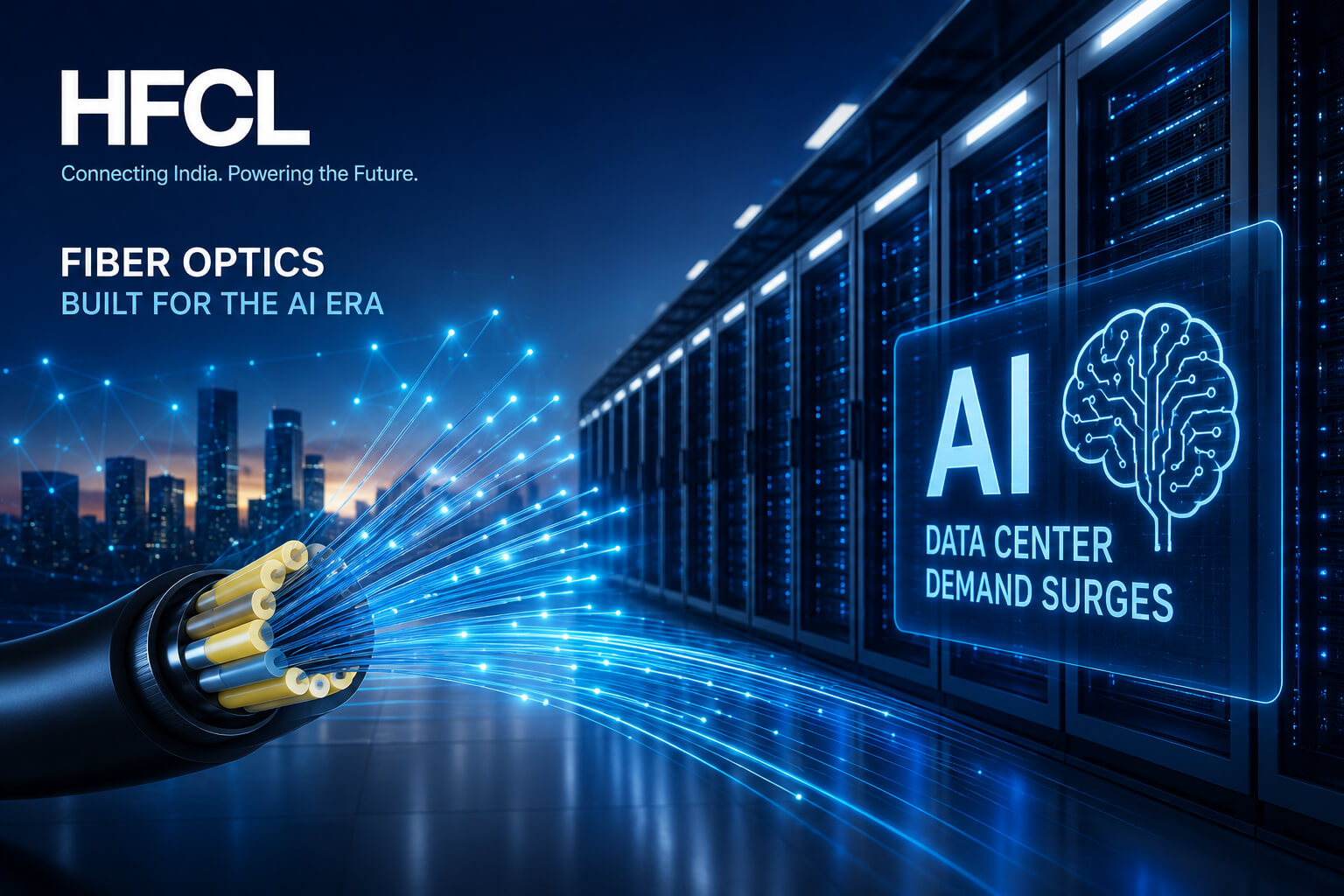
HFCL is looking at the artificial intelligence boom and seeing something very physical behind it.
Not just chips. Not just data centers. Not just cloud platforms with big promises.
Fiber.
The Indian telecom and technology company is scaling its optical fibre production as AI data center demand keeps rising. That may sound like a quiet infrastructure story, but it sits right inside one of the biggest AI buildouts happening right now. Every new AI model, every hyperscale data center, every cloud expansion needs fast, low-latency connectivity. Without that, the expensive computing hardware does not move data fast enough.
That is where HFCL wants to play.
Why AI Data Centers Need More Fiber
AI infrastructure is usually talked about through GPUs, power supply, cooling systems, and land availability. Fair enough. Those are big pieces of the puzzle.
But data still has to move.
AI workloads need huge amounts of information to pass between servers, storage systems, and networking equipment. Traditional data center networks were not built for this level of pressure. AI clusters are more demanding. They need bandwidth, speed, and lower latency at a scale that keeps getting harder to ignore.
Fiber optic cables become critical here because they support high-speed communication inside and between data centers. As more companies build AI-ready facilities, demand for high-count fibre cables and optical connectivity products is expected to rise.
HFCL seems to understand the moment. The company is positioning itself not only as a telecom supplier, but as a connectivity partner for AI infrastructure.
Hyperscalers Are Now Part of the Story
HFCL said it is seeing interest from hyperscalers and cloud service providers. That detail matters.
Hyperscalers are the companies building the largest AI and cloud infrastructure in the world. Think of the giant data center operators behind global AI platforms, enterprise cloud services, and massive compute networks. Their needs are not small. Their buying cycles are not small either.
HFCL’s Managing Director Mahendra Nahata has pointed to growing demand from regions including North America, Europe, and Asia. The company believes demand has not fully peaked yet, which suggests it sees this as a multi-year opportunity rather than a short-term order spike.
That may be the more interesting part. AI infrastructure is not being built in one neat wave. It is spreading across markets, with countries and companies trying to secure compute capacity before they fall behind.
HFCL’s OptiQ AI Push
HFCL has also introduced OptiQ AI, an optical connectivity portfolio designed for hyperscalers and cloud service providers.
The portfolio includes fibre optic cables, patch cords, cable assemblies, cassettes, enclosure panels, and related accessories. In plain terms, HFCL wants to give AI data center operators a more complete package instead of selling only one piece of the network.
That matters because data center operators are trying to move quickly. If they can reduce sourcing complexity, installation delays, and compatibility headaches, that becomes valuable. Especially when AI infrastructure projects are already dealing with power constraints, equipment shortages, land issues, and rising costs.
HFCL says the portfolio supports next-generation 800G and 1.6T network architectures, which are becoming more important as AI workloads demand faster internal networking.
A $52 Million Signal
HFCL recently announced a $52 million international order for its OptiQ AI connectivity portfolio.
That is not just a sales win. It is also a signal that AI infrastructure demand is moving beyond chipmakers and cloud platforms into the companies supplying the connective tissue of data centers.
The AI economy has a habit of making certain hardware categories suddenly more important. GPUs got the spotlight first. Power equipment followed. Cooling systems became a bigger conversation. Now optical networking is getting pulled deeper into the same story.
HFCL wants investors and customers to see it as part of that chain.
India’s AI Supply Chain Angle
There is also a bigger India story here.
HFCL is targeting international AI data center projects while also supporting domestic connectivity programs such as BharatNet. That puts the company in a useful position: part local infrastructure supplier, part global AI infrastructure vendor.
India has been trying to build a stronger role in the AI supply chain. Much of the attention goes to software talent, data centers, semiconductor ambitions, and cloud adoption. But networking infrastructure is part of the same equation.
If AI data centers expand across India and other markets, the demand will not stop at compute chips. It will include fibre, optical components, energy systems, cooling, construction, cybersecurity, and maintenance services.
That is the less glamorous side of AI. It is also where serious money can sit.
Fiber Optics Become Part of the AI Race
HFCL’s bet is simple enough: AI needs more data centers, data centers need better networks, and better networks need more optical fibre.
The company is also manufacturing optical preforms, a move that could help strengthen raw material control, reduce production costs, and improve supply chain resilience. In a market where demand can move faster than supply, that kind of control matters.
This is not the flashiest AI headline. No chatbot demo. No robot walking across a stage. No dramatic model benchmark.
Still, it tells us something important about where the AI boom is going.
The next phase of AI will not only be measured by smarter models. It will also be measured by who can build the infrastructure underneath them fast enough. HFCL is betting that fiber optics will remain one of the quiet but essential pieces of that buildout.
