


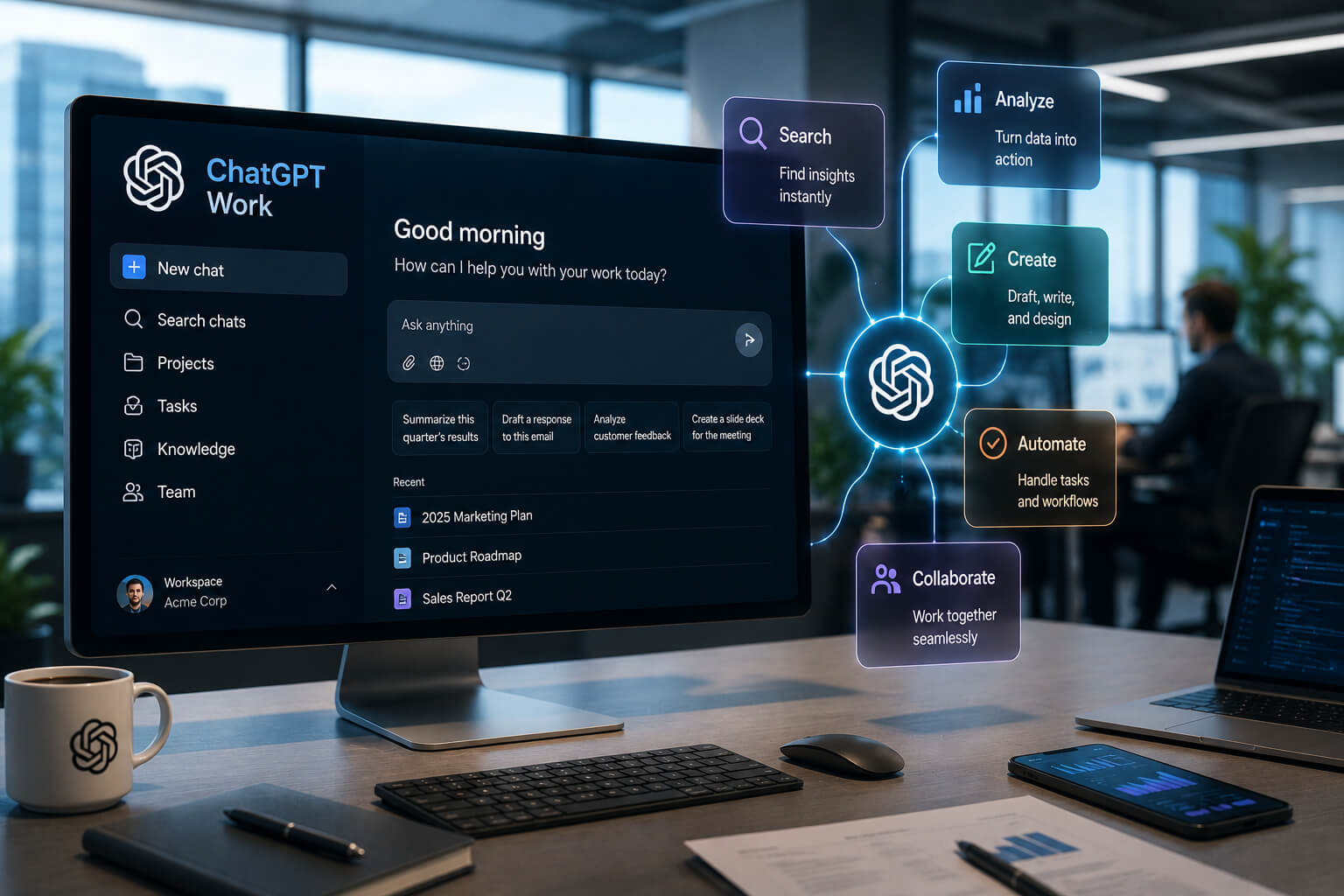
OpenAI is pushing ChatGPT into a new role, and the name says a lot: ChatGPT Work.
This is not just another chatbot update. At least, that is not how OpenAI is positioning it. The idea is to make ChatGPT less of a tool you keep prompting every five minutes and more of an AI agent that can stay with a task, work through steps, use files, handle apps, and help finish an actual project.
That changes the feel of the product.
For years, people have used ChatGPT to write emails, summarize documents, explain code, build outlines, clean up messy notes, and answer questions. Useful, yes. But still very back-and-forth. You ask. It replies. You fix. You ask again.
ChatGPT Work is aimed at something more active.
What Is OpenAI ChatGPT Work?
ChatGPT Work is described as an AI agent built for workplace tasks. It brings together ChatGPT and Codex-style capabilities so users can move between writing, coding, research, presentations, website work, and longer business projects inside one AI-driven environment.
That sounds neat on paper. The bigger point is simpler.
OpenAI wants ChatGPT to become a central workspace, not just a text box.
Instead of opening one app to write, another to code, another to build slides, another to publish something, and another to organize research, ChatGPT Work tries to pull more of that activity into one place. Not perfectly. Not magically. But clearly in that direction.
It is the “AI super app” idea again, except this time aimed at professionals who want fewer tabs and less manual switching.
What Can ChatGPT Work Actually Do?
The reported use cases are broad. ChatGPT Work can help with long-form writing, document creation, presentations, coding, debugging, website building, research, and multi-step workflows.
That last part matters most.
A normal chatbot response is usually one step. A workplace agent is supposed to manage several steps together. For example, a user might ask it to research a topic, draft a report, create a presentation from the findings, check the supporting material, and prepare the output for publishing or sharing.
That is where OpenAI is trying to take ChatGPT.
The product is not just about making words sound better. It is about taking rough goals and turning them into something closer to finished work.
GPT-5.6 Gives It More Power
ChatGPT Work is arriving alongside OpenAI’s GPT-5.6 push, which makes the timing important.
GPT-5.6 is being positioned as a stronger model family for complex work, including coding, research, science, cybersecurity, computer use, and design. OpenAI has also described GPT-5.6 as a model family with different options, giving users and businesses more room to balance speed, performance, and cost.
That is a very enterprise-friendly move.
Not every company wants the most expensive model for every task. Some jobs need serious reasoning. Others just need speed. If OpenAI can offer different GPT-5.6 tiers for different workloads, then ChatGPT Work becomes easier to fit into real business operations.
That is where the money is.
The Business Angle Is Obvious
OpenAI is not only chasing casual users here.
ChatGPT Work is clearly aimed at professionals, teams, schools, and enterprise customers that already use AI but still struggle to turn it into a daily workflow. Many companies have employees using AI quietly in scattered ways. One person uses it for reports. Another uses it for code. Someone else uses it for meeting notes. Nobody has a clean system.
OpenAI wants to become that system.
That is why this launch matters. It is not just another model announcement. It is part of a bigger fight over who owns the AI workspace.
Microsoft has Copilot. Google has Gemini inside Workspace. Anthropic is pushing Claude deeper into business use. OpenAI wants ChatGPT to sit at the center of work before someone else does.
The Risk: AI Agents Still Need Trust
The promise sounds big, but workplace agents have one problem that never really disappears: trust.
If an AI agent is writing documents, building websites, editing code, searching files, and working across apps, users need to know what it changed, why it changed it, and whether it made a mistake. A wrong chatbot answer is annoying. A wrong workflow action can be expensive.
That is why ChatGPT Work will probably need strong controls, review steps, permissions, audit trails, and admin settings if businesses are going to rely on it heavily.
People may like the idea of an AI that finishes work. They may not like the idea of an AI quietly doing too much without them noticing.
That tension is going to follow every major AI agent launch.
Why This Matters for the Future of Work
ChatGPT Work shows where AI tools are heading next.
The first phase was chat. The next phase is action.
AI companies no longer want users to simply ask questions. They want users to assign tasks. Build this. Fix that. Research this. Prepare the deck. Clean the data. Write the code. Publish the page.
That does not mean humans disappear from the workflow. In most cases, people will still review, correct, approve, and steer the final result. But the boring middle part of work could shrink.
That is the part OpenAI is targeting.
OpenAI Is Turning ChatGPT Into a Work Platform
ChatGPT Work may not replace every productivity app overnight. That would be a stretch.
But it does show OpenAI’s direction very clearly. ChatGPT is becoming less like a chatbot and more like a workplace operating layer. One place to write, code, research, build, and manage tasks with AI doing more of the heavy lifting.
For businesses, that is useful.
For competitors, it is a warning.
For workers, it is another sign that AI is moving from “assistant” to “agent” faster than many teams are prepared for.
