


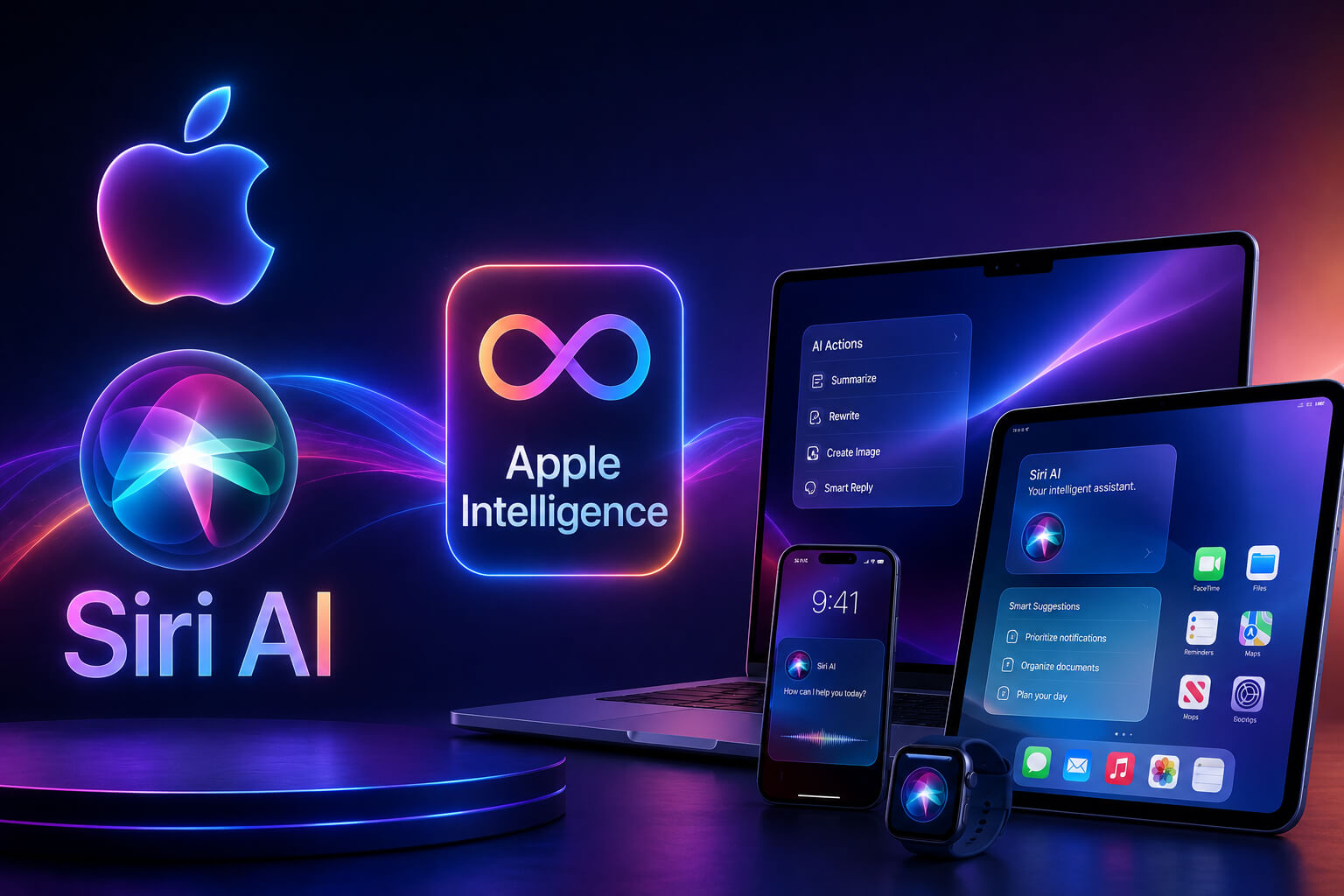
Apple is giving Siri a big artificial intelligence upgrade as it tries to beef up its position in the growing AI race. At WWDC 2026, the company announced a new version of Siri AI. It also announced the next generation of Apple Intelligence features for iPhone, iPad, Mac, Apple Watch and Vision Pro.
The announcement is part of Apple’s renewed effort to make Siri more useful, conversational and deeply integrated into its devices. After delays and criticism of previous Apple Intelligence features, Apple is now positioning Siri AI as a more capable assistant. It is designed to understand context, interact with apps and help users complete everyday tasks more naturally.
What Is Apple Siri AI?
Apple describes the new Siri AI as an entirely redesigned version of its digital assistant. Instead of simply responding to basic voice commands, Siri AI is built to be more conversational and personalized.
The updated assistant will be able to understand what is happening on a user’s screen. It will also respond to questions based on on-device content and take actions inside supported apps. As a result, that could make Siri more useful for things like managing messages and seeing what’s in a user’s calendar. It could also help with working with images or helping users complete app-based actions without manually switching between tools.
Apple also says Siri’s voice is becoming more expressive, with customization options for pace, tone, and accent.
Siri Gets Its Own AI Chat App
One of the biggest changes is that Siri AI will now have its own app. The new Siri app looks more like popular AI chatbot platforms, with a conversational interface for both text and voice interactions.
iCloud syncing means users can save their conversation history and pick up previous conversations on different devices. For example, this means someone could start a Siri AI conversation on an iPhone and later continue it on a Mac or iPad.
This move brings Apple closer to the experience already offered by AI assistants such as ChatGPT, Gemini, and Claude. However, there is tighter integration into the Apple ecosystem.
Apple Intelligence Expands Across Devices
The new Siri AI will be available across Apple’s major platforms, including iPhone, iPad, Mac, Apple Watch, and Vision Pro.
On iPhone, users will be able to access Siri AI by swiping down from the Dynamic Island, in addition to the existing Siri activation methods. On Mac, Siri AI will be accessible through Spotlight. Vision Pro users will be able to start a Siri AI conversation by looking at a new floating Siri visualization.
Apple is also updating several apps with new Apple Intelligence features. The Photos app is getting enhanced AI editing tools, including improved object removal and an Extend feature. That feature can expand the edges of an image using generative AI.
Another new feature, Spatial Reframing, will let users adjust the perspective and framing of photos, using technology connected to Apple’s work on spatial images for Vision Pro. Apple says AI-edited photos will include a hidden SynthID watermark to identify them as AI-generated or AI-altered content.
Safari and Shortcuts Get AI Upgrades
Apple Intelligence is also coming to Safari with features designed to make browsing more organized and automated. Safari will be able to group tabs by topic, helping users manage large browsing sessions more easily.
A new Notify Me feature can monitor websites for changes, such as ticket availability or product price drops. Safari will also work with Apple’s Passwords app to help fix weak or compromised passwords by navigating websites and updating login details for users.
Shortcuts is also becoming more AI-friendly. Apple says users will be able to create complex automations using natural language prompts. This will make the feature more accessible to people who are not familiar with technical workflow building.
Privacy Remains a Core Part of Apple’s AI Strategy
Apple is continuing to position privacy as one of the main selling points of its AI approach. The company says Siri AI requests will be processed either on device or through Apple’s Private Cloud Compute system.
This privacy-focused approach is designed to let Apple offer more advanced AI features while keeping user data protected. Apple has repeatedly emphasized that its AI strategy is centered around personal usefulness rather than simply adding AI for the sake of it.
Siri AI Launch and Device Compatibility
Siri AI will be open to developers first, with a public beta arriving later in 2026. However, not all users will get access immediately.
Apple says the new Siri AI will launch in English first, with more languages expected to follow. The feature will not initially be available on iPhone or iPad in the European Union because of regulatory issues. It will also not launch in China at first.
While Siri AI will work on devices that already support Apple Intelligence, some of the most advanced on-device AI features will require newer hardware. Apple says these features will be limited to select models, including the iPhone Air and iPhone 17 Pro. iPads with at least an M4 chip and Macs with at least an M3 chip and 12GB of RAM or more will also support these features.
Why This Matters
Apple has been under pressure to catch up with competitors in artificial intelligence. Google, OpenAI, Anthropic, Microsoft, and Samsung have all moved aggressively with AI assistants, chatbots, and AI-powered device features.
The new Siri AI is Apple’s clearest attempt yet to turn Siri into a modern AI assistant. By combining conversational AI, app control, screen awareness, image tools, and privacy-focused processing, Apple is trying to make AI feel native across its ecosystem.
However, Apple still faces a major challenge: proving that Siri AI can deliver reliable, useful features after previous Apple Intelligence promises arrived later than expected. If Apple can make Siri AI work smoothly across its devices, it could become one of the most important AI updates in the company’s recent history.
Key Takeaway
Apple’s Siri AI update is more than a voice assistant refresh. It is a major step in Apple’s broader AI strategy, bringing conversational intelligence, app actions, AI photo editing, Safari automation, and natural language shortcuts into the Apple ecosystem.
With developers getting access first and a public beta coming later this year, Siri AI could become one of Apple’s biggest software launches of 2026.
