


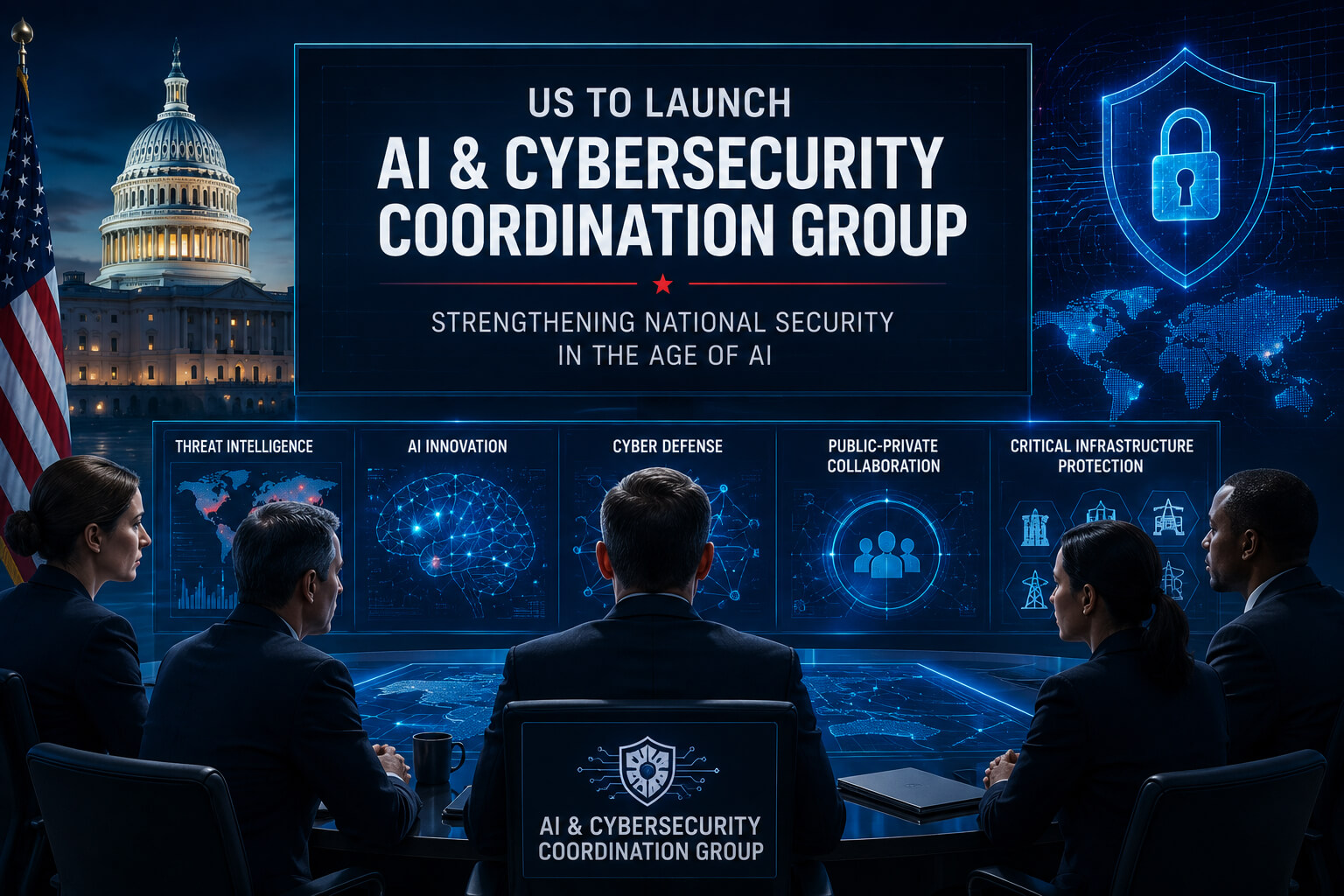
The United States is preparing to launch a new AI and cybersecurity coordination group, a move that shows how quickly artificial intelligence has moved from a technology policy issue into a national security priority.
According to the White House, the group is expected to help coordinate efforts around AI-related cyber risks, especially as powerful AI systems become more capable of finding vulnerabilities, automating attacks, and supporting defensive operations.
This is not just another committee with a long title.
Washington is trying to build a more connected response before AI-driven cyber threats become too fast, too automated, or too scattered for agencies to handle separately.
Why the White House Is Moving Now
The timing is not random.
AI is already changing cybersecurity on both sides. Defenders can use it to detect threats faster, analyze suspicious activity, and help protect critical systems. Attackers can also use it to scan for weak points, write phishing content, automate reconnaissance, and speed up cyber operations.
That is the uncomfortable part.
The same technology that can harden a hospital network or a government system can also help a hostile actor move faster. That is why the White House has been pushing for more coordination between federal agencies, the private sector, AI developers, and cybersecurity operators.
A recent executive order from the White House said advanced AI capabilities strengthen the country but also introduce national security concerns that require coordinated action across agencies. It also directed federal efforts toward stronger cyber defense, AI-enabled cybersecurity tools, and support for critical infrastructure operators.
AI Is Becoming a Cybersecurity Problem and a Cybersecurity Tool
The bigger story here is simple. AI is no longer sitting outside cybersecurity. It is becoming part of the battlefield.
For years, cybersecurity teams have dealt with malware, ransomware, phishing, stolen credentials, and state-backed hacking. Now AI adds a new layer. It can help defenders sort through huge volumes of data, but it can also help attackers move with less manual effort.
That is probably why the US government wants a dedicated coordination group instead of leaving every agency or company to figure this out on its own.
The White House has also backed a voluntary framework for AI developers to work with the federal government before releasing certain advanced frontier models. That framework includes possible government review of powerful AI systems for cybersecurity and national security risks before public deployment.
Critical Infrastructure Is the Real Concern
The focus is not only on chatbots, consumer apps, or AI products used in offices.
The bigger concern is critical infrastructure.
Power grids. Hospitals. Banks. Water systems. Telecom networks. Government services. Local utilities. These are the systems where a cyberattack can move from a technical problem into a public safety problem very quickly.
The White House order called for expanding access to cybersecurity tools and services, including AI-enabled defensive tools, for agencies, state and local authorities, and operators of critical infrastructure such as rural hospitals, community banks, and local utilities.
That detail matters. It shows the concern is not only about big federal networks or major technology companies. Smaller institutions may also need AI-era cyber protection, and many of them do not have the budget or staff to keep up alone.
Government Wants Industry In The Room
The new coordination group also points to something Washington already knows: the government cannot handle AI cybersecurity by itself.
The strongest AI models are being built by private companies. Much of the critical infrastructure is privately owned or operated. Cybersecurity firms often see threats before agencies do. Cloud providers run a huge part of the digital economy.
So coordination is not optional anymore. It is the operating model.
Legal and policy analysts have noted that the administration’s AI cybersecurity approach leans heavily on voluntary collaboration with AI companies and critical infrastructure operators, rather than a hard licensing system for frontier models.
That sounds lighter than regulation. Maybe it is. But voluntary does not mean irrelevant. Once a coordination system exists, major AI companies may face growing pressure to participate, especially if their models are viewed as powerful enough to affect national security.
The US Is Trying To Move Fast Without Slowing AI Companies
There is a tension running through all of this.
The US wants stronger AI oversight in cybersecurity. It also wants to avoid slowing down American AI companies in the global race, especially against China and other competitors.
That balance is messy.
Too much regulation could frustrate developers and investors. Too little coordination could leave the government reacting late to AI-enabled threats. The new AI and cybersecurity coordination group seems designed to sit somewhere in the middle: more structure, more communication, but not a full stop sign for the industry.
The administration’s earlier AI security order also emphasized working with the private sector to modernize systems, protect intellectual property, and harden public and private networks against external threats.
What This Means For AI Companies
For AI companies, this is another signal that cybersecurity risk is becoming part of model deployment, not just a side issue for legal teams.
Advanced model developers may need to think harder about how their systems could be used for cyber offense, vulnerability discovery, exploit generation, automated phishing, or infrastructure targeting.
That does not mean every AI tool will be treated like a national security asset. But the most powerful systems are clearly getting closer scrutiny.
Companies building frontier AI models should expect more questions around testing, safeguards, red-teaming, vulnerability disclosure, model access, and cooperation with government agencies.
What This Means For Cybersecurity Teams
For cybersecurity teams, the message is more practical.
AI will likely become part of standard defense operations. Not someday. Now.
Security teams may be pushed to adopt AI-enabled cybersecurity tools for threat detection, vulnerability management, incident response, and infrastructure monitoring. The challenge is that AI tools also bring their own risks, including false positives, model errors, data exposure, and overreliance on automation.
The new US coordination group could help align guidance, but it will not magically solve the hard part: actually deploying AI safely inside messy real-world systems.
Why This Story Matters
The US launch of an AI and cybersecurity coordination group is not a flashy product announcement. There is no new chatbot. Consumers are not getting a new feature. And no big demo is being shown.
Still, it matters.
This is the policy world adjusting to a new reality: AI is becoming part of national cyber defense, and also part of the threat environment. The government wants a system that can move faster, share information better, and bring AI companies into security conversations earlier.
It may sound bureaucratic. Some of it probably will be.
But behind the formal language is a much bigger point. AI security is no longer just about whether models say harmful things. It is about whether the systems behind governments, banks, hospitals, utilities, and companies can survive in a world where cyber operations may soon move at machine speed.
Sources
- US News / Reuters: US to launch AI and cybersecurity coordination group,
- White House saysWhite House: Promoting Advanced Artificial Intelligence Innovation and Security
- Federal Register: Promoting Advanced Artificial Intelligence Innovation and Security
- AP News: Trump signs executive order inviting vetting of top AI models for national security risks
- Holland & Knight: Executive Order on Artificial Intelligence Expands Cybersecurity
