


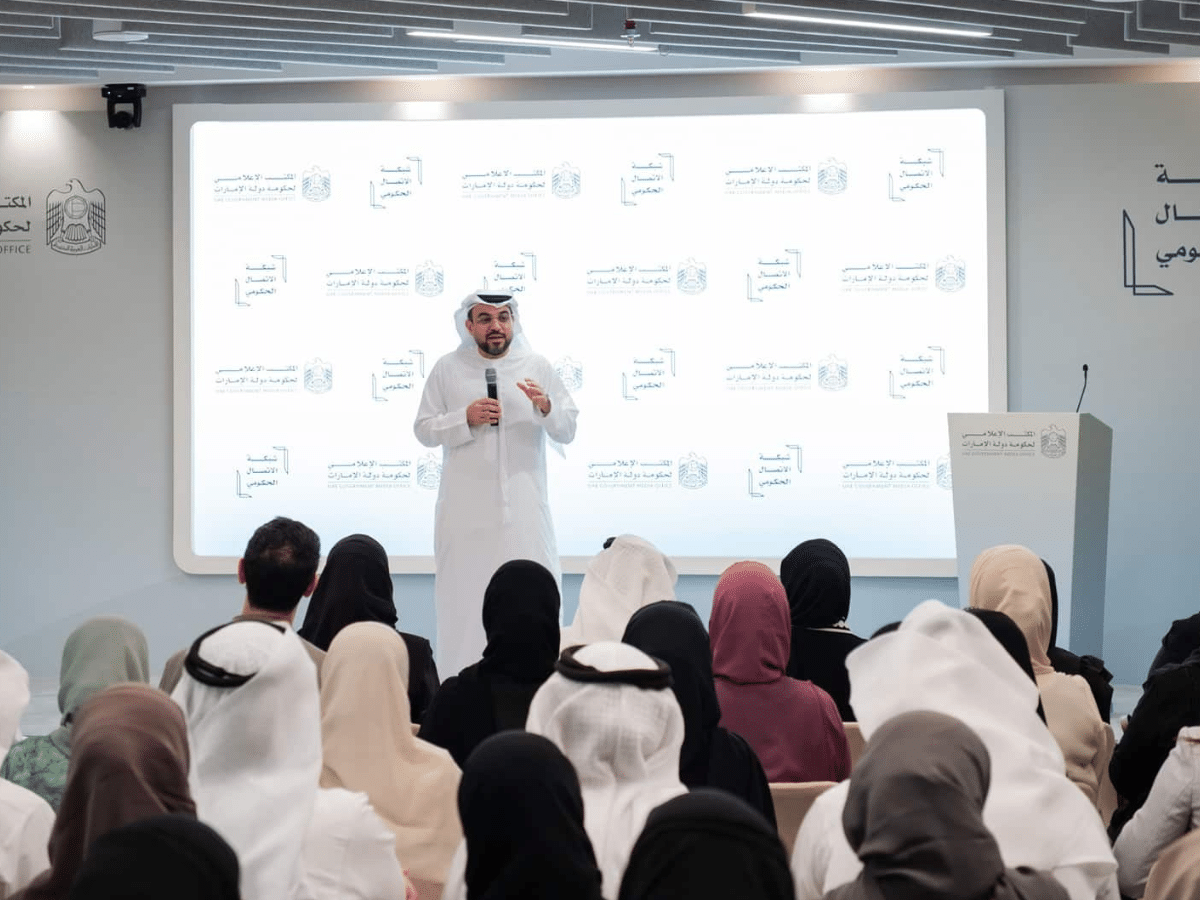
The UAE Government Media Office has rolled out new government media guidelines. This comes as the country moves to accelerate the shift to Agentic AI across public sector services, operations and communications.
This step is part of the UAE’s wider plan to improve government communication and increase public confidence. It also prepares official media teams for a future where artificial intelligence has a bigger role in producing, checking and sharing public information.
The new guidelines are designed to support government entities in producing clear, accurate, and responsible media content. They arrive at a time when the UAE is pushing ahead with one of the world’s most ambitious public sector AI transformation plans. This includes the use of Agentic AI systems capable of supporting decision-making, managing workflows, analyzing information, and improving government services.
UAE Government Media Guidelines Aim to Strengthen Public Communication
The UAE’s updated government media guidelines focus on helping public sector communicators deliver information in a consistent, professional, and trustworthy way.
With the digitization, acceleration and datafication of government communication, public institutions are facing growing pressure to publish updates in a timely manner. Yet, they must still ensure accuracy and credibility. The new framework is expected to provide officials with clearer standards for content creation, messaging and public engagement.
That’s increasingly the reality for government media teams. Audiences get updates on websites, social platforms, video channels, messaging apps and AI-powered tools. A single public announcement may need to be adapted into multiple formats. However, it must retain the same meaning, tone and official position.
The UAE’s latest media guidance appears to recognize that government communication is no longer just about publishing statements. It is about managing information responsibly across a complex digital ecosystem.
Agentic AI Becomes Central to UAE Government Transformation
The launch comes as the UAE advances its plan to deploy Agentic AI across 50% of government sectors, services, and operations within two years.
Unlike basic automation tools, Agentic AI systems are designed to take more initiative. They can process data, make recommendations, execute multi-step processes, and aid decision-making with reduced human effort. In government, these systems could help improve service delivery, reduce bureaucratic delays, personalize citizen engagement, and identify operational efficiencies in real time.
Agentic AI could assist public sector communications by writing announcements, tracking sentiment, summarizing policy changes, preparing multilingual content, and assisting officials in responding more quickly during major events.
However, the use of AI in government media also brings new responsibilities. Public institutions must ensure that AI-assisted content is accurate, transparent, culturally appropriate and consistent with official policy.
Thus clear guidelines in media are important. As AI becomes more involved in public communication, governments need rules that define how AI-generated or AI-assisted content should be reviewed, approved, and published.
Why the UAE Is Moving Quickly on AI Governance
The UAE has positioned artificial intelligence as a core pillar of its national development strategy. Its latest Agentic AI initiative builds on years of digital government investment. This includes service digitization, UAE Pass, proactive government services, and the country’s broader AI strategy.
The government has also approved a major training programme to prepare 80,000 federal employees to use Agentic AI tools and technologies. This implies the UAE is investing not just in AI systems but also the workforce to manage them.
This training change could be especially important for media and communication teams. Government employees may increasingly need to understand how AI tools work, where they are useful and where human judgment is still essential.
AI may help speed up content creation, but there is more at stake in government communications than in typical digital publishing. Errors impact public knowledge, trust, policy adherence, and national reputation.
Responsible AI Use in Government Media
The UAE’s new government media guidelines also point to a larger global issue: how governments should use AI responsibly when communicating with the public.
Generative AI can produce convincing text, images, audio, and video. Agentic AI can go further, performing tasks and orchestrating actions. This unlocks opportunities for faster, more personalized communication. However, it also brings risks around misinformation, bias, deepfakes, errors and overreliance on automated systems.
Government media teams will likely require stronger approval processes, fact-checking systems, human oversight and ethical standards for AI-generated content.
The experience of the UAE indicates that there should be no absence of rules of communication in the adoption of AI in the public sector. As governments increasingly use sophisticated AI tools, official media guidelines may be as important as technical infrastructure.
UAE Sets Example in AI-Powered Public Sector Communication
By combining Agentic AI deployment with revised media guidance, UAE is communicating that future ready government is not only about automation. It is also about trust, clarity and responsible communication.
The new guidelines could help government entities deploy AI effectively while also maintaining credibility with citizens, residents, businesses and international audiences if adopted and implemented appropriately.
Other governments eyeing similar technologies will be closely watching the UAE’s public sector AI transformation. Its success may depend not only on how powerful the AI systems are, but on how clearly and responsibly they are used.
Why it Matters
The UAE’s new government media guidelines matter because public sector communication is entering a new AI-driven era. As Agentic AI becomes part of government operations, official information may be created and distributed faster than ever before.
But speed alone is not enough. They also need to safeguard accuracy, transparency and public trust.
For the AI industry, this development implies that the next stage of artificial intelligence adoption will need more than technical innovation. It will need governance, communication standards, employee training, and human oversight.
The UAE’s move could be an early model of how governments prepare media teams to work responsibly with Agentic AI.
For more Breaking AI news, visit: https://breakingai.news
