


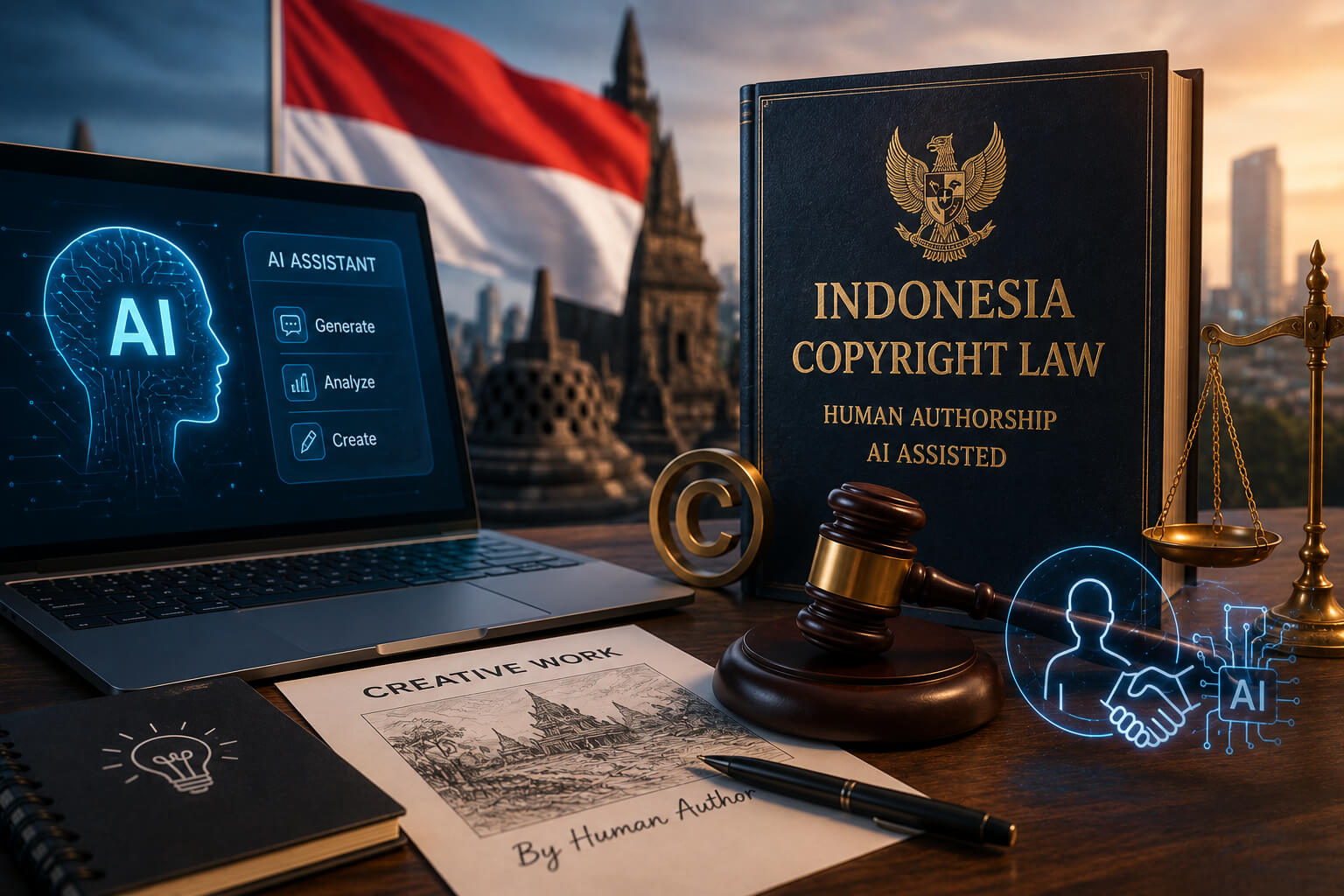
Indonesia is trying to draw a line that many countries are still dancing around.
Its draft copyright law says artificial intelligence can help create content, but it should not be treated as the author. That sounds simple. It is not. The question of who owns AI-assisted work has become one of the messiest legal fights in the creative economy.
The proposal could make Indonesia one of the first countries in Southeast Asia to put AI directly into copyright law instead of leaving the issue to courts, policy notes, or vague platform rules. The main idea is clear enough: copyright belongs to humans, not machines.
Indonesia Wants Human Creativity at the Center
The draft law reportedly says AI-assisted content can receive copyright protection only when there is real human creative input. Fully AI-generated work would not receive the same protection. That distinction matters.
A designer using AI to test visual ideas is not the same as a platform producing thousands of automated images with almost no human direction. A writer using AI for structure or editing is not the same as publishing raw machine-generated text and claiming full authorship. Indonesia appears to be saying that tools are allowed. Human authorship still has to do the heavy lifting.
AI Can Be a Tool, Not the Legal Creator
This is the part that may shape future debates in the region. Instead of asking whether AI should become a legal author, Indonesia’s draft keeps the focus on the person using the system. AI may assist the process, but the law would not recognize it as the owner of creative rights.
That is a practical position. Maybe even a necessary one. If AI could become an author, copyright law would quickly become strange. Who receives royalties? The user? The developer? The company that trained the model? The model itself? Indonesia seems to be avoiding that maze by keeping copyright tied to human intellect.
Disclosure Rules Could Change How AI Content Is Published
The draft also reportedly includes disclosure requirements when AI is used in creating content. That could affect publishers, agencies, creators, influencers, and AI platforms operating in Indonesia. If the rule becomes law, companies may need clearer labels, internal tracking, and better documentation around how AI tools were used in written, visual, or media content.
This will not please everyone. Some creators may see disclosure as a fair transparency rule. Others may worry it creates stigma around AI-assisted work. Still, the direction is obvious: governments want AI content to be traceable, not hidden behind polished output.
Indonesia’s Draft Law Also Targets AI Training Data
The proposal does not stop at authorship. It also looks at how AI companies use copyrighted material for training. According to the report, copyrighted works used to train AI systems would need to fall under licensing agreements or fair use provisions.
That is where the real fight begins. AI companies need huge amounts of data. Publishers, writers, artists, and newsrooms increasingly argue that their work has been used without permission or payment. Indonesia’s draft law appears to bring those disputes into copyright legislation rather than letting platforms decide the rules themselves.
Publishers May Get Stronger Protection
The draft could also require platforms to compensate publishers when they reuse news content, display previews, or use articles to train AI models. For newsrooms, that is a serious development.
Media companies around the world have been pushing back against AI systems that summarize, scrape, or repurpose journalism. Search engines and AI chatbots can now answer questions using publisher content without always sending traffic back to the original source. That weakens the old bargain of the internet. Indonesia’s proposal suggests a different bargain: if AI systems benefit from publisher content, publishers should not be left out of the value chain.
Tech Companies Could Face Real Consequences
One of the tougher parts of the proposal is enforcement. The draft could expose companies to sanctions if they fail to comply. That may include the possible revocation of operating licenses in Indonesia.
That is not a small warning. It tells AI companies and digital platforms that copyright compliance may become a market access issue, not just a legal headache. If a company wants to operate in Indonesia, it may need to respect Indonesia’s rules on AI content, training data, and publisher compensation.
Indonesia Is Moving Faster Than Many Neighbors
Several countries already require human contribution for copyright protection. The United States Copyright Office has taken that position in guidance, while Singapore has also placed importance on human authorship. The European Union’s AI Act has moved heavily on transparency, accountability, and deepfake labeling.
Indonesia’s difference is that it wants to write the principle directly into copyright law. That gives the proposal extra weight. It is not just a policy statement. If passed, it could become one of the clearest AI copyright frameworks in Asia.
The Bigger Question Is Bigger Than Indonesia
Indonesia’s AI copyright law is still a draft. It can change before becoming law. But the direction matters.
Governments are no longer only asking whether AI is safe. They are asking who gets paid, who gets credit, who owns the final output, and whether human creativity can survive inside a market flooded with machine-generated work.
Indonesia’s answer, at least for now, is blunt: AI can assist. Humans create. Copyright should stay with people. That may become a model other countries watch closely.
