


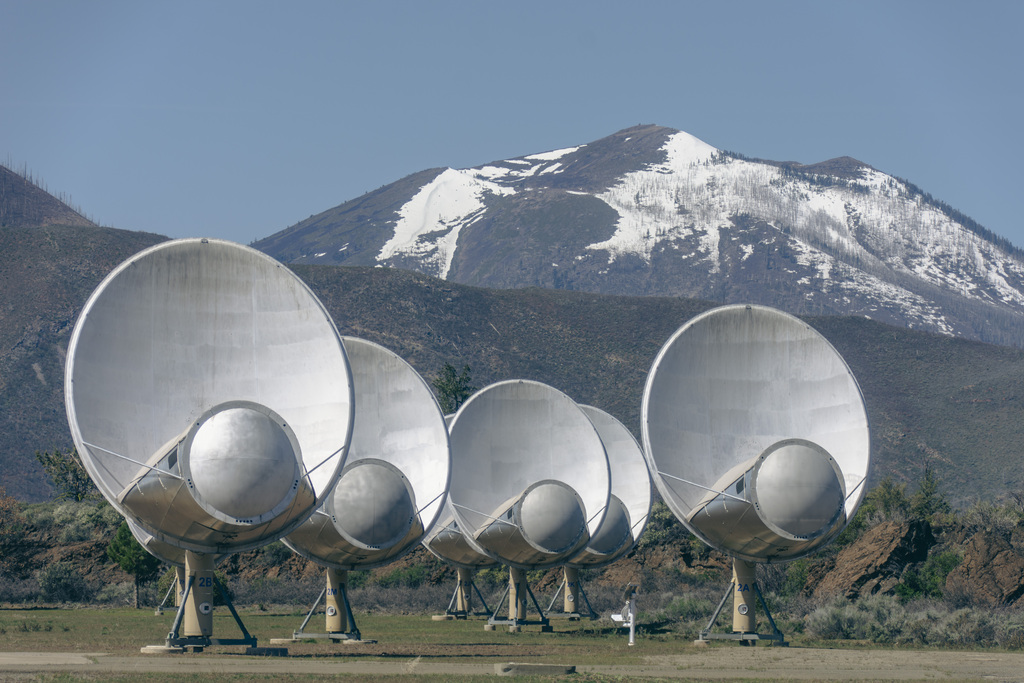
The SETI Institute has been nominated for the 2026 World AI Awards, recognising its work at the intersection of artificial intelligence, astronomy and the scientific search for life and intelligence beyond Earth.
It is an unusual corner of the AI landscape. There are no customer-service agents or marketing copilots here. Instead, machine learning is being pointed at torrents of telescope data, where potentially interesting signals can be buried among astrophysical phenomena, radio-frequency interference and millions of ordinary detections.
Founded in 1984, the nonprofit SETI Institute researches astrobiology, planetary environments and the search for extraterrestrial intelligence. Its work includes the Allen Telescope Array (ATA) in Northern California, a radio telescope designed specifically with SETI observations in mind.
AI is learning to listen faster
One of the clearest examples arrived through research involving Breakthrough Listen, NVIDIA and the SETI Institute’s Allen Telescope Array.
Researchers developed an AI system for detecting Fast Radio Bursts, extremely brief and energetic radio signals originating far beyond the Milky Way. Built using NVIDIA’s Holoscan platform, the system processes incoming telescope data in real time rather than relying entirely on conventional computational searches performed after observations.
The numbers are striking.
According to the SETI Institute, testing showed the system processing data 600 times faster than existing methods and 160 times faster than real time, while improving accuracy by 7% and cutting false positives by a factor of ten. It successfully identified giant pulses from the Crab Pulsar while handling data streams reaching 86 gigabits per second.
This does not mean AI discovered extraterrestrial intelligence. It didn’t.
The significance is more practical. A system capable of recognising complex signal structures quickly can help astronomers find transient phenomena before they disappear and potentially identify patterns that conventional search methods overlook.
That matters to SETI because a genuine technosignature may not resemble the signals researchers already know how to search for.
Millions of signals create a filtering problem
Finding an unusual radio signal is only the beginning.
In observations of the interstellar object 3I/ATLAS, SETI Institute researchers used the Allen Telescope Array to collect more than seven hours of observations across frequencies between 1 and 9 GHz. Roughly 74 million initial detections were reduced to around 200 candidates after filtering.
Every remaining signal was eventually traced to human-made radio interference. No evidence of extraterrestrial technology was found.
That result captures one of SETI’s central computational problems rather neatly: modern telescopes can produce enormous quantities of information, while the scientifically interesting events may represent a tiny fraction of what gets recorded.
Machine learning offers another way to sift that data. The Institute says advanced signal processing, machine learning and real-time computing are already being used to identify patterns that are difficult to explain through known astrophysical sources or terrestrial interference.
COSMIC turns the Very Large Array into a continuous SETI instrument
Scale becomes even more apparent with COSMIC — the Commensal Open-Source Multimode Interferometer Cluster.
Installed at the Karl G. Jansky Very Large Array in New Mexico, COSMIC receives a copy of data generated during other VLA observations. That means technosignature searches can run alongside conventional astronomy instead of requiring the telescope to spend all of its observing time specifically on SETI.
The SETI Institute reported that COSMIC had collected data from more than 485,000 astronomical sources across frequencies from 2 to 45 GHz by early 2024. During one month alone, the system gathered observations from more than 400,000 sources.
Its search pipelines look for characteristics that warrant closer investigation, including extremely narrow radio signals and signals whose frequencies drift over time.
Neither feature proves extraterrestrial technology. Human transmitters can produce similar patterns, which makes interference rejection and follow-up observations essential.
AI could widen the search beyond signals humans expect
That may be where artificial intelligence becomes particularly interesting for SETI.
Traditional searches depend heavily on researchers deciding what a technologically generated signal should look like. Machine-learning systems create opportunities to search larger datasets and recognise more complicated structures without restricting every search to one predetermined signal shape.
The Institute has explored this idea for years. Earlier machine-learning work reanalysed a 400-terabyte radio dataset and found 72 additional Fast Radio Bursts missed by the original classical search. SETI Institute researchers have also used AI algorithms to analyse more than 20 million signals captured by the Allen Telescope Array.
The objective remains scientific rather than speculative: identify anomalies worth investigating, reject terrestrial interference and make increasingly large astronomical datasets manageable.
Graham Cooke, President of the World AI Awards, said:
“The SETI Institute’s nomination highlights a fascinating application of artificial intelligence: helping scientists examine extraordinary volumes of astronomical data for patterns that conventional techniques may struggle to identify.
“From real-time radio-signal analysis to machine learning across large telescope datasets, its work shows how AI can become a practical scientific instrument rather than simply a software interface. We congratulate the SETI Institute on its 2026 World AI Awards nomination and look forward to following where this combination of astronomy, computing and artificial intelligence leads.”
The World AI Awards recognises organisations, individuals, products and technologies contributing to the development and application of artificial intelligence across industries.
The SETI Institute brings something different to that landscape. Its AI work is ultimately about scientific discovery: processing more information, identifying unusual signals faster and giving researchers better tools to investigate one of science’s oldest questions.
So far, those searches have produced intriguing astrophysics, better analytical techniques and plenty of rejected interference — but no confirmed extraterrestrial technology.
That distinction matters. The search continues.
Learn more about the SETI Institute and its research at seti.org.
Discover the World AI Awards 2026, explore the nominees and learn more about the awards at worldawards.ai.
