


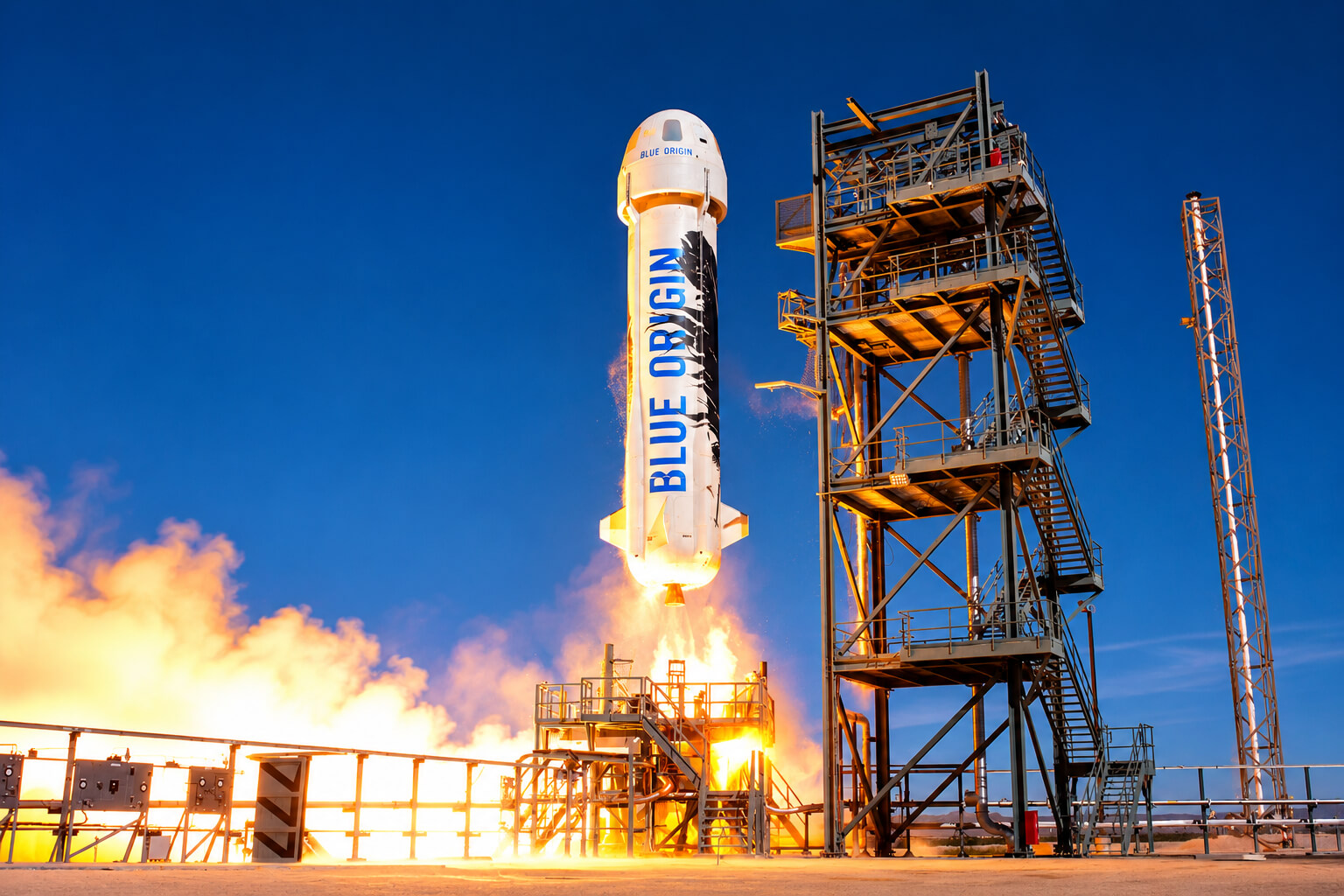
Blue Origin has been nominated for the 2026 World AI Awards in the Aerospace category, recognising the space company as autonomous systems, onboard computing and reusable launch technology become increasingly important to modern spaceflight.
The nomination puts the spotlight on a slightly different side of artificial intelligence. Blue Origin is not building a consumer AI assistant or a foundation model. Its technology has to work inside rockets and spacecraft, often in environments where there is little room for delay, constant human control or easy recovery when something goes wrong.
The World AI Awards recognises organisations, individuals, products and technologies contributing to the development and real-world application of artificial intelligence across industries.
Blue Origin’s work stretches from the fully autonomous New Shepard suborbital vehicle to the much larger New Glenn orbital rocket and Blue Ring, a multi-orbit spacecraft designed to provide onboard computing and infrastructure services in space.
New Shepard put autonomous human spaceflight into practice
Blue Origin’s New Shepard offers the clearest example of autonomy already working at scale.
The reusable suborbital vehicle is fully autonomous. There are no pilots onboard. Its flight systems manage the journey while carrying passengers beyond the Kármán line before the capsule returns under parachutes and the booster performs a vertical landing.
By January 2026, Blue Origin had completed 38 New Shepard flights. The company reported that the programme had carried 98 people above the Kármán line and launched more than 200 scientific and research payloads for customers including NASA, universities and research organisations.
Blue Origin subsequently announced that New Shepard flights would pause for at least two years as resources shifted toward its human lunar programme.
That makes New Shepard an important distinction in the autonomy discussion. This is not simply a future concept. Autonomous flight has been central to the vehicle’s operating model, including missions carrying people and scientific payloads.
New Glenn takes autonomous recovery to a much bigger rocket
The same philosophy is moving into New Glenn, Blue Origin’s heavy-lift orbital launch vehicle.
New Glenn reached orbit on its inaugural mission in January 2025, although the company lost the first-stage booster during its attempted recovery. The next flight changed the picture.
During the NG-2 mission in November 2025, New Glenn deployed NASA’s ESCAPADE spacecraft and successfully landed its reusable first stage on Blue Origin’s Jacklyn platform in the Atlantic Ocean.
The rocket continued flying in 2026. Blue Origin’s NG-3 mission profile described the first stage autonomously descending toward Jacklyn after separation while the second stage continued toward orbit.
There is no need to dress that up as science fiction. A huge rocket separating at altitude, returning through the atmosphere and targeting an offshore platform already represents an extraordinarily demanding control problem.
It is also worth being precise: sophisticated autonomy does not automatically mean every element of New Glenn’s guidance and control architecture is artificial intelligence. Blue Origin publicly describes the descent as autonomous, but that distinction matters when assessing aerospace AI claims.
Blue Ring brings AI computing directly into orbit
The more explicit AI story appears with Blue Ring.
Blue Origin is developing the highly manoeuvrable spacecraft to transport, host and deploy payloads across multiple destinations. Its architecture combines solar-electric and chemical propulsion and can accommodate more than 4,000 kilograms of deliverable payload depending on configuration.
More interesting from an AI perspective is what happens onboard.
Blue Origin says Blue Ring will provide communications, power, data storage and edge and AI computing applications to hosted and deployed payloads. Instead of sending every piece of raw information back to Earth before it can be processed, onboard computing creates the possibility of analysing information closer to where it is collected.
That becomes particularly relevant when spacecraft operate farther from Earth or generate more sensor data than communications links can efficiently handle.
An AI-powered sensor will watch what is happening around Blue Ring
Blue Origin has already identified a practical application for that orbital computing environment.
The company announced that Scout Space’s Owl sensor would fly on Blue Ring’s first mission. Owl is designed for space-domain awareness: detecting, tracking and characterising satellites, debris and other objects in orbit.
According to Blue Origin, the sensor combines advanced optical sensing with onboard AI-driven processing and autonomous decision-making. Integrated with Blue Ring, the system is intended to monitor and assess resident space objects from orbit.
The AI technology in this case belongs to Scout Space rather than Blue Origin itself, an important distinction. Blue Origin supplies the manoeuvrable spacecraft, onboard infrastructure and computing environment that allow technologies such as Owl to operate in space.
It hints at where the bigger opportunity may lie. Future spacecraft may not simply collect data and wait for Earth to tell them what it means. More processing, prioritisation and eventually decision-making can happen onboard.
Graham Cooke, President of the World AI Awards, said:
“Blue Origin’s nomination highlights an important part of the artificial intelligence story that is easy to overlook. As aerospace systems travel farther from Earth and become more capable, autonomy and onboard computing will play an increasingly important role in how those systems operate.
“From autonomous reusable rockets to Blue Ring’s planned edge and AI computing capabilities in orbit, Blue Origin is building infrastructure that can support a new generation of intelligent space operations. We congratulate the Blue Origin team on its 2026 World AI Awards nomination and look forward to following how these technologies develop.”
Blue Origin joins organisations, researchers, entrepreneurs and technology developers being recognised through the 2026 World AI Awards.
The programme recognises organisations, individuals and technologies contributing to the development and application of artificial intelligence across industries. Aerospace presents an unusual test for that technology. Computing systems do not operate separately from the physical world; they have to work with rockets, propulsion, sensors, communications systems and spacecraft moving through unforgiving environments.
Blue Origin’s nomination captures that shift.
New Shepard has already demonstrated fully autonomous human and research flights. New Glenn is extending reusable autonomous operations to a much larger orbital launch system. Blue Ring, meanwhile, points toward something newer: spacecraft that provide computing infrastructure for AI-enabled applications directly in orbit.
The next phase of aerospace AI may not look much like a chatbot. It could be a spacecraft deciding which sensor data matters before anyone on Earth even sees it.
Learn more about Blue Origin and its space technology at https://www.blueorigin.com/.
Discover the World AI Awards 2026, explore the nominees and learn more about the awards at https://www.worldawards.ai/.
