


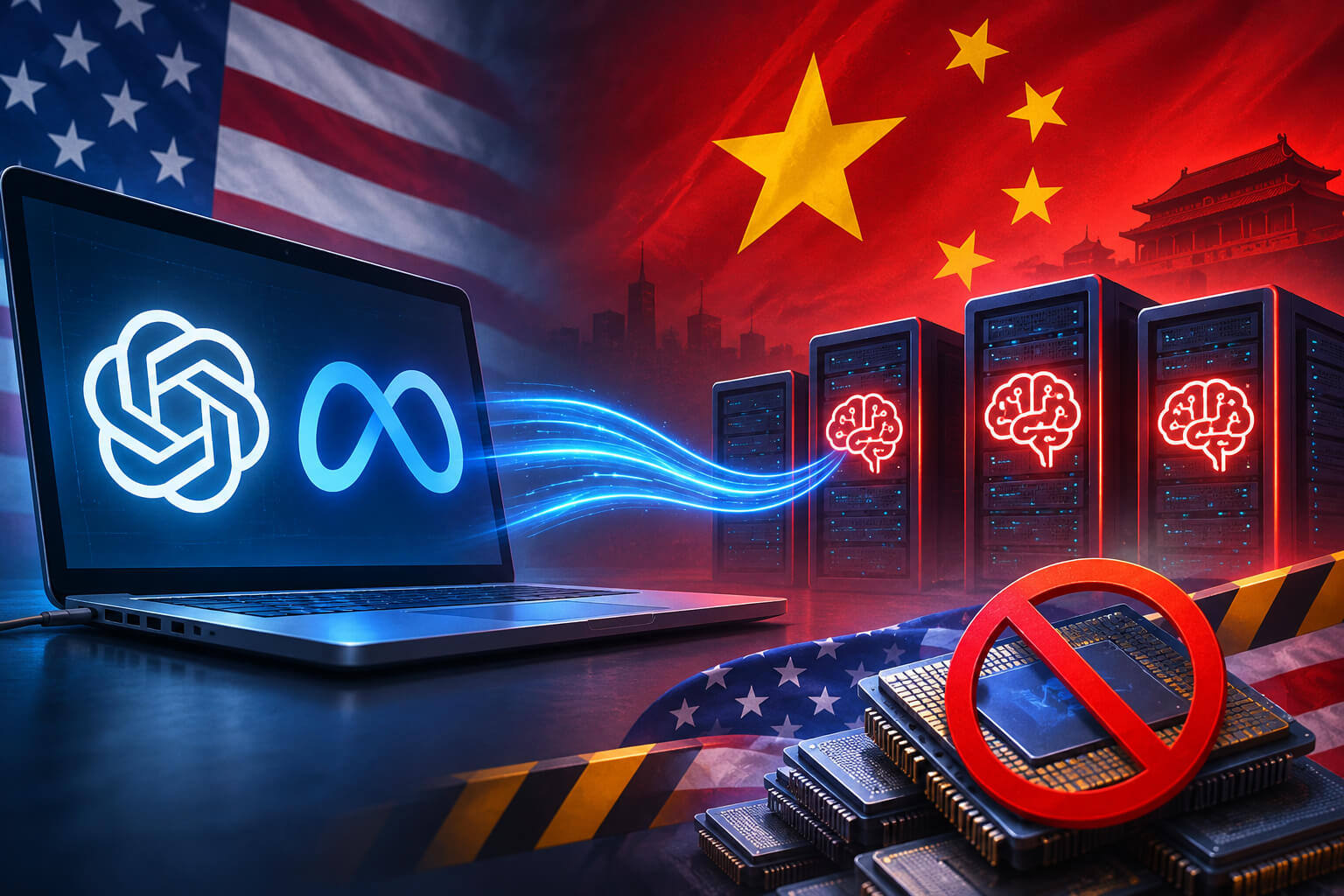
China’s artificial intelligence industry is finding new ways to compete with American technology companies, even as Washington continues restricting access to advanced semiconductor chips.
Instead of relying entirely on expensive computing infrastructure, Chinese researchers and developers are increasingly turning to existing American AI models to improve their own systems. The technique, known as AI model distillation, allows smaller models to learn from the outputs of more advanced systems without repeating the entire training process.
A Reuters investigation published on November 17, 2026, examined how Chinese technology companies, universities and research institutions have incorporated outputs from American AI models into domestic development projects. The findings highlight a growing challenge for US technology restrictions, particularly as Chinese developers look for cheaper ways to build competitive AI systems.
Chinese AI Developers Turn to American Models for Training
Chinese AI developers are increasingly experimenting with techniques that allow their systems to learn from established American models, including those developed by OpenAI. Rather than building every capability independently, researchers can generate responses from powerful AI systems and use that information to train smaller alternatives.
This approach can reduce some of the computing costs associated with developing specialized AI applications. It also gives researchers access to examples of sophisticated reasoning, programming and language processing that would otherwise require substantial resources to reproduce.
The practice has become particularly attractive as Chinese technology companies face restrictions on acquiring advanced American semiconductors. While domestic chip development continues, access to the most powerful AI hardware remains a significant competitive issue.
OpenAI Technology Plays a Role in Chinese AI Research
Research highlighted in the Reuters investigation shows how Chinese institutions have used American AI systems to generate training material for domestic models. Projects involving Shanghai Jiao Tong University and Alibaba explored ways to improve Chinese-language models using responses generated by OpenAI technology.
Some researchers collected examples of complex reasoning and multilingual responses before adapting the material for smaller systems. These experiments demonstrate how knowledge generated by advanced AI models can help improve the performance of other systems, particularly when developers focus on specific tasks.
The findings do not mean that Chinese models are simply copies of American technology. Domestic developers continue to invest in their own model architectures, training methods and optimization techniques. However, the use of American-generated training data illustrates how closely connected the global AI research ecosystem has become, despite growing political and commercial tensions.
US Chip Restrictions Push China Toward Alternative AI Strategies
American export controls have made access to advanced AI processors more difficult for Chinese technology companies. Washington has introduced restrictions intended to limit China’s ability to acquire semiconductor technology that could support sophisticated AI development and other sensitive applications.
These measures have encouraged Chinese developers to explore alternatives that make better use of available computing resources. Model distillation offers one option because it allows developers to concentrate on transferring useful capabilities into smaller, more efficient systems.
The approach is especially relevant for companies developing AI applications that do not require the full capabilities of a frontier model. Businesses working on customer service, software development, industrial automation and language processing may benefit from systems optimized for narrower tasks.
Distillation cannot entirely replace advanced hardware or original model training. China’s leading AI companies still require substantial computing infrastructure to compete at the highest level. Yet the growing interest in efficiency suggests that semiconductor restrictions are influencing how Chinese developers approach AI research.
AI Model Distillation Raises Intellectual Property Concerns
The growing use of American AI models to train Chinese alternatives is creating fresh tension over intellectual property rights and commercial competition. Although distillation is a legitimate technique used throughout the AI industry, questions arise when developers collect large volumes of outputs from proprietary systems to build competing products.
OpenAI and Anthropic maintain restrictions on certain uses of their technologies for training rival models. American officials have also expressed concerns that large-scale collection of AI-generated responses could violate intellectual property protections or commercial agreements. During discussions with Chinese regulators in July 2026, US officials raised these issues and warned about the potential consequences of unauthorized model training.
Chinese officials defended distillation as a common research practice while acknowledging that genuine intellectual property violations should be addressed. The disagreement reflects a broader challenge facing AI developers worldwide: determining where legitimate research ends and unauthorized commercial exploitation begins. Investing.com+1
Beijing Encourages Smaller AI Models for Manufacturing
China’s government is supporting the development of more efficient AI systems as part of its broader effort to integrate artificial intelligence into manufacturing and industrial operations. A national AI and manufacturing policy package introduced in January 2026 encouraged techniques such as model training, fine-tuning and distillation to make AI more practical for businesses.
Local governments in Shanghai and Shenzhen have also promoted methods that reduce computing requirements. These initiatives reflect China’s interest in developing AI systems that companies can deploy without relying on enormous computing infrastructure.
For manufacturers, smaller AI models could provide practical advantages in production monitoring, equipment maintenance, quality control and operational planning. Rather than investing in expensive general-purpose systems, businesses may be able to adopt specialized models that perform specific functions at lower costs.
The emphasis on industrial applications suggests that China is looking beyond the race to build the world’s most powerful AI model. Making artificial intelligence affordable and accessible across its manufacturing sector could become just as important as competing with American technology companies on benchmark performance.
China’s AI Strategy Could Challenge US Technology Restrictions
China’s expanding use of AI model distillation highlights the limitations of relying exclusively on semiconductor export restrictions to maintain technological advantages. Advanced chips remain essential for training frontier AI systems, but developers can sometimes achieve useful results through more efficient methods that require fewer computing resources.
American companies continue investing heavily in advanced AI infrastructure, while Chinese developers are combining domestic innovation with techniques that make existing technology more accessible. The competition is becoming less straightforward, particularly as smaller models improve and businesses increasingly prioritize affordability over maximum computing performance.
Some American officials believe industrial-scale distillation has helped Chinese AI models narrow the performance gap with US competitors. Others familiar with China’s AI industry argue that advances in engineering, algorithms and model design have also played important roles.
China’s reliance on foreign model outputs could create challenges of its own. Researchers have warned that excessive dependence on distillation may discourage original innovation, leaving developers reliant on breakthroughs achieved by other companies.
What China’s AI Model Distillation Means for the Global AI Industry
The growing adoption of AI distillation could influence how technology companies protect their models, manage access to training data and compete in international markets. As more developers discover ways to transfer selected capabilities between systems, controlling access to advanced computing hardware may become only one part of maintaining an AI advantage.
For American AI companies, the issue extends beyond competition with China. Protecting proprietary technology while allowing legitimate research and commercial innovation is becoming increasingly difficult as AI-generated information moves between platforms, developers and industries.
China, meanwhile, appears determined to expand domestic AI capabilities despite restrictions on advanced semiconductors. Its focus on smaller, efficient models could help accelerate adoption across manufacturing and other sectors where businesses need practical solutions rather than the largest available AI systems.
The next phase of the global AI race may depend not only on which country develops the most advanced models, but also on which can deploy useful AI technology more efficiently and at scale.
Sources
1. Reuters — November 17, 2026: China Taps US AI Models to Train Homegrown Rivals as Chip Curbs Bite
2. Investing.com / Reuters — November 17, 2026: Exclusive: China Taps US AI Models to Train Homegrown Rivals
3. The Business Standard / Reuters — November 17, 2026: China Taps US AI Models to Train Homegrown Rivals as Chip Curbs Bite
4. The Business Times / Reuters — November 17, 2026: China Taps US AI Models to Train Homegrown Rivals as Chip Curbs Bite
